Thursday, August 23, 2012

Impressions: Chō Genjin 2 (SFC)

Received: August 16th, 2012 / Written: August 23rd, 2012
Chō Genjin 2
Year: 1995 | Developed and Published by: Hudson Soft | [ O ]

Bonk to the rescue!!!  =D
My experience with the Bonk video game series has been very limited, but from what I played of the bald head-bonking caveman series I had a lot of fun.  Bonk's Adventure was the first game I downloaded on the Nintendo Wii Virtual Console over half a decade ago, and I really like it.  That game had decent play control, vibrant colors, cute charm, and an interesting concept.  I hated that the fight with the final boss in said game involved using cheap tactics (liberal usage of turbo buttons, away!!).  The second iteration Bonk's Revenge (which I downloaded months later) I also enjoyed, and thought was an improvement over the first game in more ways than one.  The play control was significantly polished, the visuals were better, the music was catchy and fun to listen to, it was slightly more charming, and I thought the added difficulty settings added some replay value.  Like the previous game, the final boss had to be defeated through cheap tactics (once again the turbo buttons come to the rescue), and I really hate it just as much.  I haven't played Bonk III: Bonk's Big Adventure, but I looked up that it had gameplay elements that were similar to the first New Super Mario Bros. game, and I heard mixed things about it, too; but if that game's final boss has to be defeated through cheap tactics, I swear I'm going to be p#&%ed off, because two times was bad enough.  >=(  I haven't played Bonk's first 16-bit outing Super Bonk on the Super Nintendo, which I also heard mixed things about, though I looked up that it has a big cult following, so maybe I should consider trying it one day.  The sequel, Chō Genjin 2 (Super Bonk 2) for the Super Famicom, was never released outside of Japan.  Recently I imported this game, and I've got to say, I was really surprised at how it turned out.

Bonk's dark night rises
In this sidescrolling action-platformer, Bonk is once again trying to save his world from the evil clutches of the reptilian king, who once more is threatening the prehistoric era.  Boy, you'd think that after being defeated four times prior that he would take a hint.  This time, you also get to face his five best soldiers, who will try to stop you in your tracks.  Bonk controls rather smoothly, and he is really fun to control.  To those of you that are not familiar with the series, Bonk is a caveman who attacks his enemies with his noggin; after jumping down, from below, while swimming, and while in the air.  He can even bounce off walls with his head, skip on the water like a stone if his head is facing down, climb certain walls with his teeth, scale up waterfalls, flip in the air (so long as the attack button is repeatedly being tapped), and so forth.  As is the case with the series, you start with a regular amount of health, but if you find a translucent heart icon, you'll increase your capacity.  What's neat is how collecting the food not only scores you some points but how it also replenishes a little bit of your health, too.  This time Bonk can also run if you hold down the A button, and the X button is used if you have a special ability on you.  If you find a power-up, whether it be piece of meat, or a different icon, then you will be given a power-up ability that will be taken out the moment you're hit once (damn).  Among the power-ups are the one where the fire will be spreading if Bonk hits his head on the ground (you know, the one where he looks freaky), one where Bonk turns into a bird and gains the ability to fly, one where Bonk becomes tiny and can make platforms made out of Japanese characters, and there is one where Bonk has the ability to double-jump as a girl.  Yes, Bonk becomes a girl if he eats the pink-colored meat.  I'm dead serious.

Yummy, yummy, yummy!  I've got
bugs in my tummy!
The world of Chō Genjin 2 looks very appealing, and is a big departure of the series, visually.  On one hand, it's largely reminiscent of the previous PC-Engine games, but on the other hand, the visual style looks all refined and fresh, and it's all pleasing to the eye.  Now this time around there is a map screen which is designed quite nicely, simple though it may be.  Each area looks really good, and there's a good of amount of variety.  For starters, the first area looks like it takes place in a beach-like setting, while the second one takes place in a jungle-like environment with water flowing on there.  In one area you're set in a Western-like exposition (anachronism, I love it), and in another you're venturing forth in a volcano-laden place.  One area that stands out from the rest is the cemetary.  At the start, Bonk is struck by lightning, dies, and turns into a zombie that can roam around even with zero hearts.  The only way to revive him is by filling up his entire health with food and heart power-ups.  It's an eerily dark, atmospherically morbid area where thunder strikes from time to time; and while that happens, you'll second-long glimpses of mountains changing grimaces and the round trees sprouting eyeballs.  It's linear and short, but awesome while it lasts.  You and the enemies in this stage are transparent so long as you're a zombie.  The animations are good, the enemies and bosses look great, and the stages have good layout design.  A lot of the music is sweet, catchy, and fun to listen to, including the map and boss themes.

Bonk has never looked more frightening
than he does here!  D=

The game is pretty manageable, and the length is decent and just right.  In most stages there are checkpoints represented by flowers, and the only way for them to be enabled is by hitting them, which wind up sprouting into a beautiful flower and have a big smile.  Unlike the first two games where if you lost a life you picked up at the exact spot you died, you have to start from the checkpoint once you lost a life.  So if you died during a boss fight earlier in the game, then you have to start over from the sunny flower checkpoint.  I don't know if that's the case with the original Super Bonk, although it is a nice change that's not frustrating.  Through inspection would lead to a secret power-up, a life, or even a tulip that takes you to the bonus area.  The bonus area you play is random, as there's a wheel of five bonus games, and the one it's pointed to is the one you go to.  Each involve Bonk's different ability and must score as much as you can in the allotted time; in one bonus game as a froggy Bonk you have to eat up all the flies before time expires, and in another you're bird Bonk who must pop all the balloons before it's over.  In certain stages there are neat forms of challenge, and the bosses pose a good amount of challenge, especially the penultimate one.  Like the other games, the final stage is a boss rehash leading up to the final boss, but at least there are portions that lead up to those battles.  The final encounter with the reptilian king is split up into three parts, with the bulk of the action occuring during the second part.  The third part of the battle is mindless fun.  You know what the best part about this battle with the reptilian king is?  No cheap tactics involved!!  =D
Finally a final boss in a Bonk game that's not a frustrating battle of attrition!  This is the greatest thing to ever occur in the series!  Yay!!!  =D  Sorry, got off-topic.  =|  If I were asked to give this game a score from 1 to 10, it would definitely get a 9!  So far I've beaten it twice, and both times I had a real blast.  The locations are fun, the charm is ever so appealing (if not freaky at times), the stage designs are creative, and I feel that the gameplay was even more polished than the other games I played.  My only gripe is that if you lose all your lives on a certain stage, then you have to start said stage over again, and depending on the longevity it can be incredibly annoying (do not get a game over on the final stage, or you must start all the way from the beginning).  What's cool is that there's a password system in case you feel like taking a break and do not feel like starting all over (though it is possible to beat it in one sitting).  I wonder if the last game had a password system?  Well, I won't know until I play it.  Anyway, this game is so fun to play, and it reminded me a lot of the PC-Engine Bonk games; out of the three games I played in the series, this one's the best.  Not only is it a topnotch platformer, but it is second only to DoReMi Fantasy: Milon no DokiDoki Daibōken, as far as games made by Hudson Soft are concerned.  Hudson Soft has done a bang-up job with Bonk this time.


Saturday, August 18, 2012

Impressions: TwinBee: Rainbow Bell Adventure (SFC)

Received: July 30th, 2012 / Written: August 12th-18th, 2012 (Rough Draft) / Final Draft: August 17th-18th, 2012
TwinBee: Rainbow Bell Adventure

Year: 1994 | Developed and Published by: Konami | [ O ]

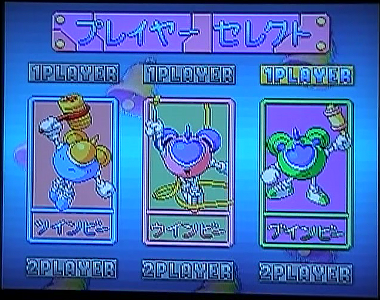
Choose your character!
Ah, TwinBee!  =)  Ever since I imported the PSP compilation TwinBee Portable from Japan last year, I fell in love with the series and became a huge fan.  Maybe not as well known (or as hysterically quirky) as Konami's other cute'em up series Parodius, I find this series of games very appealing.  The games are lighthearted, cute, colorful, cheerful, charming, and they have very and intuitive play control, too, with a fair amount of challenge to boot.  Not to mention have a very nice art style.  Back in the early '90s there were a couple titles in the series that were made for the Super Famicom and Super Nintendo console in Japan and Europe respectively: Pop'n TwinBee and TwinBee: Rainbow Bell Adventure (known as Pop'n TwinBee: Rainbow Bell Adventures in Europe).

I enjoyed Pop'n TwinBee immensely in TwinBee Portable, for I thought it was one of the best games in the cute'em up genre, if not the best.  The benefit of owning a Retro Duo is that I get to play and experience Super Famicom games from Japan, which is great and makes the world a much bigger place.  For the fifth Super Famicom purchase, I chose the (sort of) sequel to Pop'n TwinBee, TwinBee: Rainbow Bell Adventure, which is actually a spin-off (one of three, to be precise) of the series, which transitioned from vertical-scrolling cute'em up to sidescrolling platformer.  Ever since I first looked it up, I wondered how exactly a series transition like that would work.  Fortunately, it turned out to work very well, and it turned out to be very fun.

It's Hammer Time!!!
Funny story about the second 16-bit console TwinBee game: I don't know what its status in Japan or Europe is like, but as far as I looked up, it is very rare!!  No, seriously, take a gander on eBay, there are not many copies of it on there at all, if any.  And in cases when the game does pop up on eBay, it usually sells for a very high amount.  The copy I paid for sold at a very decent price.  I got lucky there.  Now how is it that a game of this caliber is so high up for grabs?  Is it because it's obscure?  Is it because it's a spin-off?  Is it because it's different than most games in the series?  Is it because both regional versions of the game had many differences upon release?  Which reminds me: as far as I looked up, when the PAL version was made, changes were made and certain elements were cut from the original Japanese version.  That version was linear, the dialogue between levels was removed, and it used passwords in order to continue your progress.  But in the Japanese version, the map is nonlinear, there are alternative exits, the map screen has dialogue between the characters, progress is saved through battery back-up, and there are several different endings...  Boy, PAL gamers sure got shortchanged when they got this game, weren't they?  Now I normally don't compare versions of games I experienced to those that I haven't since it's not exactly fair to those that have played said version, but I just had to make an exception here.  Another thing to note is that more often than not the PAL versions will be selling on eBay, while the Japanese versions don't appear as often.  Luckily, the copy I pad for was Japanese, so I got to experience the game as it was initially made.  I almost considered buying the PAL version, since it seemed like it was the only copy on there, but the moment I saw that a Japanese version was on there, I immediately jumped for it.  Totally worth it!  =D  Okay, rambling time over: it's GAME TIME!!!

Thanks to the ringing of a series of bells called the Rainbow Bell, peace had prospered in the universe.  Unfortunately, Dr. Warumon and his anthropomorphic EvilBee army step into the scene and decide to put a big end to that.  The EvilBees have snatched them away, and caused many to panic and worry.  What's worse: the ruler of Planet Meru, Princess Melora, who was previously seen in Detana!! TwinBee, is slowly beginning to fade away as a result.  What could Dr. Warumon hope to accomplish from all this?  Why, only the most diabolical thing imaginable: take over the world.


But luckily for the people the anthropomorphic bee-shaped heroes TwinBee, WinBee, and GwinBee have come to the rescue.  The first two are piloted by a couple teens called Light and Pastel (they're not called that in the game, but they were given names in the series eventually) while the third one is piloted by a baby called Mint (same with him); I kid you not!  In their adventure to stop Dr. Warumon's evil deeds, they will be aided by the pilots' grandfather Dr. Shinamon (via communication on the map screen).


Racing under a beautiful
aurora borealis!
 I remember reading years ago when I read Shiryu's description of his gameplay video that he described the gameplay was like TwinBee meets Sonic the Hedgehog meets RocketKnight Adventures.  Yeah, I can see how he would come to that, now that I played it myself.  That's a good way of putting it, really.  So in the game you can choose to play one of four save files or you could choose to use a password; but since the Japanese copy saves automatically, I find little point to use the password system at all.  From there, you have to choice of playing as the cyan and yellow-colored TwinBee, the pink and blue-colored WinBee, and the green and blue-colored GwinBee.  Of course, once you choose your character, you cannot switch to another one until after you continue if you lose a life.

Fire!!
All right, here are the basics.  If you keep holding the left or right button, you will be moving until you gradually start to run like the wind.  If you press down while running your character will be sliding ahead on its belly.  You can also throw a punch (should you not have a yellow bell power-up) by pressing the Y button in any direction.  If you want to throw a very potent fire punch attack, hold down the Y button until the Punch gauge is full, and then release the button in order to launch the fire punch towards faraway enemies in any of the eight directions.  You can also jump on most enemies and bosses via the B button, and it's also possible to propel yourself into the air and fly for a short period of time in any of the eight directions.  Just hold down the B button until the Jump gauge is full (on the ground or in midair), and once you release it while holding a direction, you'll fly as fast as you can.
The TwinBee Team
Throughout the stages there are angles, walls, and ceilings, and if you fly towards any of these surfaces, then you'll be ricocheting off said surfaces, which is very fun.  While in midair, you can even hover as long as you hold up, though you'll slwoly go down as a result.  From time to time youll come across a button with a "?" mark on it, and once it's been pushed, you'll find one of the following: a missile, a bouncing ball, and a wipeout bomb.  By pressing the X button you can pack them up and put them down, and if you press the Y button while hodling them you'll be using them.  The missile seeks out the enemies, the bouncing ball temporarily bounces all over the screen while knocking out enemies, and the wipeout bomb does exactly as the name implies.  If you want to see what's ahead of you, you can hold down either the L or the R shoulder button to shift the camera to the left or to the right, and to look upward hold up and to look downward hold down.

Having a nice conversation with
Grandpa Shinamon
In the TwinBee-verse you usually shoot at clouds in order for the bells to appear, but in TwinBee: Rainbow Bell Adventure you have to defeat the enemies in order to get the bell power-ups.  Just make sure you catch the bell as it falls, otherwise you'll miss it.  The white bell gives you a special set of shoes, the yellow bell gives your character a special weapon (with it, TwinBee can use a hammer, WinBee can use a ribbon, and GwinBee can use a rattle toy to throw towards distanced enemies), the blue bell gives you a laser gun which can be utilized with the A button, the green bell gives you a Chibi-Bee wingman which will follow you around and damage enemies upon contact (only up to three), the purple bell forms a shield around you (which is disposed if it's hit once), and finally, the pink bell renders you invincible for several seconds.  Be careful, though, because if you're hit, then all the bell power-ups you currently have will jump out from you, and you only have a chance to recuperate a few of them as they fall.  That darn "Sonic the Hedgehog Syndome"!  >=(  Oh, and you only have a health of three hearts, so if you lose your last heart regardless of whether or not you have bell power-ups on you, you'll lose a life.

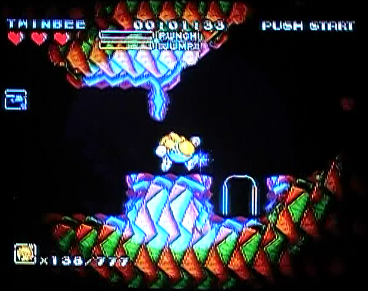
The pastel-toned visuals lathered in each area are bright, colorful, eye-pleasing, and oh-so inviting.  To name a few: in the sunny green areas there are neat-looking mountains and hills in the background, as well as a few floating islands with a waterfall streaming down.  In the cavernous areas it's all dark save for the round oval centering on your character, and the way the rocks and enemies are revealed as they're in the vicinity gives a rather cool atmospheric feel.  The rainforest areas are great with all the vegetated trees and the water-filled parts you can swim in, while the snowy areas are simply beautiful to look at with all the snow, the ice, and the sky which has a wonderful aurora borealis the higher up you go (I'm a sucker for those).  Each of the main characters are designed very nicely, and they all display smooth animation.  Their various animations are neat, especially the running and idle ones.  The enemies and bosses look great, too, and I love how there are character portraits for whenever dialogue is taking place.

Exploring the dark, strangely
atmospheric cave
The TwinBee cute'em ups usually have a good amount of smooth-flowing challenge while at the same time not being too difficult.  I don't know what to say about this game's challenge, however, and I'm not even certain how I feel about it.  Basically the goal of each stage is to reach the goal represented by a small arch with Dr. Shinamon's face on it.  Some stages are straightforward in that there is only one goal, but in other stages there are alternate goals, similar to Super Mario World.  If ever you feel lost, you can consult the stage's grid-based map whenever you pause the game.  The "G" grid stands for Goal, and if it's yellow it means that it hasn't been accessed yet.  In certain stages, if you haven't gotten them yet, you'll notice a key symbol on the map.  There are six colored keys in total, each found in their corresponding areas.  With these keys in possession, you'll be able to enter the door(s) in each stage that corresponds to that color.  Entering them will send you to a different part of the stage in a secret room.  You'll know you haven't entered the door yet if the map shows a black door symbol on certain grids; why that's important I'll get to shortly.  You'll notice in each stage that there is a timer at the top, and fortunately you can stick around as long as you want with no repercussions whatsoever.

As was the case with the last game, you have health and must beat the stages in one life.  Fortunately, you have an unlimited amount of continues at your disposal.  Unfortunately, your health is comprised of three hearts, while depending on the difficulty (or how you play) feels a little restricting and can make the game harder than it really is.  Some spikes will alleviate you of one heart, while certain other spikes will put an end to your journey, so it's best to be cautious.  The only way to recuperate health is if you either find a heart lying around, or if you collect a hundred round bells (every hundred will reward you with one).

I've got nothing creative to say
about this screenshot
Each Rainbow Bell is guarded by a boss who's name ends with the suffix "Bee" (it's a little like how in the Digimon series pretty much every non-human character's name ended with the suffix "mon"), and the only way to confront Dr. Warumon is if you have gathered all seven of them.  The thing about certain boss stages is that some of them can only be accessed once you find an alternate exit; in the monitor with Dr. Shinamon neat it, there are arrows in each grid that show where you'll be heading depending on the exit you take.  Some exits are easy to reach, while some are rather difficult to access (particularly that one in a Toyland-like stage).  The boss battles require a bit of strategy, and your choices of combating them are to jump on them or to do the fire punch.  The fire punches are more effective since they'll take out four of the bosses' health away.  The thing about fire punches are that you have to wait until the fire gauge is full in order for them to work, and that it takes a second or two depending on which character you play as.  TwinBee takes an equal amount of time to charge up his punches and jumps, while GwinBee pulls off faster fire punches and WinBee propels herself in the air the quickest.  Since you have three hearts, being careful when fighting the bosses are a must, and messing up will lessen the chance of victory; so as a result, GwinBee is your best bet when it comes to boss fights.  I have not defeated any of the bosses on my first try, not even the first one.  A personal quibble I have with this game is that if you hold down the B button while jumping and while holding a directions in moments when you don't need to propel yourself, do not let go (unless the Control Pad is left alone).  If you do, you'll accidentally fly off when you didn't mean to, which is a big issue for someone who regularly holds down the jump button whenever it comes ot jumping; but that's just me.  TwinBee: Rainbow Bell Adventure is neither an easy game nor a hard on, but I'm not exactly sure what difficulty Konami was aiming for here.  That's why I didn't know what to say about this aspect.

That is so adorable!
If I were asked to give this game a score from 1 too 10, I would give this game an 8 at best.  But did this spin-off live up to the TwinBee name?  Yeah, I think it did.  Does it in any way exceed the other games in the series?  No, not really.  I didn't expect it to surpass the series upon playing it (don't know about the two Nintendo 8-bit games and the two PlayStation spin-offs, since I haven't played those), but I had a lot of fun with it in the end, for it had all the charm that I love about the series.  The stages are fun and good-looking, the stage designs are decent (if not difficult at times), and the gameplay is rock solid.  The visual style is pleasing to the eyes, the still shots seen after beating a stage in certain areas is appealing, and the music fits perfectly with the atmosphere.  I just wish there was a consistent difficulty here, because I didn't feel that there was one, which I found distracting.  The boss fights were nice (the way a pair of them react on one stage upon losing is absolutely adorable), the final boss encounter really took me by surprise, and I like how there is a lot of replay value.  I loved how the characters weren't simply palette swaps, and that they actually had differing animations and stats that made them stand out.  The various exits lead to different stages, and some of them will take a long time to access.  I only got one ending so far, but at the end after the credits have finished rolling they show you the results of your performance; you'll be shown how many fairies you gathered, how many doors you opened, how many exits you reached, and how much of the game you've completed.  Some fairies can be found by searching thoroughly in the stage; some of the foregrounds are breakable (there are ones that are obvious and ones that are concealed by blending with the scenery), and some fairies are found by accessing secret rooms once you access a colored door.  Most fairies are hard to find and collect, so stay alert and be careful.  There are different endings, too, and I'm curious as to what happens during them.  It has its glaring flaws, sure, and the inconsistent difficulty drove me off (I regularly have an easy time talking about a video game's difficulty most of the time), but in the end I had a good time with it.  It's fun, cute, charming, and very lighthearted.


I know what you may be thinking when earlier in this post: "fifth Super Famicom purchase"?  "What about your third and fourth SFC games?  Why didn't make an impressions post about them?"  For those that are curious, my third purchase was Gokujō Parodius! ~Kako no Eikō o Motomete~ and my fourth game was Tenchi Sōzō (known to many as Terranigma).  The reason I didn't share my impressions about the former is because I want to create a full-length review of that game (so don't expect news of it anytime soon), and the reason there isn't an impressions post made regarding the latter is because I lost my rought draft.  =(

Tuesday, June 12, 2012

Impressions: Mickey no Tokyo Disneyland Daibōken (SFC)

Received: June 9th, 2012 / Written: June 12th, 2012
Mickey no Tokyo Disneyland Daibōken
Year: 1994 | Developed by: GRC | Published by: Tomy | [ O ]

What a beautiful attraction!

Walt Disney's Mickey Mouse has starred in a lot of video games back in the '90s, and there were only a few of them that remained Japan-exclusive, including Mickey no Tokyo Disneyland Daibōken for the Super Famicom, which takes place in Disneyland.  I've never been to Disneyland before, but I've always heard great things about that place, and I hope I get to visit it someday.  I first heard of this game on RVGFanatic's website on his Obscure SFC Hub section years ago, and from what I've read about it back then it had me real interested.  Flashforward a few years later, and I would finally experience Mickey's adventure in Tokyo Disneyland, and honestly, I ended up liking it a lot in the end.
You should see this rollercoaster, it's
marvelous!!

Mickey and friends decide to head out and have fun at Disneyland one day, and while they're there something terrible happens.  Mickey's informed by Minnie that Pete has kidnapped the rest of his companions, so he sets out to find and rescue them in the iconic segments of Disneyland.  On his journey Mickey brings a combo water/air balloon pack so he can get around, for there many obstacles to face.  By holding down the X button, you'll be filling your balloon with air, and should you fill up the G gauge, you'll be floating upward until the gauge becomes empty.  You can let go of the balloon by releasing the X button; if you do it while ducking, then the balloon will rise up all on its own, but should you do it while floating, then Mickey will propel himself into the air in whichever direction you choose (just bear in mind how much of the G gauge you've got left).  By holding down the Y button, Mickey will fill a balloon with water, which is the essential weapon against enemies and bosses.  Throwing the water balloon with the W gauge full will have a greater impact on enemies than if you do it early.  If you want, you could also place the full water balloon on the ground while ducking in order to use it as a temporary trampoline.  Experimenting is key.  Each location looks really good and detailed, for they all have a nice visual look, feel, and charm.  The first area is pirate-themed, with cool backdrops abound, neat settings, and a beautiful starry sky in the penultimate portion.  The third area is water-themed, and I feel it displays a great amount of atmosphere, for it at first takes place in a cave, and then afterwards we see the outside, which looks very great, not to mention there are a few moments where Mickey will be log-riding (if not swimming), which adds to the fun.  The fifth stage takes place in a futuristic-like space environment, and is very effective because it's so surreal; there are transporters, space cadets trying to stop you, cutely-designed robotic enemies, incredibly detailed inside locations, all culminating in a rollercoaster ride under a gorgeous night sky.  Basically, all the areas have such a great amount of appeal, for they're incredibly memorable and charming.  The background music does a great job at complementing each location so perfectly, because it creates a very fitting atmosphere.

"Gosh, Goofy, when did we start
learning Japanese?"

One thing I should mention is that Mickey no Tokyo Disneyland Daibōken is very difficult for a Disney-themed game, and that's largely attributed to the fact that the controls are less than stellar.  Jumping takes a bit of practice to get right, Mickey swims a little slowly (though you can still walk or run underwater), and there's the matter of proper timing when it comes to propelling into the air (in several cases, it's highly mandatory).  There are only a few occasions where you have to propel yourself a few times into (and while in) the air until you reach your target.  Letting go at just before the opportune moment will send you to the ground (or to instant death), so you have to make sure the gauge is full before launching yourself to the sky.  However, it's best to hold a direction of a button before you propel yourself, for if you release the X button without holding a direction, then you'll drop down.  There's also a breath gauge for whenever you're submerged in the water, for the longer you stay, the slowly the gauge begins to decrease.  If it gets empty, you won't die, but you will lose one hit point and then the gauge refills itself (same case for if spikes or enemies damage you).  Reaching the surface at any time will completely fill the gauge until you go back in the water.  The controls aren't terrible, for they can be managed with enough time and practice, but they could've been benefited with more polish.  Another factor that adds to the difficulty are the area designs.  Some areas are designed so notoriously, that it's hair-raising at best.  A few stage portions are long, and the final stage is one of the most frustrating areas I've ever been in!  I mean, damn!  Using the balloon and propelling yourself at exactly the right moment is an absolute must in here, particularly on Stage 6-3, which is infuriating in terms of design and challenge.  The consolation to the final stage is that there is a big payoff at the end, where you get to combat Pete in a room fashioned to pay homage to the (in my opinion) underrated 1985 animated movie The Black Cauldron (can you imagine my surprise when I noticed that and entered the room for the first time?).  If that's not enough to make the situation exciting, then the fight itself and the epic music that accompanies it is, making it the best final boss fight I've yet experienced in a Disney game.  Some of the game's challenge is commendable, but other times it can be proven to be otherwise, which makes it the most challenging Mickey Mouse game I've ever played and beaten; not even Mickey's Wild Adventure, the PAL-exclusive PlayStation adaptation of Mickey Mania: The Timeless Adventures of Mickey Mouse, can touch this.  There are three difficulty modes in Mickey no Tokyo Disneyland Daibōken; on Easy you start with a health of eight (represented by small balloons), on Normal you have a health of five, and on Hard three (though in the latter two, you can raise your health if you find some health power-ups).  There are a few obstacles added in the area if you play on either Normal or Hard that makes things a little harder, but otherwise there's not much difference between the modes.  The boss fights are nice (even though they're largely against Pete), and there are a few instances of slowdown here and there, but not enough to detract the enjoyment.  In each cutscene Mickey converses with a friend (one of them is even Scrooge McDuck), and even though the dialogue is in Japanese, it's all right, because it's a platformer, and it only occurs during the cutscene; though I must confess I do wish I knew what it would translate to.  For all the flaws it has, it's got a lot of good going for it.  The selected areas are wonderful to behold, the animations are decent, it's very charming, and the battle with Horned Pete is awesome!  Depending on what difficulty setting you play, you'll see a varied ending scene, with Hard mode displaying the full ending, which makes the experience rewarding.  The controls could have been tweaked a bit, and some area designs are better left not mentioned, but regardless, I had fun with Mickey's Tokyo Disneyland adventure, and in the end I thought it was good.  GRC did a nice job.


Thursday, June 7, 2012

Impressions: Alcahest (SFC)

Received: May 22nd, 2012 / Written: June 7th, 2012
Alcahest
Year: 1993 | Developed by: HAL Laboratory | Published by: SquareSoft | [ O ]

9/14/13 Update: Click here to read my current thoughts on it
Alcahest for the Super Famicom is quite an interesting experience, and it almost blows my mind that it was never released overseas.  All I knew prior to playing the game was that it was an action-oriented RPG with a limited amount of lives, had several stages, and that you could continue your progress through password, that's it.  But when I began to experience it, boy was I in for a surprise.

Golden dragon: friend or foe?
The last of HAL's two RPGs (their first one being the turn-based Arcana) was my very first Super Famicom cartridge, and I'm very glad I got to play it, for it turned out to be really fun.  The gameplay is very solid, and throughout the experience you would meet different guardians and partners that would help aid you in your quest, each with varied magic and special powers (as long as you had enough magic and special orbs).  Depending on which guardian attribute you chose, if you held down the attack button until the bar is flashing, then you'll amass a different and potent sword attack (if you let go early, the sword attack will still occur, it just won't be as powerful).  The locations are detailed and wonderful to look at (that rain effect during one of the early segments of the third stage, while simple, is so mesmerizing), and several of them are pretty fascinating (one even takes place in space; I'm serious).  Each stage has a different set of items that you have to find and use in order to progress a little forward; for example, in the cavern of the first stage you have to find a pair of boots in order to walk on lava.  The areas are fun to explore, the enemy roster is interesting, and some of the bosses even have two forms.  Even though I couldn't understand what was going on due to all the Japanese dialogue, I felt like I was in another world entirely and it really had me glued in, plus there were several moments that were intense which truly shocked me.  And even if the experience was Japanese, this RPG is surprisingly straightforward considering its genre, and there weren't any "Yes or No" situations nor moments when I had to make a choice through the dialogue, so I didn't have a hard time progressing because of that.  The boss battles are fun, and a lot of the areas are atmospheric in feel and are quite nice.  I should also mention that Alcahest's score, composed by famed Jun Ishikawa, is that good, for there's a wide range of themes all throughout.  Also, you don't see many RPGs that have actual knights riding on horseback, and there are few scenes where that happens, which I have to say is very neat.

Now, with all that said, there are a few reservations I have with the game.  As great as the gameplay is, it could benefit from slightly more responsive dashing controls, for sometimes if you tap to a certain direction sometimes it'll respond and sometimes it won't.  Entering the password can take a bit of time, for you have to be real accurate with certain Japanese characters (my advice: take a snapshot of the password, bit by bit).  As epic as the final boss encounter with Alcahest is (apparently, from what I researched, this is one of those games where it is named after the main villain), it can be a tad time-consuming to take him down without losing a life.  The game's also rather short for an A-RPG, as it can take approximately three to four hours to beat, and it's a shame really, because it's a very, very fun game.  In some aspects, Alcahest is a better game than Arcana is (though that says a lot considering how I feel about the latter), and the ending to this game is far more superior and much more rewarding than that of Arcana's, which was crap.  Out of the four difficulty settings (yes, there are difficulty settings in an A-RPG, hard to grasp!) I've only beaten Easy and Normal, and what gives this game replay value is that depending on which difficulty setting you play under you'll start out with lesser lives, which luckily can be earned by reaching a specific score (Easy starts with 8 lives, Normal 5, Hard 3, and Pro zilch).  When I turned on Alcahest on for the first time on May 31st after I bought the Retro Duo system, I knew I was in for a wild ride, plus it opened the doorway to new possibilites (I can import FC and SFC games now, which has me excited).  I'll admit that while I wish I could comprehend what was happening in the game dialogue-wise, it didn't detract from my enjoyment one bit (I also like how the character portraits would appear if a key character or villain was speaking).  I really enjoyed it, and I couldn't have chosen a better first SFC experience in cartridge format.  In the end, I was very impressed with HAL's attempt at crafting an A-RPG.

Sunday, April 1, 2012

Game & Watch Gallery (GB) Review

AKA Game Boy Gallery [JP] and Game Boy Gallery 2 [AUS]
1997 Nintendo

Reviewed: March 29th-31st, 2012
It's amazing that the Game & Watch Gallery series for the Game Boy has been around for fifteen years now. While technically it's not the first Game & Watch compilation that was ever made (that award goes to the PAL- and Australia-exclusive Game Boy Gallery made in 1994), it was the first compilation in the Game & Watch Gallery name. For those not of you not in the know, the Game & Watch games are of series of handhelds that were created by Nintendo from 1980 up to the early '90s, and they were pretty successful and highly enjoyable despite their simple play control. They also had a lot of replay value, for many reasons. The neat thing with the Game & Watch Gallery series is that you were given the opportunity to play a selection of games: as they originally appeared back then (Classic), or with the enhanced look and gameplay plus background music featuring Mario and the rest of the gang (Modern). And wouldn't you know it, Game & Watch Gallery was my first introduction to these series of games, and one I found very fun when I was little (I lost it once, but I found it beneath the sofa before moving to the US; I can't remember how it got there in the first place). What's sweet is that, playing it again as a teen and a young adult, I found the compilation just as fun. Available in the first of four iterations are Manhole, Fire, Octopus, and Oil Panic.

Our first game is Manhole, which was the sixth Game & Watch game ever made, initially released in 1981 as a Gold series and released again in 1983 as a New Wide Screen edition (the version used here). There are four holes in the street without a void, which unfortunately would make it easy for the civilians to fall down the sewer (not to mention get soaking wet). It's your job to make sure that the civilians cross the street with ease. However, you can only place one manhole at a time, so you'll have to do a lot of moving around if you wish to prolong your survival. At first it'll be easy with one coming after another, however as time passes by many civilians will come at a time, making things gradually challenging because the game will run at a much faster pace. In Classic mode, if you manage to reach 300 points without having gotten a miss, your score will double up until you lose a life. But, if you reach that many points and had one or two lives lost, you'll be cleared of all your misses. Should you let civilians inadvertently fall down the sewer three times, it's game over. In Modern mode you take control of Yoshi, who remains stationary in the center and handles the four manholes himself (above him he can place his head below two manholes, and below him he can keep the two manholes afloat by sticking his tongue onto them. Unlike the Classic mode, the manholes stay up until they're stepped on, so Yoshi will have to place them up again in all the commotion. Passing by will be several Toads, Donkey Kong Jr., and (from time to time) Mario himself. If you score 200, 500, and even 700 points, a mole will award you with a life (if you have one or two misses at that time); lose three times, however, and it's game over. Like Classic, though, it starts out easy enough, but eventually becomes complicated and hard to manage due to the gradually faster pace. You can choose any of the four directions to place your manhole in each version, but if you want to make it a little easier for yourself, you can switch to a diagonal position (i.e. Northwest to Southeast) by pressing the A button. The visuals are enhanced in Modern mode, and they look really good and detailed despite the simplicity, and the flowing water is a nice touch. The characters also display good animation here, and you'll get a different miss icon depending on who gets wet. If you play Classic mode on the Super Game Boy, you'll see a border reminiscent of the New Wide Screen release and the game's all colorized, which is neat.

The next game in this lineup is Fire, the fourth Game & Watch game that was created back in 1980 as a Silver series, after which it was released again in 1981 as a Wide Screen edition (the version used here). A building has been consumed by fire, which leaves its countless inhabitants no choice but to escape by window. Your objective is to position your trampoline below the falling victims and bounce them over to the ambulance van on the right. Controls are pretty simple, just move left and right. However, there are moments when you'll have to make two quick steps to reach the farthest person quickly (e.g. press right and A simultaneously to step quickly to the right twice). At first it will be relatively easy, but the more you progress the gradually harder it will get. Misses can be lifted when you reach 200 and 500 points, and as is the case with pretty much every Game & Watch game, it's game over if you lose a life thrice. Modern mode plays the same as Classic mode, only you guide Mario and Luigi who have to rescue Toads, Yoshis, and Donkey Kong Jrs. who flee from the burning castle tower and send them to the mushroom-shaped coach. From time to time you will also catch eggs which break upon the first bounce to reveal either a star or a Bob-Omb. If a star appears (it's totally optional to send it to the coach) and it bounces on the trampoline, you'll be rewarded five points per star bounce, but if a Bob-Omb appears then you may wish to drop it to the ground, for if it lands on the coach there will be destructive consequences. The visuals are cool, and the animations displayed here are nice. The various miss icons look good, and the reactions Mario and Luigi make when someone lands on the ground is funny. Starts off easy with the characters fleeing the castle one by one, but eventually it gets to the point where you'll have to be really quick on your toes because characters will keep bouncing on the trampolines, the action will get incredibly fast, and it'll get incredibly complicated. If you reach 200, 500, and 700 points, Princess Toadstool will send you a life from the lower left corner, but make sure you catch it, otherwise you won't have your miss removed. Playing it on the Super Game Boy will give you a colorful experience and add a border reminiscent of the 1981 release. Just curious, how can the building/castle fit so many people/characters, and how on earth can that ambulance van/coach fit so many people/characters? That's just weird!

Octopus was released in 1981 as a Wide Screen release. Sunken treasure has been discovered underneath the sea, but it's being guarded by a giant octopus. Taking as much of the treasure and returning it to the boat as much as possible will prove to be a big task, because you'll have to be very careful not to be grabbed and choked by one of its tentacles. Controls, again, are very simple, just move left and right; it's also possible to move right twice (again, right and A simultaneously). You can grab a lot of treasure, but make sure you get out of reach if a tentacle tries to lower itself down to get you. Any time you return to the boat, you'll be awarded three extra points; misses can be alleviated once you reach 200 and 500 points. Careful not to lose all three lives. In Modern mode you guide Mario who has to go down to get the treasure and return as much of it to the boat with Princess Toadstool. There are more moving spaces than there was in Classic mode, plus there's more additions that were made. You'll still have to evade the octopus' elusive tentacles, and if you grab enough treasure and return it to the boat, you'll get double the points for the times you put them in a bag. There's a catch, though: if you try to grab too much treasure, then the weight of the bag will slow Mario down, making him vulnerable to be grabbed by a tentacle (unless you're careful). It's also possible, if a tentacle is trying to reach you, to launch a bag towards it to temporarily incapacitate it. From time to time there may be moments when the octopus will try to spew black ink out of anger, so be careful. If you reach 200, 500, and even 700 points, Lakitu will drop a life removing one miss. Begins easy, but it gets harder as time goes by. Modern mode looks good, and it's nice how the octopus' tentacles animate, plus how it reacts when one of its tentacles is hit is priceless. Classic mode looks good, too, especially when you play it on the Super Game Boy cartridge with colors and border. There is so much treasure being guarded by the octopus, that it's endless!

And our last game here is Oil Panic, the first of several Game & Watch Multi Screen games made in 1982 (basically the precursor to the Nintendo DS, sans the stylus controls). Oil is gradually dripping from the ceiling, and you have to make sure that it doesn't touch the floor (in the top part of the screen), otherwise the building will catch on fire. You guide a man with a beaker that can only contain up to three oil drops, but if it overflows there's flames abound. Below you is a man who has a drum which can take countless amounts of oil drops; thing is he moves around often, so make sure he stays still long enough on either the left or the right side, otherwise you'll wind up spilling it incidentally on either innocent civilians near the gas station. There are two ways of losing a life: oil falling on the floor, and oil spilled on a civilian; so you can lose up to five lives. If you reach 300 points (lifeless), there will be two people at the bottom who will remain stationary for several seconds, making things a little easier. However, if you have lost a few lives by that time, all your misses will be cleared out. In Modern mode things are slightly different: Bowser is attempting to spill oil in a home, and it's up to Mario to make sure there's no fire. Mario has two beakers, and you can turn around, so he can carry up to six oil drops which he has to feed to Yoshi (who keeps moving around, so make sure you find a good time to do that). If you feed Yoshi two sets of three oil drops on either the left or right side, he'll breathe fire which in turn creates a block. If you manage to successfully let Yoshi create four blocks on the left of side of the playing field, Yoshi will climb up said blocks and knock Bowser off the building through various means (i.e. egg throwing, watermelon seed spitting, fire breathing), giving you a perfect chance to score major points. On the right side, if Yoshi spews fire on the block, then several coins will emerge out of it (unless you reach 200, 500, and 700 points, in which case you'll be awarded a life if Yoshi breathes fire on the then-transformed/emerged "?" block). One thing you should bear in mind is Donkey Kong Jr. and Luigi, who are minding their business below you, and if you spill the oil and Yoshi didn't catch it, then you get a miss. It begins easy enough, but afterwards it will get to the point where catching all the oil and disposing it will become a hard accomplishment due to the faster pace. Game looks good on the Super Game Boy, too; plus, the animation on Modern mode is great.

So, overall, the four-in-one package resulted in quite a memorable experience. It's fun to play through these games every once in a while, and it just amazes me how much they've aged well. For some reason, the Classic modes feel more "modern" than the Modern modes do, and I do appreciate the amenities that were implemented in the Modern modes' play control and visual appearance. What keeps the four games from growing stale are the two difficulty settings on both Modern (Easy "Mushroom" and Hard "Fire Flower") and Classic (Game A and Game B) modes, and if you manage to reach 1,000 points on any of the two Modern modes, you'll unlock the Very Hard "Star" mode, which will truly test your skill with its swift pace and dangerously complex action. If you reach every 200 star in each mode of each game, you'll be rewarded a star (which is optional); seeing how high you can score points in the game is a fun challenge (even though I'm not really the type of gamer who plays for score). The additional background music you hear on the four Modern modes are catchy and great, I even like how it speeds up throughout the course of the game. Normally I frown upon the option to disable background music when it comes to video games, but this is one of those rare exceptions because even though the music sounds good, it can get a little repetitive if listened to for too long. Another special feature in Game & Watch Gallery is the Gallery screen, where you can view certain Game & Watch games and learn a bit about their history, most of which you'll be able to play in the next Gallery follow-ups. There are sixteen games in the Gallery, and if you manage to score a certain amount of points in any of the two modes of any of the four games, you'll be awarded a star block (which is your Gallery piece). It's another fun way of challenging yourself. Game & Watch Gallery was so successful that it garnered three more games in the series (my favorite out of the four being the third). It's a blast to play, and one of those many childhood classics, especially when played on the Super Game Boy (should you own an SNES console); the Super Mario World 2: Yoshi's Island-themed border just rocks. Definitely worth checking out if you can find it for a decent price, or if you download it on the Nintendo 3DS Virtual Handheld service.

8.0/10

Sunday, February 26, 2012

ActRaiser 2 (SNES) Review

AKA ActRaiser 2: The Crusade to Silence [JP]
1993 Quintet/Enix

Let's talk about ActRaiser. The name is synonymous by many as one of the first games that was released for the SNES console, often lauded as a work of Tolstoy. I don't think that personally, but I do think it's a great game in its own right. It incorporated decent sidescrolling action/platform elements with fantastic town micromanagement elements to keep things versatile and fresh. Back in 2007, back when I downloaded it on the Wii Virtual Console, I had gotten my hopes in thinking that the other games developed by Quintet by would be released for the current gaming generation to experience, but it never happened (wish someone would ask Square-Enix what the hold up is). In 2009, when I bought SoulBlazer in its physical SNES format from eBay, and its follow-up Illusion of Gaia the following year, I since realized that if you wish to experience a game from the past you missed out on and/or are really interested in (whether or not there's a high probability it will be released for the current generation to experience), just go ahead and try it in its original format if you don't wish to wait who knows how long until it gets rereleased to a downloadable service or a compilation (if you own the console in question, that is). But I digress. Now I ask you: is it hard to make a sequel that lives up to the name of the original and be just as fun, if not good? The answer to that question, I surmise, would be: "Maybe?" That's the case with ActRaiser 2, which I've long been curious about but was hesitant to try. This October ('11), I decided to bite the bullet and give it a go; and when I got to play it, it was better than I thought it was going to be. But does it do the ActRaiser name justice? [Click the images or open them in a new tab to see their native size]

In the first ActRaiser, a battle had emerged between the Master (God, your character) and Tanzra (Satan), and only one entity emerged the victor. The Master, having been defeated by his arch nemesis, was forced to flee to the Sky Palace (Heaven) due to the injuries he had sustained. A long time passed following that event, and the world was being overrun by monsters under Tanzra's rule. After a vigorous, involved quest to restore peace to the people, a rematch with Tanzra was settled in Death Heim (Hell) in the end, and the Master wound up defeating him, saving the world in the process. Now onto ActRaiser 2's plot: long ago, a battle had emerged between the Master and Tanzra, and only one entity emerged the victor. In the Sky Palace, a rebellion led by Tanzrra was taking place, and the Master put a stop to it once and for all and won the battle. Burdened by vengeance for Tanzra's death, his thirteen generals vowed to revive their leader and take down the Master by all means necessary. Confused? If you are, there's a reason for that: the plot consistency between the two is incoherent. There's no explanation as to when the game occurs (before, during, or after the first game?). But wait, despite the nonsensical timeline, there's one thing in common: when Tanzra won the monsters invaded and terrorized the villages and the people themselves, but when the Master won... basically, regardless of what happens, the outcome will be the same. But enough ranting, will you succeed in salvaging Earth once more? Only time will tell. Luckily, for the weak plot point it's got, it more than makes up for with atmosphere, and there is a lot! You will be traversing through foliage, trek underwater, roam through mutant-infested locales, pass through fames, travel inside a prison, explore palaces, and more. There are various issues going on in the seven villages of the world (for example, a village might be in starvation because the monsters are stealing their food), and in order to save them, you must go down and defeat the evil general. The generals all represent a different sin, whether it's a minor one or a deadly one (i.e. Gluttony, Greed, Pride). And I've got to say, Quintet sure found some interesting representations of these vices, but more on that later. Can you think of any other similar games where you fight off the seven sins?

The play control is pretty decent, but due to how it was handled, a little time will be required in order to get full adjusted to them. Like the previous game, you'll start off in the overworld (or "Skyworld") where you get to place the Sky Palace on top of a city and then on a location infested with monsters. Once you're ready, you'll descend to Earth and will try to vanquish the monsters so you'll save the current city in peril. Unlike the previous game, this iteration decided to skip the town simulation elements, which means that this game is a full action/platformer, which disappointed several fants of the first ActRaiser. I don't mind it personally, even though I did love the micromanagement acts. But I can't help but wonder why Quintet decided to go with this decision; heck, I'm not sure if they've even given a reason to do what they did (but if they did, a link to the inverview or article would be much appreciated). As for the controls: only two buttons are required, the jump button and the attack button. The Master is a little slow on foot this time around, and his sword attacks are more versatile. He can thrust straight ahead, below, above, which crouching, and in the air. He can even attack downward; if you press down after a normal jump, then the sword will point straight down, but if you press down after a double jump, you'll amass a powerful downward thrust toward your foes. Now the Master holds a shield by his side and has wings on his back. With the shield you can block the projectiles in front or above you, and if you do a double jump your wings will help you glide a long distance (but if you press down, you'll plunge downward). It's also possible to glide slowly by pressing up after double jumping. By dropping down from the platform, press down and the jump button together so you can slide down (as long as it's a "thin" platform). Also this time around you've got various magic spells at your disposal, but which one you use depends on which position you're in. To conjure the spell, hold down the attack button until the Master starts to swiftly flash red, and then once the magic symbol appears at the top, you can let go to unleash it. Some examples of the magic you'll cast is a flame attack from your sword like a flamethrower (by casting it in front of you), a temporary explosive force field that will shield you from enemy attack (by casting it while ducking), and a deadly phoenix attack (by casting it while you're attempting the super downward thrust). The potency of your magic will depend on which one you use; but beware, for the magic can only be cast by using a scroll, so use your spells sparingly. Throughout the stages there will be rune-like statues, and inside them you'll find helpful stuff like health (2 HP, 5 HP, or 10 HP), scrolls (1 MP, or 3 MP), and a life (should you find it). In most stages, you'll be encountering a midboss who'll attempt to impede your progress, and in the end of the stage a boss will be waiting for your arrival. One thing you want to make sure doesn't happen is letting the Master skid if you landed on the ground after gliding, for if it happens when you're near a ledge it's not going to be pretty (it's happened to me several times). In order to avoid this (especially when it comes to small platforms), plunge towards the platform and hold down long enough so the Master doesn't skid off the platform. I think the game's control scheme is good, although it does have its issues.

Like the first game, ActRaiser 2's soundtrack was composed by legendary Yuzo Koshiro. After the greatness of the first game's music, Streets of Rage 1 and 2, Super Adventure Island, and Ys Book I & II, you'd think he would make just as strong a delivery for this title like he did for the aforementioned games--but he didn't. It's not that the music is bad, as it's nice to listen to; it's just that it's not as powerful in comparison to the first ActRaiser's soundtrack. Not even the remix of the title theme is energetic, but it's not bad. But despite the low quality sound, I've grown to like it the more I played it. The Devote theme (Tortoise Isl. and Altheria) is a depressing-sounding underwater theme which makes you feel like you're in a long-lost place. The Leon theme (Gratis and Stormrook) tries to be as ominous as it can, but it falls a little flat due to its sparse melody. The Lovaous Palace theme is a neverending string symphony with a chill of sorts. The penultimate area, the Tower of Babel, has a theme which, if listened to for so long, can sound nightmarishly overwhelming (especially considering the stage's layout and difficulty). Usually when it comes to video games, if a midboss theme sounds stronger and more energetic than the main boss theme, then depending on how you look at it, it can be a problem. The midboss theme uses percussion drums and riveting string work, while the main boss theme is rather laid back, in and out of comparison. Again, I don't dislike the music from ActRaiser 2, I just don't feel it delivered as strongly as the first game's music did. The songs are decent, too, like the Skyworld theme, where the music compliments the bird's eye view and the events that go on up above. The music for when you fight Tanzra and the ending music, despite the sound quality, are actually pretty good (the latter can be a big reward for finishing the game, especially on Hard mode). But, believe it or not, Quintet actually lifted a song from the first ActRaiser: the music you hear for whenever you descend to Earth. Odd choice, considering it's rather short, but eh, whatever. The sound effects, initially heard in ActRaiser and SoulBlazer, are always a joy to listen to. There are even a couple of original sound effects: the dragon boss' breath which tries to blow you away and the Master's dying sound, which bothers me a lot as it sounds like the roar of a dying lion or something similar. Even when I first heard it while watching Shiryu's gameplay video of it years ago I was like "What the heck was that?" In the end, there's no bad music here, but not great music, either.

One thing without a doubt which surpasses the first game is the overall visual appearances. ActRaiser 2's visuals are detailed, in-depth, atmospheric, dark, and downright beautiful. The first game had very great visuals at the time of its release, but Quintet has managed to make a much more visually improved experience. Each area has its own distinct look and feel, each with a unique variety. The first stage, Industen, kicks things off with a lush forest landscape with dripping water protruding from the leaves, with giant mushrooms, large trees present in the background, a dense mist surrounding you, and dangerous quicksand near the end. but i doesn't end there, as there's more visual wonder throughout the game. The Demon's Cave takes place inside a mutant ant hill, and as you progress through that stage, there will eventually be spider webs flowing so pristinely in the foreground, which incorporates a lot of depth. Death Field begins as you trek along a field littered with flames, which creates smoke which consume the present area's entire skyline. The prison of Gratis is dark and grueling, where you're greed to dozens of skulls littered on the ground before you with an ominous message written on pieces of wood. It's also a dark area, with sets of lights here and there that make it a tad brighter. The first part of the Lovaous palace is wonderful, for it is made entirely out of ice and snow, with falling stalactites and icy fixtures hanging in the background. But one of my favorite areas, visually, is Stormrook. It's a fantastic setup for... a fantastic setup. It starts outside the castle walls, with a full moon in the background with blue shades of trees in the backdrop. After you get past the first part, you'll enter the castle, which is fully coated with gold which seamlessly glimmers throughout the interior area (when you watch it in motion, it's very impressive). The underwater areas (Tortoise Isl. and Altheria) are also visual splendors, with backdrops of the ocean and a beautiful temple-like establishment. Basically all the areas are beautiful to look at. The Master animates decently, and his appearance is cool, too. In here, he's a winged entity decked out in only some sort of battle garb; he also looks like a Greek mythological hero, come to think of it. Now onto the enemies: now, I normally don't care if a game's enemy is designed in a serious or cartoony way (regardless of the overall tone of the game), but the enemies in this title fall so much into the latter category that I cannot help but think it doesn't match the dark tone of this game. We've got pirahnas wearing swimming trunks, "skull"-erflies, cyclopic rock-throwing enemies who have goats legs, "Gules" of different statuses (I could swear the purple one has a green spiky mohawk on its head), et al. The thing they all have in common is that they're neither dark nor theatening. Considering that the Master and his angelic compatriots are all serious-looking, it's just jarring to me. I don't know if it's because Quintet altered the visual appearance from their first two games or something, but I can't help but wonder: what happened? One of the midbosses you combat looks like he jumped out of one of Pablo Picasso's paintings. When looking at Picasso's cubist work, it's powerful, energetic, captivating, and totally natural. But if a Picasso-like subject is inserted in a game of this type, it just stands out and looks silly. I just can't take the majority of the enemy designs in this game seriously. Anytime you lash a hit towards an enemey, a white and green starburst effect will appear which feels very out of place. I mean what it this, Streets of Rage? Again, normally I don't mind whether an enemy is designed in a serious or cartoony way, but I couldn't help it with this game. That's not to say the enemy designs are bad; actually, there are pretty decent, and some of them look very cool. For example: the Demon's Cave is infested with the result of ant and an alien from H.R. Giger's Alien giving birth, and they also animate pretty smoothly. The midbosses and bosses also look pretty interesting. Among the midboss roster are a gigantic venus fly trap, a big serpent, and a winged centaur. The main bosses look great as well, and the seven of them you fight are each representations of one of the seven deadly sins. The boss of Stormrook is a dragon bound by gold scales which represents Greed, for in a room that's already filled with gold he's even wearing some of the gold jewelry on him during the battle. The boss of Altheria is a representative of Jealousy; basically, the flame needs to be extinguished all the while contending with an ugly head trying to prevent you from doing so. And it all takes place in front of a statue of the Virgin Mary. Um, aren't we going too far, Quintet? Anyway, it's a pretty near boss experience to look at, and the other bosses are cool, too. I like how whenever you press either the A or the B button anywhere on the Skyworld map, there's a cool shifting sequence from bird's eye view to third person view where you meet one of your angelic companions. It's a little similar to an effect done in Produce's turn-based RPG The 7th Saga whenever you engage in battle in the overworld, only in this game it's done much smoother, with less spiraling, and it's straightforward. ActRaiser 2 also has nice stylized font, which is very awesome, and perhaps the best font choice I've seen in a Quintet game. But I've rambled long enough; I know what you really want to know.

Chances are that if you heard anything about ActRaiser 2 is that it's challenging. But how challenging is it exactly? Let's look at my challenge-o-meter for a second. Wow! That is quite an accomplishment, Quintet! Quite an accomplishment! I'm not kidding, this game makes Plok's difficulty seem like child's play, even when you're not playing that game's Child's Play mode. Each of the stages has their own series of hazards and obstacles that will try to put a stop to your progress. Unlike the first iteration where you lost the same amount of damage regardlesss of what enemy or boss hit you, that's an entirely different story here. Some enemies might remove a tiny portion of your health, while others may remove a much larger portion if you're not careful. There may be a few moments where you'll have to avert a bed of spikes in midair, for if you fail to to do so you'll lose a whopping 8 HP (one full circle is the equivalent of 2 HP). But much more vital to avoid is touching the spikes implaneted on the floor or the ceiling, for one touch from them will cost you a life. One such occasion where you'll have to avoid getting punctured will be in Gratis, where you have to successfully jump over them on a diagonal slope, with a tight diagonal ceiling space to bear in mind. It's simple to get past that if you time your double jump correctly, but the very thought of it is quite scary. Leaps of faith, or glides of faith, are required as well in a few of the stages. Some midbosses will pose a bit of a challenge the first time around. In most stages you'll only bout against one midboss, and in a few cases you might dish out against two, and in certain stages you might not meet with a midboss at all. If fighting against two doesn't sound intimidating, imagine fighting against six of them, one by one. Att the end of the Tower of Souls stage (should you be successful to do so), there's the boss representing Pride, but before that happens, you have to encounter six midbosses. Here's how the process goes: enter the room, fight a midboss, beat said midboss, rinse and repeat until the demise of the sixth one. Want to hear some good news? After the third one, there is a rune-like statue with a set of health, as well as when you defeat the sixth one. At first the midbosses will pose a major threat, but shouls you study their patterns long enough (or devise a full-proof strategy against them), they actually aren't that hard. Not saying they're easy, as you'll have to really concentrate during those moments. The bosses can be slightly difficult at times, and they can be easily dispatched if you conjure some pieces of magic against them, but should you not have magic at that time, you'll have to make do with your blade. Just be careful that they don't do you out quick. As was the case in the first ActRaiser, there is a boss rehash in Death Heim with the seven main bosses before you meet Tanzra (only in the Normal and Hard difficulty modes). The Easy difficulty setting will end the game right after you beat the Tower of Souls. Anyway, during the boss rehash, you'll be granted a powerful type of magic emanating from your sword, which makes some bosses easy than they were before. And if you thought Tanzra looked hideous in the first game, then you've seen nothing yet. He looks like a total monstrosity here, I mean he's really horrendous here (I looked up that it's loosely based on Satan being frozen wasit-deep in an icy lake from Dante Alighieri's The Divine Comedy). But look on the bright side: at least he's not like the Demon King in Produce's little-known action-oriented RPG Brain Lord, where he was totally unbearable in appearance. But I'm getting dangerously off topic. Once the score has been settled with the seventh and final sin, you then go to confront Tanzra, and soon the screen turns black and the next moment he appears right before you. There's one thing that I don't appreciate during the final boss fight, and that is the moment he appears, the HUD will be gone. Unacceptable! Tanzra is manageable enough if you follow his pattern, and he's one boss you must absolutely be careful with (on Hard mode, specifically, as it takes longer than it does on Normal). Since there's no HUD at the top, there's no telling how many hits he'll sustain until he's finished once and for all. Unfortunately at this time, there's no telling how much health you'll have before you go down, as there's no way of telling how much damage Tanzra's fire power will take away from the Master if you do get hit. At this point there's nothing to do but persevere and be careful. Also, should you lose all your lives near the end, you have to start Death Heim all over again. ActRaiser 2 has three difficulty settings, and there's a major difference between the three. On Easy mode, you start off each stage with five lives and five magic scrolls. There are less enemies to deal with, they take up less damage, it takes a shorter time to charge up your magic, there are more rune-like statues, the mid-bosses have 10 HP (five full circles), and the game ends when you beat the Tower of Souls. On Normal mode, you start off each stage with three lives and three magic scrolls. There are slightly more enemies, they begin to take a bit more damage than before, it takes a little longer to charge up your magic, a few rune-like statues are omitted, the mid-bosses have 16 HP (eight full circles), and you get to go to Death Heim in the end. On Hard mode, you start off each stage with two lives and three magic scrolls. There are more enemies than before, they take much more damage, it takes the longest to charge up your magic, the mid-bosses have a full set of 20 HP (ten full circles), Tanzra takes more damage, and like on Normal mode you get to go to Death Heim. Getting through the stages is no piece of cake (most definitely the case on Hard mode). You'll have to pay attention to the enemy patterns, and there are some moments when getting to the end of the stage will prove most difficult because a few enemies might come out of thin air or because certain enemy attacks are difficult to avoid. I find going at a steady pace to be a safer option, although you'll still have to conted with the enemies, and of course avoid the spikes. During the first part of the Lovaous Palace, there are platforms that will appear and disappear in a matter of seconds (one by one), so you'll have to jump on them on time to move forward (think the infamous platfroms from the Mega Man series). There's a moment during the volcanic stage Almetha where you must successfully reach the boss by hopping onto gradually falling rocks without being struck by the lightning that sometimes strikes. There are branching paths in the Gratis prison, plus several spikes to avert. There are various ways that the game challenges you, and I like that. There are some frustrating moments, sure, but overall it's got a commendable amount of challenge, as far as I'm concerned. Unlike the first game, ActRaiser 2 has a password system (three sets of four characters), and honestly, it's not so bad. The thing that bothers me about the first ActRaiser (not that big a problem, mind you) is that it's only got one save file, and that's it. That game's easy for me to beat, but even if it weren't the case, at least it was very manageable; but what if there were a group of gamers (novice or not) that wanted to play it, they had to wait until one was finished with it. You can see how big a problem that might be. But ActRaiser 2 I strongly felt offered a much more superior and recommendable way of continuing your progress. Press the A button anywhere on the Skyworld that is not on a city or on a stage, and the recorder angel will give you the password.

So yeah, it has its legitimate issues (not to mention some issues I personally have with it), but to be quite honest, I had a lot of fun with it. Yeah, it's not as enjoyable or as great as the original ActRaiser, Quintet's other games, or even Plok for that matter, but its strengths far outweight its weaknesses. The visuals are flat-out gorgeous , and the controls are, as I said earlier, decent. Although the soundtrack isn't quite as hight quality of some of Yuzo Koshiro's other pieces of work, it's definitely nice to listen to. The plot is a little lacking and inconsistent to the first title (I question the ActRaiser continuity, as it doesn't really feel like an ActRaiser experience), but the atmosphere makes up for it all with its great expositions and dark tone (for the most part), and I like how Quintet took some risks. The various amounts of challenge make it exciting, even if it is difficult, and with three difficulty settings it adds a touch of replay value, believe it or not. The enemies can sometimes be annoying, and the (mid)bosses are cool, especially Tanzra. I do admit I would've liked the town simulation elements to have returned here, but for being a straight action/platformer, from Quintet of all developers, it was actually quite a nice experience. The ending for when you beat the game on Normal and Hard is similar, only in the latter there is a visual imagery that is so breathtaking it's rewarding; I won't disclose the ending scene for the sake of posterity. Beating the stages will take some time to accomplish, on Hard mode most of all. As I kept getting beaten, I kept getting back up, and as I kept on persevering, I kept on getting farther. The password system is a nice touch, and what's neat is that there are also secret passwords for more enjoyment; three of which are the credits with the sketch of the crew behind the game, an intro sequence that's interactive, and even the chance to battle Tanzra as he appeared in the first ActRaiser (to do so, go to the password screen, and enter Xxxx Yyyy Zzzz; press Select to lowercase or uppercase). It's pretty neat. Without spoiling anything, the opening of Death Heim is perhaps one of the most depressing set ups I've seen in an SNES game. Fans of the original were disappointed with the sequel due the fact that it excised the town simulation elements in favor of 100% action, and if that did not drive some away from it, then the difficulty most certainly did. ActRaiser 2 is a game many should be able to beat (with one or two difficulty settings), but few will manage to complete (with all three difficulty settings). It's not for everyone, and if you're not keen on playing this game, then you're not really missing out on much. But, should you wish to partake in this crusade to silence, then you'll need the following items with you: patience, observance, and perseverance. It's one of those love it or hate it type of games, but let me tell you: I'm glad I played it. In sum: ActRaiser 2 is a bad ActRaiser game, but a good game on its own.7.5/10


Thank you for reading! Please leave a comment!