Friday, November 9, 2012

Impressions: Pocky & Rocky (SNES)

Received: May 24th, 2012 / Written: November 6th-9th, 2012
Pocky & Rocky
Year: 1992, 1993 | Developed and Published by: Natsume | Licensed by: Taito

"Hey!  Quit hoggin' all the food!!!"  >=(
I've got a confession to make: two days before I got this game I had received my very first Super Famicom cart Alcahest, but sometime before that I had gotten a Game Genie.  It was at that point that I really wanted to start importing SFC games from Japan; I was under the impression that the Game Genie could play SFC games.  The SFC cart didn't fit on the Game Genie slot, and I was let down.  And yet some websites say that it works for SFC games, so either someone's lying or I'm missing something, and I probably am.  I really wanted to play Alcahest and I was sad that I couldn't do it and had lost all hope for a chance to import SFC games.  ='(  Two days later I went to 3D Games to buy some games, when I saw a system that caught my interest.  It was a Retro Duo, and the employee there said that it worked for NTSC SNES games and SFC games from Japan.  That day my hope was restored, and I would go on to purchase the system the very following Thursday.  It cost a bit, but it was worth the price, and it turned out to be one of the best gaming decisions I ever made!  =D

Sorry, slightly offtopic.  Anyway, on the 24th, I had decided to buy some games, like I said before.  I bought three SNES games that day: the always classic Pilotwings (which I enjoyed since I was little; now that I have my own copy, I no longer have to wait until I visit my relatives in order to play it), X-Men: Mutant Apocalypse (which was new to me, and is a decent brawler based on the '90s X-Men animated series), and finally there was the game of the day, Pocky & Rocky.  I've oft heard of this game online, as it's highly lauded as a cult classic among many, and I heard that it was pretty good too.  When I saw a copy of the game with that name on there, I knew I had to buy it.  What's cool is that I got to try it for a little bit at the 3D Games store on the displayed Retro Duo, with the employee's consent.  It was a pretty neat experience, and it's not often that it happens.  From what I had played at the game store, it was good, but when I played it at home, it was even better.  Pocky & Rocky (known in Japan as KiKi KaiKai: Nazo no Kuro Manto) is the SNES-exclusive follow-up to Taito's 1986 arcade game KiKi KaiKai (known outside Japan as Knight Boy for some reason).  Unlike the arcade original (which I have not played), this 16-bit SNES game was made by Natsume with the license by Taito.  And yet, surprisingly, Natsume managed to create a console-exclusive experience with a rather arcade-like feel to it; but I'm getting ahead of myself.  So is the game really that good?

Trailing through the big bamboo forest
This game takes place after the events of the original arcade game, from what I looked up (and from what I could gather in the first part of the intro).  In the past the Nopino Goblins went rampant around the land during Feudal Japan, until they were stopped one day by the young priestess named Pocky who then led them the right path, and all was well with the world.  One day, a raccoon dog named Rocky visits the priestess' shrine in a panic.  He asks for her help when his fellow Nopino Goblins have gone awry due to a mysterious force; oh, and Rocky's a Nopino Goblin, too.  He tried to pacify them by himself before, but to no avail.  Together, Pocky and Rocky would venture forth to free the Nopino Goblins and defeat the force behind the trouble.  During their quest they discover that the Black Mantle is the one behind the mayhem, and that he's also taking advantage of a group of monsters known as the "Gorgonzola Goblins".  That name is just too funny, and it's nice to hear the word outside of a kind of cheese.  When it comes to discussing about games, I try my goshdarn best not to reveal the majority of the plot (just minor parts) or give away any plot-related spoilers (though that applies to games that have a good plot), and if it's a game with a really good plot, then I try to be as non-spoilerish if possible; but considering it's not that long a game, I can't help but explain some of the plot.  Will the duo Pocky and Rocky break the spell controlling the Nopino Goblins?  And will they be able to defeat the Black Mantle--who for some reason looks like a cross between Empress Sonia from Equinox and the evil cult worshipper Shaft from Akumajō Dracula X: Chi no Rondo--before it's too late?  Play and find out the answer!  The fate of Feudal Japan rests in your hands!

"Fear me, foes, and behold my Leaf Power!!"
Pocky & Rocky's gameplay is just awesome!!  =D  Basically it plays like a shoot'em up, only you have the freedom of movement and direction of your character and you fight off creatures from Japanese culture and mythology in Japan, as opposed to just heading towards one direction and fighting off opposing alien/ship armadas in space and outer planets.  That works really well for this game, but that's only the icing on the fun cake.  In the game you can decide to take control of the priestess Pocky (who throws cards) or her round tanuki friend Rocky (who throws leaves), or if you have another friend alonside you, then you can play with both characters simultaneously.  The controls are really responsive and great as well.  The default controls go like this: holding down the Y button has you unleash a vast unlimited array of projectiles toward enemies in a rapidfire manner (I love it), pressing the A button has you throw one projectile at a time (why would anyone want to opt for that when the rapidfire button is available?), pressing the X button and a certain direction while make you slide in the direction of your choice, and tapping the B button repeatedly will have your character deflect most enemy projectiles (very useful in many situations, especially during midboss and boss fights).  By holding down the B button until just the right moment, your character will unleash a special temporary move that will make enemies bounce away; Pocky will make a short rotating fan attack while Rocky will become a solid tanuki statue.  Both heroes will execute a special devastating attack that will wipe all enemies who overwhelm you by pressing either shoulder button, as long as you have the special green power-ups at your disposal.  And while the impact will be the same, the execution is done a little differently.  However, it's best that you use these sparingly, since those power-ups are few and far between.  Whilst contending with the enemies, you'll come across various power-ups such as spread shots (purple), fire (red), forcefield (which goes away after it's been in contact a few times), and food power-ups to augment your health.  For example, if you get several purple power-ups in a row, then you'll have amass a very powerful projectile attack in big numbers.  If you get hit a few times or if you get a different power-up instead, then the power-up will (gradually) level down.  My favorite is the spread shot, as I think it's the better main weapon and the most highly effective out of the two, but it all goes down to personal preference in the end.  After defeating each boss you're awarded an extra increase in health capacity, furthering your chances of survival.  Here's the catch, though: if you lose all your lives, get a game over, and decide to continue, you'll start at the beginning of the stage you lost all your lives in with the exact number of hearts you started the game with.  It just seems like a step back to me, but it's not too much of a problem, it's just an observation.

"I WAS FROZEN TODAY!"
The visuals here are colorful, detailed, and great, for they do a really good job at presenting the world of Pocky & Rocky, not to mention it's got an arcade-like, anime look to it which I like very much.  The first stage takes place near a shrine, which looks neat; there's a moment when it becomes dark and rains hard only to clear up again, and in a later part you'll cross a bridge and see enemies pop out from the water (they even have watery reflections, that's so cool).  The second stage, the bamboo forest, is my favorite, in terms of visuals.  I like how the majority of the area is filled with green bamboo trees, and there's a sense that you're setting foot in a special, myserious foreign location.  The third stage takes place in a cemetery, during the night with the creepy mist filling the air, until you step inside a building and then a cave, where things are just as weird.  One of the first rooms you step in has lights coming from windows, and what's neat about them is how there are clouds that are moving alongside it, which is a really sweet detail (one of my screenshots illustrates what I'm talking about).  The rest of the stages I'll leave up to you to discover, but I will say that each area has a real sense of atmosphere all around, mostly due the fact that it takes place in a foreign land.  Clever usage of shadows and shadow layering effects on the characters, too.  A lot of the enemies are based on Japanese myth and folklore, like obake and tsukumogami, among others.  The main characters Pocky and Rocky animate smoothly, and I like how swiftly their throwing animations are like when they rapidfire.  There are times when they might look humorous, and Rocky I feel plays a big role in comedic relief.  The bosses and midbosses are big and look good, and after each stage there is a cutscene telling the story with some nice artwork on there.  This game has a lighthearted anime feel, and I like it.  =)

Darn it, Rocky!  What did I tell you about lying
down on the job?!
One of the greatest aspects of the game is the background music, composed by Hiroyuki Iwatsuki, which really compliments each area's atmosphere, and as a result it creates a fitting mood.  The soundtrack is notable in that he combined an electric beat with traditional Japanese music, and the result is quite marvelous.  They are all fun, catchy songs to listen to, and I quite enjoy the sound quality.  The different themes for each cutscene is good, and in some cases the songs can be very effective.  The bamboo forest theme is wonderful due to the melody that was used and the way it sounds relaxing and action-packed at the same time.  The cemetery themes are appropriately thrilling, and the last one out of the two I find to be truly haunting.  The fourth area theme packs some epic sounding punch to the action, and it gives the feeling of doing something big, even though the theme is really simple.  The boss themes are rather energetic, especially the final one against the Black Mantle, which is excellent.  What I find interesting in this aspect is the sound effects: they don't sound at all like 16-bit sounds, they sound like they were lifted from a mid-80's arcade game; which I suppose is befitting considering when the first KiKi KaiKai title came out.  I don't say that as a bad thing, though, as I personally feel that it gives this game a solid edge over others of its kin.  Several of the sounds are fun and engaging, like the devastating attack sound effect, the sound effect used whenever an item is being deflected, and the sounds each character makes when they lose all their health.  It's rather cool, really.

Red bridge crossing
When I tried Pocky & Rocky at 3D Games for the very first time, I thought it was pretty good, but when I played it at home for a much fuller experience, I grew to like it more and more, and it has quickly become one of my favorites these past several months.  I like the execution behind the game, and the result is rather spectacular.  Pocky and Rocky are cute, likeably charming protagonists, and the Japanese theme, content, and enemies really make an out of this world experience; it's like you really are in feudal Japan.  The visuals and sound are great, but what really steals the show is the controls.  It is non-stop, fast-paced action throughout the whole adventure, and the controls are some of the most fun I've had in this type of game, especially considering that you can attack in a rapidfire fashion.  Awesome!  =D  I brought up from time to time the word "arcade" when talking about this classic, because that's what I honestly felt: this is a well-done console-exclusive arcade game, which an arcade feel and look to it.  It's even about as long as a regular mid-80's arcade game, at six stages.  Considering the difficulty, that's not such a bad thing.  Speaking of difficulty: Pocky & Rocky is quite a hard video game, even on Easy mode it's very challenging.  The action is hectic, enemies appear frequently and often, plus it shares the difficulty that's often found in arcade games (not to the point of being impossible, but rather just enough to be of great challenge).  It's manageable if you go at a steady pace, which does soften the challenge flow a tad bit, though it's best to keep advancing forward, especially since there's a timer at the bottom of the screen; so no lollygagging about in here.  So far I've only beaten Easy mode a couple times, and I've yet to try the subsequent two difficulty settings; one day I'll try to attempt that.  Fortunately the game offers unlimited continues, so you could play as long as you want; you'll just have to start the stage over again, that's all.  The boss fights are fun, and some of them require special patterns for them to be taken down.  Pocky & Rocky is a fun arcade-like experience, and one such game that's fun to visit every once in awhile.  I quite love it.

Online I looked up that it's often likened to Konami's The Legend of the Mystical Ninja (the first 16-bit Ganbare Goemon), and, yeah, I can see that; both games present a lot charm, there's Japanese quirkiness on the horizon, and the gameplay is a tad bit similar.  Personally though, I felt that Pocky and Rocky's venture was more fun and more fair than Ganbare Goemon's, because I felt the latter was plodding, slow, and unfair, if not frustrating at times (not necesarrily because that game is hard, it's not; but because the password system is ridiculously hefty, losing lives makes me feel like the game is to condescending me, the power-ups keep decreasing the more I get hit by enemies, and it's just too damn time-consuming for me).  I honestly felt that The Legend of the Mystical Ninja was unenjoyable, though that's just me.  Nothing personal against you, Konami, but Natsume's game is far superior as far as I'm concerned.  I digress, though, Pocky & Rocky is awesome and deserves to be played by all!  =)

This classic was successful enough to spawn two sequels, Pocky & Rocky 2 on the SNES and Pocky & Rocky with Becky for the Game Boy Advance, even though it's quite obscure.  Though not quite as obscure as the second and third games.  And when I looked up the second SNES game on eBay, all I've got to say is damn, man!  Is the game really that obscure, or that good (if not better) than the first SNES game?  I ask that because it sells for outrageously high prices on there!  Maybe I'll ask for it on my Christmas list.  Considering how much I like Pocky & Rocky, I'm curious to see if the second one delivers just as much enjoyment, if not more.

Thank you for reading, please leave a comment!  =)
P.S.: This game deserves a 9!  It's just that much fun to play.
P.S. 2: From what I looked up, whilst the American and Japanese versions maintained the plotline, the European version totally axed it.  It seems like a poor excuse to not have it translated in different languages to me, though I don't know that for a fact.
P.S. 3: If you like The Legend of the Mystical Ninja, then that's great, different strokes for different folks, to each their own.  It just didn't do it for me, personally.

Saturday, November 3, 2012

Impressions: Castle of Illusion starring Mickey Mouse (GEN)

Received: October 9th, 2012 / Written: November 3rd, 2012
Castle of Illusion starring Mickey Mouse
Year: 1990 | Developed by: Sega (AM7) | Published by: Sega

The Itsy Bitsy Spider came down to greet
the Mouse
For the longest time the only 2D platformer I ever played that starred Mickey Mouse since I was very little was Mickey's Wild Adventure for the first PlayStation console (the PAL-exclusive, enhanced port of the MegaDrive/Genesis game Mickey Mania: The Timeless Adventures of Mickey Mouse); I lived in Europe back then, and I always visit my relatives each year.  After all these years, I think that game has aged well; it's got good aesthetic qualities, good play control, memorable areas, decent amount of challenge, and it was always a fun, enjoyable experience for me.  One of my childhood favorites, and one of my current favorites today, though I still wish the Sony version reached the American shores.

It wasn't until some time early this year (2012) that I would finally get to experience another retro 2D Mickey Mouse platformer, Capcom's The Great Circus Mystery starring Mickey & Minnie for the SNES console.  Then on my birthday (April 5th), one of the games I was given and was going to play was its predecessor, The Magical Quest starring Mickey Mouse, also on the SNES.  And during the summer, I purchased a Retro Duo system, which lets me play not only NES and SNES games, but also Super Famicom games, I decided to start importing SFC games from Japan (one of the best things to happen to me as a gamer).  One of the first games I decided to import was the obscure, Japan-exclusive Mickey no Tokyo Disneyland Daibōken.  All good, very fun games in their own right, and I'm glad that I got to play them all!  =)

Swim away from those piranhas through
these perilous water caves
There was this one Mickey Mouse game, though, that has attracted my curiosity for so many years, and that game was none other than Sega's Castle of Illusion starring Mickey Mouse.  I remember one time when I visited some of my cousins in America, they had a Genesis console with some games for it, and I remember there was an ad for it in the back of the instruction manual for the first Sonic the Hedgehog.  I've also always heard positive, good word of mouth for this game, and since then I've always been interested and curious about it.  Recently I've decided to order it from eBay and experience it this past month.  But wait, I don't own Sega's 16-bit console, so how was I ever to play it?  Well, at the same time I ordered a RetroGen, an adaptor that lets you play Genesis and MegaDrive games on the SNES and Retro Duo consoles.  While I was initially skeptical about the adaptor, I was amazed by its capabilities when I finally got it (it's not flawless, but it works all the same).  However, it didn't arrive until the 27th, and seeing as the game arrived long before that, I was really eager to play the game so badly.  When the adaptor arrived, though, I was finally able to play the game, and having got a chance to play Castle of Illusion starring Mickey Mouse, I knew I was in for something special.  My own Sega cartridge, yay!  =D

I've never seen Mickey look so panicked
before
In Vera City, all the inhabitants and visitors are happy and joyful, especially the always charming Mickey Mouse and his equally charming girlfriend Minnie Mouse.  Everyone in there liked and admired Minnie for her popularity and beauty... well, not everyone exactly.  One day she gets kidnapped out of envy by the witch Mizrabel, who looks like she came out of Disney's 1937 animated classic Snow White and the Seven Dwarves (intentional homage?).  Mickey, wanting to save Minnie, traced them all the way to the titular Castle of Illusion.  It's there that an inhabitant warns you that Mizrabel plans to steal Minnie's beauty to make the witch look beautiful and Minnie look evil like her, and that the only way to stop the evil witch is to recoup the seven rainbow gems, most of which are guarded by the Masters of Illusion.  Inside the castle there are doors that lead to different realms; so basically the exterior part of the castle is like a hub world, only it's entirely linear in structure and scope.  Anyway, what are you waiting for?  Minnie awaits your rescue!

The controls for this game are nice, yet simple.  There are two main types of action: jumping and throwing items (should you have them at your disposal).  It's been so long since I touched the croissant-shaped Sega controller, so I wasn't certain how the buttons would function on the SNES controller.  The back of the RetroGen box was kind enough to tell which button was which in the transition (i.e. Genesis B = SNES B, Genesis A = SNES Y), and I really appreciated that since I found it very helpful.  Each realm is divided into small portions, and at the end of each stage there is a boss encounter.  The thing about the jumping controls here are that you have to hold down on the directional controls in order for them to be defeated, otherwise you'll take damage from them.  Holding down the jump button while pressing down on the enemies will make you bounce high.  How effective!  Every realm has a different kind of item to throw towards enemies, and finding a bag will give you ten items.  Mickey can also duck, swing, swim under water, and run down diagonal slopes.  At times there are moments when you'll come across small white gems (for bonus points) and stars (which serves as a health power-up).  The area design layouts are good, and the controls are fairly responsive.

Warning: Do NOT play this area on an empty
tummy!
For a game that was made in 1990, it's rather surprising how impressive the visuals were for its time, and I think it's quite beautiful to look at, all simplicity for its time aside.  During the intro sequence, there is a cutscene rendered in a small box-shaped view, but the moment Mickey arrives in front of the castle, said box widens to fill up the size for the title "Castle of Illusion" to fit on there, and I think it's rather neat, and the way he stops and looks towards the castle at that moment reminds of a similar cutscene in the NES Ninja Gaiden game.  Awesome!  The forest is a wonderful-looking area with all the green foliage and trees that surround it; there is even a sub-area with a pristine look to it, with interconnected spider-webs and leaves lathered all over the place, and the trees viewed from that perspective look sweet.  The way the spider-webs are detailed, with the water drops on them, and the way it sometimes glows is quite breathtaking.  The water cave portions are neat, and one of them was made in such an in-depth matter, with the smooth parallax scrolling, abundance of waterfalls, and the ruinous-like stature which makes me think of the lost underwater city of Atlantis.  One of the sub-areas of the library is a pastry- and sweet-filled wonderland, with its mouth-watering look and feel, which if looked at too long will cause one to be very hungry; so be prepared.  The thing that caught my attention here was the way the parallax scrolling was implemented during this part, done in such a way that it almost feels like Mickey's in a carousel or other fun ride in an amusement park, which I find very impressive.  The other areas look good, too, and from time to time there are moments of layering over the character and enemies.  Since the MegaDrive/Genesis isn't capable of smooth color-layering effects, instead we're treated to a unique kind of layering effect called "dithering".  It's not as flawless as in consoles that do implement smooth color-layering, but it's not horrible; in fact, it does a good job of giving a nice feeling of depth.  Mickey Mouse is designed greatly, even if at times he looks a little anime-ish (hey, it was made by Sega of Japan, after all), though I don't find that to be a bad thing.  The animations are decent, though the way he runs down slopes and the way he looks as he's standing near an edge are funny, if not disconcerting at times.  The enemies are memorable, and the bosses don't look shabby either, especially Mizrabel.

Sega's 16-bit machine isn't particularly known for displaying impressive sound capabilities, but the music presented in this game is not bad.  In fact, many of the songs are catchy, energetic, upbeat, and are just so much fun to listen to, despite the console's sound quality.  The forest and toyland themes are lighthearted, the water cave themes sound epic and adventurous, and the boss themes sound really pumped up and energetic.  The theme that plays during the portion with the spider-webs and when you're swimming inside a coffee cup in the library sound whimsical and adds a magical sense of feeling and wonder.  The other songs are good, too, and a few of them sound dark, even.  The sound effects, interestingly, have a higher quality to them than the music does; and I know that sounds crazy, but that's what it sounds like to me.  The way the door closes in the castle hub as Mickey enters sounds crisp with a good quality.  The other sound effects, like when Mickey jumps on the enemies, he collects items, or the sound effect that plays when a clown is struck and the unicycle is riding on its own is humorous.  The ending suite is nice, and it gives you a sense that you've done a big accomplishment.

Swingin' on through to the other side
Castle of Illusion starring Mickey Mouse has three difficulty settings.  The easy difficulty setting is so short and easy that you can literally beat in a matter of minutes.  The normal difficulty has more length put to it, with some more enemies and areas in the mix.  The hard difficulty setting adds more enemies, makes them do more, not to mention add more challenge to the game thanks to the fact that there are less items to use and find; made even more challenging by the fact that hard mode must be beaten in one continue, otherwise it's game over.  Talk about harsh!  At least on normal mode you're given a few continues to begin with.  But I won't give up, I'll have the hard difficulty setting beaten one day, it's just going to take some time.  In all difficulty settings you start with a different amount of health in each stage; on easy you start with five, on normal you start with three, and on hard you begin with two.

Sega's first Disney-licensed game is a fun platformer, and I can see why it's often touted as such a classic.  It plays like a charm (though it seems like Mickey has floaty jumps sometimes), looks like a charm, and even sounds like a charm.  It's one of those cases where a game can be most effective at its simplest.  It's rare, but the game somehow fits the bill.  Playing in each area is such a joy, the amount of creativity is good, exploring some of the bigger areas is an exciting moment, and the boss fights are fun, even though they have simple patterns to defeat them.  One thing I noticed about this platformer is that it can be beaten in over a half hour.  When it comes to games that are so fun to play yet are so short in length, that can either be a bad thing (*cough* Tiny Toon Adventures: Buster Busts Loose! *cough*) or it can be a not-so bad thing, depending on how you view it.  Castle of Illusion starring Mickey Mouse has only five stages, but they've got a good amount of challenge to them, and yet oddly enough I'm not bothered by its brevity.  It's a fun game while it lasts, and it's a rather addicting one, too.  Quickly became one of my favorites, and it's become my favorite 2D Mickey game so far.  I heard that there was a version of it made for the Sega Master System, only it plays a little differently.  Mickey's first 16-bit Sega adventure was so successful among gamers and critics, that it garnered some sequels: Land of Illusion starring Mickey Mouse on the Sega Master System, World of Illusion starring Mickey Mouse & Donald Duck for the MegaDrive/Genesis, and lastly Legend of Illusion starring Mickey Mouse for the Sega Master System.  Recently there was news that there's a new Mickey Mouse game for the Nintendo 3DS Disney Epic Mickey: Power of Illusion, which is both a follow-up to the Nintendo Wii game and an homage to Castle of Illusion.  In fact, that's one of the reasons I bought this game (to prepare myself for the 3DS game), aside from being curious about it, and I'm hoping the 3DS game lives up to its hype and is a good, faithful follow-up to Sega's classic.  But, who knows, in time we'll see; just a few more weeks left to wait.  I'm glad I got to play Castle of Illusion starring Mickey Mouse; it's one of the best MegaDrive/Genesis games I ever played, and I daresay it's the best Disney game ever made!  It's simple yet effective!  =)

Thank you for reading!  Please leave a comment!  =)
P.S.: If I were to give this game a grade, it would be a 9.5!  I couldn't have picked a better first Genesis game!  =D
P.S. 2: The ending is well-done, and the post-credits scenario is nicely done, too, though it leaves so many questions.

Saturday, September 1, 2012

Impressions: Tenchi Sōzō (SFC)

Received: July 18th, 2012 / Written: August 30th-September 1st, 2012
Tenchi Sōzō (AKA Terranigma)
Year: 1995 | Developer: Quintet | Publisher: Enix | [ O ]

6/6/14 Update: Click here to read my current thoughts on this awesome game!  =D
Blogger's Note:
After I beat this game last month, I started writing a rough draft expressing my thoughts and feelings on my experience with it and saved it on my flashdrive.  I spent about two weeks working on it, and it was going to be split into two parts because I wrote like twenty-plus paragraphs on it; medium-sized, mind you (most aspects were written in a few paragraphs as opposed to one long one).  I felt like I did a really decent job on it, and I liked how it turned out (it was almost done, and I only just had to make a few adjustments).  Sadly, my flashdrive malfunctioned when I inserted it one time, so I couldn't access my files, and in turn I lost my rough draft.  It's my fault, because I never thought of creating a copy of it; and I really wanted to share my thoughts on my blog with everyone once I finished my rough draft.  Originally it was going to be over twenty paragraphs, yet I don't know how I could express my thoughts on it in just a few.  Well, let me try.
EDIT: I still had some video game footage on my video camera, so I managed to create a few still shots again (since the ones on my flashdrive got lost, too).  Click on the screenshots to see their native size.  One day I'll make a full-length review, but for now, my feelings must be shared.  You may notice that from time to time I'll refer to the game with its Japanese name; if I reference it as Terranigma over and over, it'll give the false implication that I played the European version, when in actuality I played the original Japanese version.  The last thing I want to do is mislead anyone, so please bear with me.

Impressions Time:
In the early to mid-90's, Quintet developed a series of action-oriented RPGs many regard as the Gaia trilogy for the Super Famicom and Super Nintendo consoles respectively, which are highly praised and lauded as some of the best video games available on Nintendo's 16-bit console, and for good reason.  The first game, SoulBlazer, I absolutely love to pieces and is one of my favorites, despite being a victim of bad translation.  The easy-going nature, not to mention its lighthearted feel and quirkiness, make it very charming to me; also, it makes for a perfect starter RPG for those new to the genre (almost to the point that it makes me wish it was my first RPG).  Eventually it was followed by the second title, Illusion of Gaia (Time for PAL countries), which is another game I love to death, even if it didn't have a satisfactory difficulty (in my opinion) and suffered from a lot of plotholes.  The stark contrast between this game and the previous one was that the controls were vastly expanded, had a unique leveling up system, it was linear, the tone was much darker, and there was an optional secret boss fight.  In some respects, it's a superior game to SoulBlazer, but overall it's still a fantastic, fun game, though not in the same level as the aformentioned title.  Finally, today's game, Tenchi Sōzō, released in Europe as Terranigma, was the third and final game of the trilogy.  And all I've got to say is: damn, it's one of the most incredible video game experiences I've ever had in my life!

Before I start, I should share a little story.  Ever since I first looked it up, I became very interested and intrigued, and for a long time it's been at the top of my wishlist, for I heard tons of great things about it.  Sadly, it only saw release in Japan and Europe and was never released in America back then.  Over the years, there have been "repro" carts that were made to play on an NTSC Super Nintendo console.  I'm sure you must be curious as to why I bought the original Japanese cart over the localized version.  The reason I didn't buy the American "repro" cart was because it's way too expensive for my taste, and the reason I didn't buy the PAL version was because I researched that it's one of those games that won't work on a Retro Duo system (the console I use to play Super Famicom games).  If it did, I would've totally picked that up.  Luckily the Japanese version sells at a smaller price than the other two versions do, and I thought that Tenchi Sōzō was more likely to function on the Retro Duo than the PAL cart.  I thought right, for when I turned it on for the first time, I was totally surprised to see that not only did it work, but I was also about to play one of the most critically acclaimed video games of all time.  I was super excited when I got it, and I did not regret buying the Japanese cart one bit.  Yeah, it's all in Japanese (well, mostly; there are a few instances where you see English words or letters, though not exactly many), and I may not have understood what was going on dialogue-wise, but it didn't stop me from playing and enjoying it.

The main character Ark, or whatever you wish to name him (fortunately you can name him with English letters if you scroll down far enough in the character naming screen, up to five characters), is a really fun character to control, and a versatile and responsive one, too.  He can move in all eight directions, run (by either double tapping a direction or by holding down the Y button), attack with the A button, jump (one of the few games in the genre that allow you this ability), use the chosen item in his inventory with the X button (depending on what it is), and he can shield himself from enemy projectiles with the R shoulder button no matter where he faces.  What's neat is that in the game you'll find variations of not swords, but spears, pikes, and even rods, and there are even variations in how you attack.  Some of the examples being repeated strikes (by repeatedly tapping the A button), attacking while jumping, and there is even a potent diving strike attack that occurs when you press the attack button while in the air after having dashed in a certain direction.  There are various weapons and armor to be found and equipped, with the newest ones being more stronger than the previous one.  Some weapons even have elemental powers within them, if not unique qualities of their own.  You can even do other forms of action in certain dungeons and enemy fields, but I won't give them away here.  There are also a series of magic rings and special pins that can be bought at a magic store, but only if you have some crystal rocks called Magirocks (which are found around the world), and these items can be very helpful in certain situations.  Sometimes whenever an enemy is defeated, they might leave behind some gems, which is Tenchi Sōzō's form of currency.  Any time Ark levels up, his health, strength, defense, and luck will gradually increase; sometimes you might come across a potion that will augment any of these stats by just a few points.  One other thing I want to share is the menu design; normally I don't talk about menu designs unless there's something about them that is unique and stands out (like the ring menu system in Secret of Mana).  The menu is incredibly interactive, and I love how you can move Yomi (the winged round creature Ark meets in the beginning of the adventure) anywhere around it until you choose to go to an inventory room or until you choose an item to equip.  You could even alter the controls to your liking, change the dialgoue window color, and even change the message speed.

Tenchi Sōzō takes place in two sides of Earth: the Darkside in the underworld (found inside the planet) and the Lightside in the surface world.  Each area is very beautiful to look at, for they are detailed, colorful, and they all have got a great amount of variety, which I find very impressive.  What's nice is how each new location has their own unique look and quality, and as a result it rarely feels like you're visiting the same place twice.  I like that!  To name one example, the village you start in has a very surreal-like atmosphere, with big soap bubbles flowing in the air and taking place in a grass-filled land.  You'll find yourself battling enemies and bosses in locations like towers, castles, jungles, and caves, among others.  The area designs and layouts are well-done, but the most impressive aspect of the game, visually, has got to be the resurrection cutscenes.  Prior to playing it, I only read like a couple comments online that praised them, and I didn't know what to expect; but when I saw them for the first time, oh my God, my mind was blown.  One of them left a big smile on my face, and I swear it looks like most of the backgrounds during these moments were prerendered in 3D.  They are absolutely marvelous.  The animations displayed by Ark, the creatures (plants, animals, and humans), the enemies, and the bosses are smooth and very good.  The symphonic-sounding soundtrack is absolutely breathtaking, and a lot of the songs are very effective depending on what's going on, plus they blend with the atmosphere so perfectly.  The underworld and surface world themes are spectacular to say the least, the varied dungeon and boss themes are good, and the ending music is beautiful in every sense of the word.  One of the town themes is incredible-sounding, as it's very relaxing and emotional.  Some characters even have their own themes, all of which are very pleasing to the ears.

The amount of challenge in this game is very decent.  Out of the three Gaia titles, this game is the hardest, in my opinion.  Yeah, I know most regard Illusion of Gaia as the hardest in the trilogy, but let's be honest: save for a few spikes, not to mention the consistently expanded play control, it's really no harder than SoulBlazer, though that's just me.  That's not to say that Tenchi Sōzō is a difficult game, as it does have a medium-based difficulty level while at the same time being manageable with the game gradually getting a little harder the more you progress.  There are moments when the game gets challenging, and when it comes to boss fights it's important to be equipped properly and stock yourself with healing items.  Some bosses will require that you level up  just enough in order to defeat them, otherwise they'll be difficult to defeat.  You can only stock up to nine of each item in your inventory, which is fair to be quite honest.  Another thing that makes this game different than the first two games is that your character can actually get inflicted with a negative status, which can be remedied if you use an antidote or if you go to a different room.  Some of them are rather temporary.  The dungeon layout designs are very good, and each of them have their own sets of puzzles and challenges; several of them are even multi-tiered.  You can even consult your map (only in the dungeon) in the menu to see your current whereabouts.  The bosses will require a good strategy in order to be vanquished, and when it comes to the harder bosses (the final one especially, who I lost to a few times), it's highly essential that you have lots of healing items with you.

So how did I feel about Tenchi Sōzō in the end, and how does it stack up with its two older siblings?  The game is so chock-full of charm and personality.  The amount of variety found in here is just so incredible, and each location is really beautiful to behold.  I love how the majority of the adventure takes place on the surface world on Earth (which is like our Earth), and many of the places have their own atmosphere (many of them feel like real locations).  The visuals are gorgeous, and the soundtrack is one of the best (if not the best) I heard from a 16-bit game.  The controls are polished and very responsive, and Ark is a very likeable, charming protagonist.  In fact, a lot of the creatures, characters, and friendly areas are likeable as well, and I ended up caring a lot about them (not that I don't care about all that in other video games, I do, but bear with me).  It may have been in Japanese, and even though dialogue-wise I didn't know what was occuring, I could get an idea of what was happening during the game, and it didn't stop me from playing it.  I stuck with the game until the very end.

There were many effective moments of different kinds, including charming, funny, scary, shocking, and even poignant moments.  I'm not going to lie, there was a moment in a desolate, deserted town that really had me quiver in fear.  I won't say what it was that happened there, though let's just say it was quite a frightful moment for me (the ominous music that played during this situation made it truly effective for me).  The encounter with the final boss made me very nervous, as I thought it was an intensely epic battle.  A lot of the moments in Tenchi Sōzō took me by surprise (there were a few moments when I was like "Whoa!  Did that really just happen?" and "Wow, this is the best thing I've ever seen in my life!"), and I consistently kept getting surprised the more I played and explored around each area.  I said there were poignant moments, for there were moments that I thought were rather touching and moving.  There were moments I thought were very emotional, but the ending really did it for me.  After I defeated the final boss, while I was witnessing the ending, I reflected on my experience with the adventure and all that happened up to that point, and that's when it happened.  It hit me really hard and began to break out crying; the ending was incredibly moving to me (the ending music was equally touching), and it's one of those video game moments that I'll always remember.  Even if it was in Japanese, I still felt emotionally involved and invested.  Few video games have ever left me with an emotional impact, but Tenchi Sōzō was truly the first game to make me cry.  I finished it in a week and a day, about twenty-eight (non-consecutive; the game keeps track of your time) hours, and I was at Level 36.  I'm still thinking about it even now, over a month later.  This incredible game is one unforgettable journey from the beginning to the very end.  Quintet incorporated the better elements from SoulBlazer and Illusion of Gaia, and turned it into something bigger and even better.  In fact, it's not only one of the best games available on Nintendo's 16-bit console, but it's got to be (dare I say it?) the best Nintendo 16-bit title I've ever played.  I would even go so far to say that it's the best game I've ever played in my life!  That's how effective it was on me.  No lie.  I loved the previous two games, but Tenchi Sōzō I absolutely adored!  It was dark, but it was one fun ride, and I felt it was a heartwarming conclusion to a great series.  What would I give it if I was asked to score it from 1 to 10?  I would give it a freakin' 11!  It's that good, and all the praise it gets is totally deserving; it is 32-Megabits of absolute brilliance!  Simply put: I love Tenchi Sōzō=)

Thank you for reading!  Please leave a comment!  =)


Thursday, August 23, 2012

Impressions: Chō Genjin 2 (SFC)

Received: August 16th, 2012 / Written: August 23rd, 2012
Chō Genjin 2
Year: 1995 | Developed and Published by: Hudson Soft | [ O ]

Bonk to the rescue!!!  =D
My experience with the Bonk video game series has been very limited, but from what I played of the bald head-bonking caveman series I had a lot of fun.  Bonk's Adventure was the first game I downloaded on the Nintendo Wii Virtual Console over half a decade ago, and I really like it.  That game had decent play control, vibrant colors, cute charm, and an interesting concept.  I hated that the fight with the final boss in said game involved using cheap tactics (liberal usage of turbo buttons, away!!).  The second iteration Bonk's Revenge (which I downloaded months later) I also enjoyed, and thought was an improvement over the first game in more ways than one.  The play control was significantly polished, the visuals were better, the music was catchy and fun to listen to, it was slightly more charming, and I thought the added difficulty settings added some replay value.  Like the previous game, the final boss had to be defeated through cheap tactics (once again the turbo buttons come to the rescue), and I really hate it just as much.  I haven't played Bonk III: Bonk's Big Adventure, but I looked up that it had gameplay elements that were similar to the first New Super Mario Bros. game, and I heard mixed things about it, too; but if that game's final boss has to be defeated through cheap tactics, I swear I'm going to be p#&%ed off, because two times was bad enough.  >=(  I haven't played Bonk's first 16-bit outing Super Bonk on the Super Nintendo, which I also heard mixed things about, though I looked up that it has a big cult following, so maybe I should consider trying it one day.  The sequel, Chō Genjin 2 (Super Bonk 2) for the Super Famicom, was never released outside of Japan.  Recently I imported this game, and I've got to say, I was really surprised at how it turned out.

Bonk's dark night rises
In this sidescrolling action-platformer, Bonk is once again trying to save his world from the evil clutches of the reptilian king, who once more is threatening the prehistoric era.  Boy, you'd think that after being defeated four times prior that he would take a hint.  This time, you also get to face his five best soldiers, who will try to stop you in your tracks.  Bonk controls rather smoothly, and he is really fun to control.  To those of you that are not familiar with the series, Bonk is a caveman who attacks his enemies with his noggin; after jumping down, from below, while swimming, and while in the air.  He can even bounce off walls with his head, skip on the water like a stone if his head is facing down, climb certain walls with his teeth, scale up waterfalls, flip in the air (so long as the attack button is repeatedly being tapped), and so forth.  As is the case with the series, you start with a regular amount of health, but if you find a translucent heart icon, you'll increase your capacity.  What's neat is how collecting the food not only scores you some points but how it also replenishes a little bit of your health, too.  This time Bonk can also run if you hold down the A button, and the X button is used if you have a special ability on you.  If you find a power-up, whether it be piece of meat, or a different icon, then you will be given a power-up ability that will be taken out the moment you're hit once (damn).  Among the power-ups are the one where the fire will be spreading if Bonk hits his head on the ground (you know, the one where he looks freaky), one where Bonk turns into a bird and gains the ability to fly, one where Bonk becomes tiny and can make platforms made out of Japanese characters, and there is one where Bonk has the ability to double-jump as a girl.  Yes, Bonk becomes a girl if he eats the pink-colored meat.  I'm dead serious.

Yummy, yummy, yummy!  I've got
bugs in my tummy!
The world of Chō Genjin 2 looks very appealing, and is a big departure of the series, visually.  On one hand, it's largely reminiscent of the previous PC-Engine games, but on the other hand, the visual style looks all refined and fresh, and it's all pleasing to the eye.  Now this time around there is a map screen which is designed quite nicely, simple though it may be.  Each area looks really good, and there's a good of amount of variety.  For starters, the first area looks like it takes place in a beach-like setting, while the second one takes place in a jungle-like environment with water flowing on there.  In one area you're set in a Western-like exposition (anachronism, I love it), and in another you're venturing forth in a volcano-laden place.  One area that stands out from the rest is the cemetary.  At the start, Bonk is struck by lightning, dies, and turns into a zombie that can roam around even with zero hearts.  The only way to revive him is by filling up his entire health with food and heart power-ups.  It's an eerily dark, atmospherically morbid area where thunder strikes from time to time; and while that happens, you'll second-long glimpses of mountains changing grimaces and the round trees sprouting eyeballs.  It's linear and short, but awesome while it lasts.  You and the enemies in this stage are transparent so long as you're a zombie.  The animations are good, the enemies and bosses look great, and the stages have good layout design.  A lot of the music is sweet, catchy, and fun to listen to, including the map and boss themes.

Bonk has never looked more frightening
than he does here!  D=

The game is pretty manageable, and the length is decent and just right.  In most stages there are checkpoints represented by flowers, and the only way for them to be enabled is by hitting them, which wind up sprouting into a beautiful flower and have a big smile.  Unlike the first two games where if you lost a life you picked up at the exact spot you died, you have to start from the checkpoint once you lost a life.  So if you died during a boss fight earlier in the game, then you have to start over from the sunny flower checkpoint.  I don't know if that's the case with the original Super Bonk, although it is a nice change that's not frustrating.  Through inspection would lead to a secret power-up, a life, or even a tulip that takes you to the bonus area.  The bonus area you play is random, as there's a wheel of five bonus games, and the one it's pointed to is the one you go to.  Each involve Bonk's different ability and must score as much as you can in the allotted time; in one bonus game as a froggy Bonk you have to eat up all the flies before time expires, and in another you're bird Bonk who must pop all the balloons before it's over.  In certain stages there are neat forms of challenge, and the bosses pose a good amount of challenge, especially the penultimate one.  Like the other games, the final stage is a boss rehash leading up to the final boss, but at least there are portions that lead up to those battles.  The final encounter with the reptilian king is split up into three parts, with the bulk of the action occuring during the second part.  The third part of the battle is mindless fun.  You know what the best part about this battle with the reptilian king is?  No cheap tactics involved!!  =D
Finally a final boss in a Bonk game that's not a frustrating battle of attrition!  This is the greatest thing to ever occur in the series!  Yay!!!  =D  Sorry, got off-topic.  =|  If I were asked to give this game a score from 1 to 10, it would definitely get a 9!  So far I've beaten it twice, and both times I had a real blast.  The locations are fun, the charm is ever so appealing (if not freaky at times), the stage designs are creative, and I feel that the gameplay was even more polished than the other games I played.  My only gripe is that if you lose all your lives on a certain stage, then you have to start said stage over again, and depending on the longevity it can be incredibly annoying (do not get a game over on the final stage, or you must start all the way from the beginning).  What's cool is that there's a password system in case you feel like taking a break and do not feel like starting all over (though it is possible to beat it in one sitting).  I wonder if the last game had a password system?  Well, I won't know until I play it.  Anyway, this game is so fun to play, and it reminded me a lot of the PC-Engine Bonk games; out of the three games I played in the series, this one's the best.  Not only is it a topnotch platformer, but it is second only to DoReMi Fantasy: Milon no DokiDoki Daibōken, as far as games made by Hudson Soft are concerned.  Hudson Soft has done a bang-up job with Bonk this time.


Saturday, August 18, 2012

Impressions: TwinBee: Rainbow Bell Adventure (SFC)

Received: July 30th, 2012 / Written: August 12th-18th, 2012 (Rough Draft) / Final Draft: August 17th-18th, 2012
TwinBee: Rainbow Bell Adventure

Year: 1994 | Developed and Published by: Konami | [ O ]

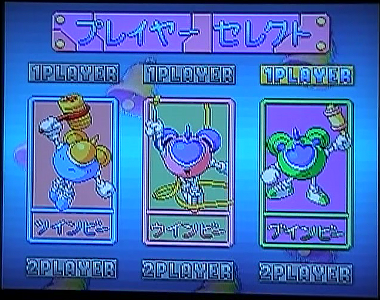
Choose your character!
Ah, TwinBee!  =)  Ever since I imported the PSP compilation TwinBee Portable from Japan last year, I fell in love with the series and became a huge fan.  Maybe not as well known (or as hysterically quirky) as Konami's other cute'em up series Parodius, I find this series of games very appealing.  The games are lighthearted, cute, colorful, cheerful, charming, and they have very and intuitive play control, too, with a fair amount of challenge to boot.  Not to mention have a very nice art style.  Back in the early '90s there were a couple titles in the series that were made for the Super Famicom and Super Nintendo console in Japan and Europe respectively: Pop'n TwinBee and TwinBee: Rainbow Bell Adventure (known as Pop'n TwinBee: Rainbow Bell Adventures in Europe).

I enjoyed Pop'n TwinBee immensely in TwinBee Portable, for I thought it was one of the best games in the cute'em up genre, if not the best.  The benefit of owning a Retro Duo is that I get to play and experience Super Famicom games from Japan, which is great and makes the world a much bigger place.  For the fifth Super Famicom purchase, I chose the (sort of) sequel to Pop'n TwinBee, TwinBee: Rainbow Bell Adventure, which is actually a spin-off (one of three, to be precise) of the series, which transitioned from vertical-scrolling cute'em up to sidescrolling platformer.  Ever since I first looked it up, I wondered how exactly a series transition like that would work.  Fortunately, it turned out to work very well, and it turned out to be very fun.

It's Hammer Time!!!
Funny story about the second 16-bit console TwinBee game: I don't know what its status in Japan or Europe is like, but as far as I looked up, it is very rare!!  No, seriously, take a gander on eBay, there are not many copies of it on there at all, if any.  And in cases when the game does pop up on eBay, it usually sells for a very high amount.  The copy I paid for sold at a very decent price.  I got lucky there.  Now how is it that a game of this caliber is so high up for grabs?  Is it because it's obscure?  Is it because it's a spin-off?  Is it because it's different than most games in the series?  Is it because both regional versions of the game had many differences upon release?  Which reminds me: as far as I looked up, when the PAL version was made, changes were made and certain elements were cut from the original Japanese version.  That version was linear, the dialogue between levels was removed, and it used passwords in order to continue your progress.  But in the Japanese version, the map is nonlinear, there are alternative exits, the map screen has dialogue between the characters, progress is saved through battery back-up, and there are several different endings...  Boy, PAL gamers sure got shortchanged when they got this game, weren't they?  Now I normally don't compare versions of games I experienced to those that I haven't since it's not exactly fair to those that have played said version, but I just had to make an exception here.  Another thing to note is that more often than not the PAL versions will be selling on eBay, while the Japanese versions don't appear as often.  Luckily, the copy I pad for was Japanese, so I got to experience the game as it was initially made.  I almost considered buying the PAL version, since it seemed like it was the only copy on there, but the moment I saw that a Japanese version was on there, I immediately jumped for it.  Totally worth it!  =D  Okay, rambling time over: it's GAME TIME!!!

Thanks to the ringing of a series of bells called the Rainbow Bell, peace had prospered in the universe.  Unfortunately, Dr. Warumon and his anthropomorphic EvilBee army step into the scene and decide to put a big end to that.  The EvilBees have snatched them away, and caused many to panic and worry.  What's worse: the ruler of Planet Meru, Princess Melora, who was previously seen in Detana!! TwinBee, is slowly beginning to fade away as a result.  What could Dr. Warumon hope to accomplish from all this?  Why, only the most diabolical thing imaginable: take over the world.


But luckily for the people the anthropomorphic bee-shaped heroes TwinBee, WinBee, and GwinBee have come to the rescue.  The first two are piloted by a couple teens called Light and Pastel (they're not called that in the game, but they were given names in the series eventually) while the third one is piloted by a baby called Mint (same with him); I kid you not!  In their adventure to stop Dr. Warumon's evil deeds, they will be aided by the pilots' grandfather Dr. Shinamon (via communication on the map screen).


Racing under a beautiful
aurora borealis!
 I remember reading years ago when I read Shiryu's description of his gameplay video that he described the gameplay was like TwinBee meets Sonic the Hedgehog meets RocketKnight Adventures.  Yeah, I can see how he would come to that, now that I played it myself.  That's a good way of putting it, really.  So in the game you can choose to play one of four save files or you could choose to use a password; but since the Japanese copy saves automatically, I find little point to use the password system at all.  From there, you have to choice of playing as the cyan and yellow-colored TwinBee, the pink and blue-colored WinBee, and the green and blue-colored GwinBee.  Of course, once you choose your character, you cannot switch to another one until after you continue if you lose a life.

Fire!!
All right, here are the basics.  If you keep holding the left or right button, you will be moving until you gradually start to run like the wind.  If you press down while running your character will be sliding ahead on its belly.  You can also throw a punch (should you not have a yellow bell power-up) by pressing the Y button in any direction.  If you want to throw a very potent fire punch attack, hold down the Y button until the Punch gauge is full, and then release the button in order to launch the fire punch towards faraway enemies in any of the eight directions.  You can also jump on most enemies and bosses via the B button, and it's also possible to propel yourself into the air and fly for a short period of time in any of the eight directions.  Just hold down the B button until the Jump gauge is full (on the ground or in midair), and once you release it while holding a direction, you'll fly as fast as you can.
The TwinBee Team
Throughout the stages there are angles, walls, and ceilings, and if you fly towards any of these surfaces, then you'll be ricocheting off said surfaces, which is very fun.  While in midair, you can even hover as long as you hold up, though you'll slwoly go down as a result.  From time to time youll come across a button with a "?" mark on it, and once it's been pushed, you'll find one of the following: a missile, a bouncing ball, and a wipeout bomb.  By pressing the X button you can pack them up and put them down, and if you press the Y button while hodling them you'll be using them.  The missile seeks out the enemies, the bouncing ball temporarily bounces all over the screen while knocking out enemies, and the wipeout bomb does exactly as the name implies.  If you want to see what's ahead of you, you can hold down either the L or the R shoulder button to shift the camera to the left or to the right, and to look upward hold up and to look downward hold down.

Having a nice conversation with
Grandpa Shinamon
In the TwinBee-verse you usually shoot at clouds in order for the bells to appear, but in TwinBee: Rainbow Bell Adventure you have to defeat the enemies in order to get the bell power-ups.  Just make sure you catch the bell as it falls, otherwise you'll miss it.  The white bell gives you a special set of shoes, the yellow bell gives your character a special weapon (with it, TwinBee can use a hammer, WinBee can use a ribbon, and GwinBee can use a rattle toy to throw towards distanced enemies), the blue bell gives you a laser gun which can be utilized with the A button, the green bell gives you a Chibi-Bee wingman which will follow you around and damage enemies upon contact (only up to three), the purple bell forms a shield around you (which is disposed if it's hit once), and finally, the pink bell renders you invincible for several seconds.  Be careful, though, because if you're hit, then all the bell power-ups you currently have will jump out from you, and you only have a chance to recuperate a few of them as they fall.  That darn "Sonic the Hedgehog Syndome"!  >=(  Oh, and you only have a health of three hearts, so if you lose your last heart regardless of whether or not you have bell power-ups on you, you'll lose a life.

The pastel-toned visuals lathered in each area are bright, colorful, eye-pleasing, and oh-so inviting.  To name a few: in the sunny green areas there are neat-looking mountains and hills in the background, as well as a few floating islands with a waterfall streaming down.  In the cavernous areas it's all dark save for the round oval centering on your character, and the way the rocks and enemies are revealed as they're in the vicinity gives a rather cool atmospheric feel.  The rainforest areas are great with all the vegetated trees and the water-filled parts you can swim in, while the snowy areas are simply beautiful to look at with all the snow, the ice, and the sky which has a wonderful aurora borealis the higher up you go (I'm a sucker for those).  Each of the main characters are designed very nicely, and they all display smooth animation.  Their various animations are neat, especially the running and idle ones.  The enemies and bosses look great, too, and I love how there are character portraits for whenever dialogue is taking place.

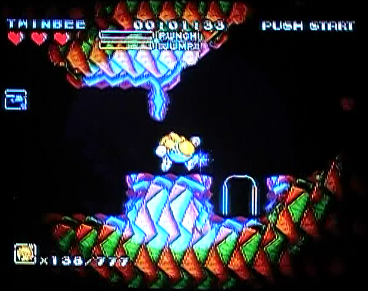
Exploring the dark, strangely
atmospheric cave
The TwinBee cute'em ups usually have a good amount of smooth-flowing challenge while at the same time not being too difficult.  I don't know what to say about this game's challenge, however, and I'm not even certain how I feel about it.  Basically the goal of each stage is to reach the goal represented by a small arch with Dr. Shinamon's face on it.  Some stages are straightforward in that there is only one goal, but in other stages there are alternate goals, similar to Super Mario World.  If ever you feel lost, you can consult the stage's grid-based map whenever you pause the game.  The "G" grid stands for Goal, and if it's yellow it means that it hasn't been accessed yet.  In certain stages, if you haven't gotten them yet, you'll notice a key symbol on the map.  There are six colored keys in total, each found in their corresponding areas.  With these keys in possession, you'll be able to enter the door(s) in each stage that corresponds to that color.  Entering them will send you to a different part of the stage in a secret room.  You'll know you haven't entered the door yet if the map shows a black door symbol on certain grids; why that's important I'll get to shortly.  You'll notice in each stage that there is a timer at the top, and fortunately you can stick around as long as you want with no repercussions whatsoever.

As was the case with the last game, you have health and must beat the stages in one life.  Fortunately, you have an unlimited amount of continues at your disposal.  Unfortunately, your health is comprised of three hearts, while depending on the difficulty (or how you play) feels a little restricting and can make the game harder than it really is.  Some spikes will alleviate you of one heart, while certain other spikes will put an end to your journey, so it's best to be cautious.  The only way to recuperate health is if you either find a heart lying around, or if you collect a hundred round bells (every hundred will reward you with one).

I've got nothing creative to say
about this screenshot
Each Rainbow Bell is guarded by a boss who's name ends with the suffix "Bee" (it's a little like how in the Digimon series pretty much every non-human character's name ended with the suffix "mon"), and the only way to confront Dr. Warumon is if you have gathered all seven of them.  The thing about certain boss stages is that some of them can only be accessed once you find an alternate exit; in the monitor with Dr. Shinamon neat it, there are arrows in each grid that show where you'll be heading depending on the exit you take.  Some exits are easy to reach, while some are rather difficult to access (particularly that one in a Toyland-like stage).  The boss battles require a bit of strategy, and your choices of combating them are to jump on them or to do the fire punch.  The fire punches are more effective since they'll take out four of the bosses' health away.  The thing about fire punches are that you have to wait until the fire gauge is full in order for them to work, and that it takes a second or two depending on which character you play as.  TwinBee takes an equal amount of time to charge up his punches and jumps, while GwinBee pulls off faster fire punches and WinBee propels herself in the air the quickest.  Since you have three hearts, being careful when fighting the bosses are a must, and messing up will lessen the chance of victory; so as a result, GwinBee is your best bet when it comes to boss fights.  I have not defeated any of the bosses on my first try, not even the first one.  A personal quibble I have with this game is that if you hold down the B button while jumping and while holding a directions in moments when you don't need to propel yourself, do not let go (unless the Control Pad is left alone).  If you do, you'll accidentally fly off when you didn't mean to, which is a big issue for someone who regularly holds down the jump button whenever it comes ot jumping; but that's just me.  TwinBee: Rainbow Bell Adventure is neither an easy game nor a hard on, but I'm not exactly sure what difficulty Konami was aiming for here.  That's why I didn't know what to say about this aspect.

That is so adorable!
If I were asked to give this game a score from 1 too 10, I would give this game an 8 at best.  But did this spin-off live up to the TwinBee name?  Yeah, I think it did.  Does it in any way exceed the other games in the series?  No, not really.  I didn't expect it to surpass the series upon playing it (don't know about the two Nintendo 8-bit games and the two PlayStation spin-offs, since I haven't played those), but I had a lot of fun with it in the end, for it had all the charm that I love about the series.  The stages are fun and good-looking, the stage designs are decent (if not difficult at times), and the gameplay is rock solid.  The visual style is pleasing to the eyes, the still shots seen after beating a stage in certain areas is appealing, and the music fits perfectly with the atmosphere.  I just wish there was a consistent difficulty here, because I didn't feel that there was one, which I found distracting.  The boss fights were nice (the way a pair of them react on one stage upon losing is absolutely adorable), the final boss encounter really took me by surprise, and I like how there is a lot of replay value.  I loved how the characters weren't simply palette swaps, and that they actually had differing animations and stats that made them stand out.  The various exits lead to different stages, and some of them will take a long time to access.  I only got one ending so far, but at the end after the credits have finished rolling they show you the results of your performance; you'll be shown how many fairies you gathered, how many doors you opened, how many exits you reached, and how much of the game you've completed.  Some fairies can be found by searching thoroughly in the stage; some of the foregrounds are breakable (there are ones that are obvious and ones that are concealed by blending with the scenery), and some fairies are found by accessing secret rooms once you access a colored door.  Most fairies are hard to find and collect, so stay alert and be careful.  There are different endings, too, and I'm curious as to what happens during them.  It has its glaring flaws, sure, and the inconsistent difficulty drove me off (I regularly have an easy time talking about a video game's difficulty most of the time), but in the end I had a good time with it.  It's fun, cute, charming, and very lighthearted.


I know what you may be thinking when earlier in this post: "fifth Super Famicom purchase"?  "What about your third and fourth SFC games?  Why didn't make an impressions post about them?"  For those that are curious, my third purchase was Gokujō Parodius! ~Kako no Eikō o Motomete~ and my fourth game was Tenchi Sōzō (known to many as Terranigma).  The reason I didn't share my impressions about the former is because I want to create a full-length review of that game (so don't expect news of it anytime soon), and the reason there isn't an impressions post made regarding the latter is because I lost my rought draft.  =(