Friday, December 19, 2014

Super Morph (SNES) Review

Received: March 4th, 2014 / Written: December 15th-19th, 2014
Year: 1993 | Developed by: Millenium Entertainment
Published by: Sony Imagesoft | [|O|]
 
Hello everyone, StarBoy91 here; passionate about video games, big retrophile, and fan of all things 16-bit.  =)  From the early to mid '90s there were many games that were made based on a similar premise, some better than others.  The subject I'm referring to for this context is blobs and slimes (if I'm not mistaken it all started with the original NES version of A Boy and his Blob).
 
Game itself is okay, in my opinion, but its
premise is cool
One game that comes to mind that centered around a (boy turned) blob-like slime was the 1991 Nintendo 16-bit GameFreak/Sacom System collaborated title by the name of Jerry Boy published in Japan by Epic/Sony Records, later localized for American audiences months later as Smart Ball under the Sony Imagesoft label.  It was an interesting sidescrolling action/platformer which had the main character attack enemies by either spewing out balls or by stretching out his own body.  It's a clever bit of gameplay, I'll give it that, and there's a lot of benefits to it (like climbing walls and sticking to the ceiling).  Of course there were more games that revolved around blobs and slimes, each with their own twists and perks, and it's interesting to see a company's own take on these things.  Originally my plan was to talk about Jerry Boy first but sadly I do not have enough screenshots in order to form up a proper review of it (especially since I was going to compare it to the Americanized counterpart); so instead I'll discuss a game that thematically is similar but is somewhat structurally different.
 
Sadly Europe missed out on Jerry Boy  =(  Let's
see if the game they received is better?
In 1993 a PAL-exclusive game simply titled Morph was created by Millenium Entertainment that was made for the Amiga computer; that same year, as luck may have it, Europeans were given a Super Nintendo port which was never given a proper release in either America or Japan, titled Super Morph (guess that's payback for never having been given a chance to play the 1991 cart).  That version was published by none other than Sony Imagesooooo--- wow!  What are the odds that two completely unrelated games with similar themes, similar premises, and slightly different mechanics would be published by the same exact company?  O.O  Incredible!  Let us take a look at this little-known game and see how Millenium takes a crack at the blob/slime theme.
 
One day a random little boy is dropped off by a school bus and walks to a completely random scientist stranger's door unsupervised.  Because that's sound; this will clearly only lead to good.  <=|
So the scientist shows him around and takes him to his laboratory where he asks the little boy to test his new experiment.  What's scary is that the little tyke agrees to go through with this having no reservations whatsoever!  o_O  What???
Oh yeah, I know that this is the kind of face you can trust.  Nothing bad could possibly happen in this scenario.
So the scientist pulls the lever and oh look, something bad just happened in this scenario in the form of the boy becoming a particle until he vanishes; the machine also malfunctions sending gears flying everywhere after exploding.  *sigh*  Well, I hope the crazy scientist enjoys prison time because he's going to be spending a lot of years for child murder.

No, the game would never be this dark even if it tried.  The gears have scattered in four different areas: the garden, the sewers, the factory, and finally the laboratory; and it is up to the boy who just now got infused with morphing abilities to get them back while the scientist guides him and seemingly offers moral support (and a slew of bad puns).  What, did he have a large hole or window in the room, how the hell is that even possible?!?  Geez, were all Amiga games this weird?  I should hope not, 'cause this plot manages to singlehandedly be even more bizarre than the entirety of The Adventures of Kid Kleets/Soccer Kid=\

Stuck in a factory
In each area are nine sections, and in each section there is a gear you must find.  You control the boy who just became an embodiment of four elements, who you can move around with the Control Pad, who you must guide to the exit after having found the gear in one piece.  To make things a bit challenging are a myriad of obstacles scattered about, some of which are more lethal than others, adding a puzzle element to the proceedings.  Conveniently in the bottom left corner the four transformations that you'll utilize compose the icons in a way that matches the buttons on the right side of your controller, so that way there will be no question as to which button you must press when the moment calls for it.  The B button morphs you into a solid ball, the Y button changes you into a liquefied sentient state, the X button transforms you into a gaseous state in the form of a small cloud, and finally the A button morphs you into a bouncy rubber ball.  But it doesn't end there.

Problem solving is a common goal
In these areas you must make a wise call on when and where the proper transformation should take place, for you cannot use it as many times as you would like; only how many you're allowed to.  Scattered throughout the areas you'll find star icons and any of the four transformation icons, for you are going to need those in order to change form.  Rather rare in this kind of hybrid genre there are no enemies to be fought anywhere, but to make up for that are obstacles aplenty.  Each of the areas' nine individual sections have a very open-ended design, so it is absolutely important as sometimes the exits are easy to reach while others not so much.  I'll cover the rest of the gameplay and challenge later.

Wall bustin'!
While the visuals aren't anything to write home about Super Morph's worlds, solid as they are, are really good to look at.  =)  But is it just me or does the art of the intro scenes and score screens look rather inconsistent?  In the intro there are times when the characters are either very detailed or have simple colors; and the crazy scientist is no different, especially with his many different animations in the score and stage lost screens (I mean seriously, he looks younger there than he does in the intro).  Whenever you begin (or resume after having taken a break from) an area the scientist will don stuff pertaining to the respective area (for the garden he wears boots and carries a shovel, and for the factory he wears safety goggles to name two examples).  He's even got brief animations for each different way that your character fails and dies; and I mean it.

Making an effort in the sewers
The areas are vast in design and variety, and some might exhibit different décor in particular sections.  The garden area sections are the only ones that take place outside, and as basic as the sky and clouds look, it is effective in its simplicity; another good touch is the grassy segments, the bushes, and the occasional waterfalls from time to time.  =)  The factory is high-tech and brimming with metallic walls, tubes, glass, and construction parts; the sewers are menacingly decrepit and eerie in nature with the heavily bricked patterns in the foreground, stalactites sometimes protruding from the ceiling, sprawling tubes, and deadly acid; and finally there's the laboratory areas which seems gigantic with the giant books resting in giant book cases, giant stairs, giant Bunsen burners, giant faucets, large windows, and even gigantic potions.  And to be fair the feeling small in the gigantic universe feel applies to the other areas as well, not just because of the sizes of the elements that belong to said areas but due to how large and mysterious the worlds seem.

Bouncy!  Bouncy!  Bouncy!  Bouncy!
Now let's talk about the main character turned morpher.  In the intro the best look for him is the fourth frame when he's still human, but he's a very different animal once he gets his newfound abilities.  His various forms have got really well-drawn and fluid animations, especially when he turns directions.  The solid form is solid in motion but its serviceable, the gaseous form has got neat cloud-like movement, the rubber ball actually reacts like a really rubber ball (whenever it touches the ceiling or ground after bouncing towards it culminating in a slight malleable follow-through), and the liquid form slushes its way and splashes itself before forming itself up again after having touched the ground after falling).  The transformations themselves, brief as they may be, I feel to be quite seamless; and to add to the charm the main character has got big wide eyes (occasionally blinking) which look at the direction that you are holding on the controller (by holding up he looks up, by holding lower-right he looks to the lower-right, and by not pressing the Control Pad at all he looks directly at the screen).  =)  Depending on what form he's got his death animations differ, and quite frankly they're rather gruesome considering it happens to a little boy despite the otherwise lighthearted tone.

Well, only one way to resolve this
Even though there aren't any enemies in sight it doesn't make the worlds the morpher explores any less dangerous.  Each form has got their own strengths and weaknesses; the solid ball is impervious to anything and can break through bricked barriers, the liquid form can douse out any fire and phase through thin platforme below it, the gaseous form will gradually float up and phase through thin walls, and the rubber ball format is the only one that allows you to bounce your way (by holding up).  Regardless of the form you're currently using, there are obstacles; whether it be fires, water, sharp objects, and rotating fans; the solid form will sink if it rolls itself onto water, the liquid form becomes water if you fall there and dissolves itself the moment you stand on top of a grater, the gaseous form will be sucked up if it's near a functioning rotating fan and burst into flames if it comes into contact with fire, and while the rubber ball format can float on the water (only leaving it if there's even-grounded land next to it) it will pop and deflate if it lands on a spike or catch on fire if it gets burned by flames.  And to make things more intense, you only have one health.

Oh, crap!
You'll notice there are numbers next to each icon, each of which can be replenished if you attain them in the area.  Each time you use a transformation the star count will go down by one, and if you use any one of them past the point of zero the count will become red and you will not be eligible to pass the stage even if you do reach the exit with the gear in possession.  The important thing is to judge which proper ones you must use and to not overshoot your mark for any reason; you will still be alive if a transformation has a red one, but getting another red count of the same one will cause you to disappear.  If you feel that you've messed up you can always exit the stage by pressing Start and then Select; it doesn't matter whether you start in the garden, the laboratory, the factory, or the sewers for you can actually start wherever you please.  Some of the items will come into play once you find them, like the key to unlock keyholes blocking a segment, switches which you can flip to turn the rotating fans (or lights) on or off, trampolines, shades to help you see clearly underneath the tubes, and an optional map.
By pressing Select after having obtained the map you'll see the entire layout of the stage you are currently in, showing how big the area you're going in is and revealing spots where you would normally not venture.  Thing is, however, you cannot do it while it's paused and you can't pause while viewing it so you'll only find yourself looking at it for a few seconds as the timer gradually goes down.  Oh yeah, there's a timer in each stage, so you must find the gear and reach the exit under the allotted time that you're given; so don't even consider dawdling.

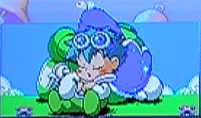
There is a very high chance that you either only played Super Morph or Jerry Boy/Smart Ball and not both.  But if you are dubious as to why I compare the two:
look at that!  They could practically be the same character!  Maybe this is the cancelled sequel to Jerry Boy that we never got.

Joking aside, I remember having first heard about this game several years ago, only having seen some screenshots of it from the Moby Games website.  It looked interesting, and I eventually saw some gameplay footage of it on YouTube, which made me a bit more curious.  The thing that kept me back, up until I bit the bullet and gave it a shot, was that Super Morph was PAL-exclusive.
Screenshots of Super Bomberman 3 and Xandra no Daibōken: Valkyrie to no Deai (Whirlo as it's appeared on the site) from MobyGames, since I didn't get my own screenshots for the two
When I bought a Retro Duo more than two and a half years ago my main goal was importing Super Famicom games from Japan, and I found that with many of them they worked; not so much the case for all European games, which is why I settled for the Japanese versions of these five games that you see here, since it was more likely that they would work on Retro-Bit's system than the European ones would.

After having played Jerry Boy back in February I thought it would be fitting that the next import would be Super Morph (however I got Super Bomberman 3 shortly before that since I ordered the two at the same time), sort of like a back-to-back deal and fearing that I would've risked having bought a game that would not operate on there; when it eventually got here I was relieved to discover that my first PAL SNES cart was working properly.  =)

Just flowing by
Super Morph has got a good sense of challenge flow where the areas start off with a manageable stage and then the further you go the stages become more thought-provoking in design and aptly puzzling nature.  Later on there may be a moment where you must bounce yourself as high as you can on the trampoline; sometimes a later stage that you'll be on will require warps to different parts of the room; and believe it or not there is even a time where you must be required to bounce from moving platform to moving platform, which is both exhilarating and worrisome at the same time since you must control how high or far you must bounce without falling and having to start that part over.  I think it's cool how many ways Millenium tries to challenge you.  Any time you fail or abort a stage you're given a chance to play it again for a later time, but regardless it must be done in one go as there are no checkpoints.

Made it!  =)
From what I looked up about the original Amiga version its intro sequence was fully animated and it only had twenty-four stages, while the SNES version's intro sequence was a series of stills and comprises of thirty-six stages (nine for each area).  I neglected to mention it, but in each stage there are some morphing squares where if you move towards it you'll given a random form (you can go through the same more than once if you wish to change form without pressing any of the buttons), so that's one way to conserve transformation stars.  The music and sound effects were composed by Graham King, who was also involved in the Sensible Soccer series, James Pond 3: Operation Starfish, and Rise of the Robots; but the only time you hear music in this game is during the title, the stage selection screen, the stage failed or succeeded stage, and the ending credits.

No, I refuse to make that reference!  >=(
Basically you only hear sound effects while actually playing the game, and I don't mean like Equinox in that it starts with a musical prelude followed by several minutes of ambient sound effects, nonono; I mean it's nothing but sound effects (ambient ones too) giving this game an eerily quiet (yet atmospheric) feel.  So much so that after you get out of the stage (in any way) you'll find yourself doing a double take when music suddenly starts playing (even if for a brief moment); I haven't experienced a video game instant like that since NCAA Basketball.  But as far as the sound effects are concerned they're low-key but serviceable in their own right.

Super Morph is a fun action-puzzler to play once in awhile, and I liked how many of its puzzles were laid out; and between Jerry Boy and this game I actually preferred this one because at least today's game doesn't suffer from occasionally slippery and loose controls.  It's a pretty good alternative to The Lost Vikings as far as the hybrid genre is concerned, but ultimately what prevents Super Morph from being as excellent as the aforementioned Viking venture is that it has to be beaten in one sitting.  Don't get me wrong, there's nothing necessarily bad about that, but when you really think about it the fact that you have to solve thirty-six puzzles in the same playthrough sounds a bit excessive (especially with many of the latter stages' puzzles being longer and more complex).  It can be done (it takes less than an hour to beat), but I think a password feature would've been very appreciated in my opinion.

It's not very expensive and you can buy it for a good price on eBay, but you'll need the right system to be able to play it.  If your method of playing imported Nintendo 16-bit carts is by modding your NTSC SNES console (if you live in America) then you may be very disappointed for PAL SNES carts will not work there; the main reason for that is that while both the NTSC SNES and JP SFC carts run in 60 hertz PAL SNES games when played in Europe ran in 50 hertz, running roughly 16.7% slower than the other versions (for most games) and sometimes squishing the aspect ratio through a letterbox format.
This was an issue in the late '80s and early 90's for European gamers, and reportedly speaking it's still recurring today (for both Virtual Console services of the Nintendo Wii and the Nintendo Wii U), even though Europe has largely worked over that since the mid-'90s.  This was not the video game developers' fault, because they had to convert Japanese and/or American games for Europe under conditions which they had no control of.  =(

I don't know how Super Morph originally ran on a PAL TV, so I compared how it ran on my TV with how it ran in a World of Longplay video dedicated to it on YouTube; it was about on par as far as I could tell, but in the long run the game ran a lot smoother on my flat NTSC widescreen.  Your best option to play this game if you live in America or Japan is by either buying a European Super Nintendo console (not likely) or buying a Super Famiclone system which is compatible with Super Famicom games and some SNES PAL carts; I know it works on the Retro Duo, so that one's not a bad choice.  =)

Good luck
Even if it requires to be beaten in solely one sitting Super Morph is a solidly quaint action-puzzler that's cleverly designed and strangely involving thanks to the literally quiet atmosphere and trying to outsmart inconvenient trappings in your way.  It plays good, the European charm is nice, and it has got a reasonably high amount of replay value; although how much you like it depends on whether you're in to the hybrid genre or not.  If you want to solve a good series of puzzles that involve a lot of problem solving and navigation then you may have a good time with it.  If you're not into puzzling and just want in for the action then it may not work for you as much as it would if you were.  If you want to play for the atmosphere, well you'll feel right at home with Super Morph.  It's not perfect, but it is solid in its own right.  =)

7.0/10
<(^o^)^TO EACH THEIR OWN^(^o^)>
P.S. I know that the screenshot I took of Pop'n TwinBee wasn't from my TV, but I did eventually get the original Super Famicom cart... thing was I never took footage of that one so under short notice I instead took a literal still of it while playing it on TwinBee Portable for the PlayStation Portable.
 
P.S. 2 You know, The Suite Life's Arwin Hawkhauser makes inventions which malfunction all the time.  Maybe he and Super Morph's crazy scientist should get together sometime.  =P
 
Thank you for reading my review, my readers, please leave me a comment and let me know what you think.  I hope you have a great day and Merry Christmas.  Take care!  =)
--------------------------------------------------------
Next Review: ????? (?????) on Christmas Day

Sunday, December 14, 2014

TwinBee: Rainbow Bell Adventure (SFC) Review

Received: July 30th, 2012 / Written: December 8th-14th, 2014
Alternate Name: Pop'n TwinBee: Rainbow Bell Adventures [|O|]
Year: 1994 | Developed and Published by: Konami | [|O|]
 
Hello everyone, StarBoy91 here; passionate about video games, big retrophile, and fan of all things 16-bit.  =)  After having gotten a Retro Duo back in the first half of 2012, it really helped broaden my horizons by enabling me to access Super Famicarts from Japan.
From Alcahest to Mickey no Tokyo Disneyland Daibōken to Gokujō Parodius! ~Kako no Eikō o Motomete~ to Tenchi Sōzō, these four were good games to start my physical Super Famicom collection.  =)

My fifth Super Famicom game would be Konami's first of three spinoffs to the TwinBee cute'em up series TwinBee: Rainbow Bell Adventure that July.  The copy I imported from Japan cost about $30, and quite frankly I was lucky to have gotten the Japanese original since I heard beforehand that the European version was much more simplified and different in structure.  Purism, it will get you places.  I had shared my initial thoughts on it less than a month after I played it, at the time stating that it was good not great and that I felt conflicted as to what its difficulty was supposed to be.  But hey, a lot can happen in two-plus years and who knows, perhaps I changed my mind on it since then?  And I have.  =D  Here is my proper review on the game now that I have completed it at last.

Somewhere in the far off galaxy there is an evil genius called Dr. Warumon who unleashes his legion of EvilBees in the very planet he targets.
There the EvilBees have searched about and have located and hidden all the Rainbow Bells, not to mention spread out intimidating everyone, which causes Queen Melora to vanish pleading for help.
With her gone, Dr. Warumon can take over everything.  Who will stop him now?
None other than the fighter jets, of course!  With the help of their benefactor and chief Dr. Shinamon, TwinBee, WinBee, and GwinBee (piloted by teenagers Light and Pastel and toddler Mint respectively) will set out to undo all the harm Dr. Warumon's EvilBees have caused and retrieve all the fairies and Rainbow Bells that were seized by his forces.  Can they defeat him and free Queen Melora?
In TwinBee: Rainbow Bell Adventure you could choose whether to play it as a one- or two-player game, playing either as TwinBee, WinBee, or GwinBee; each of whom have differing stats and skills.
 
Ricocheting off of corners in a dark place
For the most part the TwinBee series was comprised of vertical cute'em ups, but for this entry Konami decided to shift it into a sidescrolling platformer.  And really, why not?  The fighter jets have all got arms and legs, this is perfect for them!  =)  The gameplay is a mixture of Sonic the Hedgehog, Rocket Knight Adventures, and (partially) Bubsy thrown together.  For Sonic, it's speed; for Rocket Knight Adventures, it's the gadgetry; and for Bubsy, it's the lookaround.  In any part of the stage whichever fighter jet you're controlling can see what's ahead of or behind them by holding the L or R shoulder buttons, look above them by holding up, and below them by holding down.  It's a good feature to use if you want to know about your surroundings and which enemies or secrets are around; so keep your eyes peeled.  You can also slide down thin platforms by pressing B while holding down.
 
See what's ahead of you
For first and foremost you'll be working with gadgetry, with elements of speed coming into play whenever the time for them comes.  The fighter jets have got their own arsenal of moves, with their own special abilities each being different.  To throw a powerful beam punch hold down the Y button until the Punch gauge is full, and then let go to let it fly in any direction you aim; to skyrocket yourself (and sometimes ricochet) in any direction you hold down the B button until the Jump gauge is full, and then let go to blastoff.  GwinBee takes the shortest time to charge his Punch gauge but the longest for the Jump while WinBee takes the longest to charge the Punch gauge but a very short time to charge her Jump gauge.  TwinBee is the middle guy and more balanced one of the trio, in that it takes an equal amount of time for him to charge up either gauge.
 
Swimming is a lot of fun!
Learning the proper time to let go of the jump button when the Jump gauge is fully charged is essential in order to not get hurt, since it is easy to accidentally fly off if you're not careful.  If you're in a situation when you don't want to fly off but your gauge is full then let go of the B button while not pressing any of the directions.  Takes a bit of practice to get right.  After jumping it is possible to glide yourself down slowly by holding the up button while in midair.  After jumping on enemies they will leave behind a bell power-up of a different color, which is the staple of the TwinBee cute'em up series.  The silver bell gives you spiked boots, the blue bell gives you the blaster gun (as a nod to Detana!! TwinBee) which you use with the A button, the green bell gives you a chibi which will follow you around and do damage to enemies if they touch them (you can only get three), the purple bell gives you a shield which will protect you from losing any hearts but will be gone if you get hit, the pink bell will render you invincible for a short period of time, and golden bell will give the fighter jets their respective special weapon.
 
The cold never bothered me anyway
Being hit without any defensive shield will cause you to lose your power-ups (much like Sonic would lose his rings once he's hit), so you only have a brief moment to recoup any power-up bell you can before they fall offscreen.  Without the gold bell power-up if you simply press the Y button then the fighter jets will do a weak punch (which humorously is able to squish enemies); but with the gold bell power-up you get a main secondary weapon.  For TwinBee it's the hammer, for WinBee it's the streamer which is used for a whip, and for GwinBee it's an unlimited array of rattles which have got a long range.  There is also a massive punch effect that when made contact with the enemy then they will fly far in the distance, but I personally have no idea what the proper controls are that are used to implement it, so if I feel like doing that then I just dabble with the directions and the Y button until it's done.  Occasionally the fighter jets can also swim underwater and zip through wires.  You only have a health of three (which can be replenished), and any time you lose a life then you have to choose a fighter jet anew.
 
Whooshing by the stream!
The pastel-toned visuals are colorful and fun to look at.  There's only line scrolling in each area, no real parallax scrolling, but even so there is a good amount of depth and atmosphere.  The first set of areas take place in a fantastical environment with scenery pleasing to the eyes adorned with floating platforms which have got streaming waterfalls emanating from them; one part takes place during the day while the other takes place at sunset.  Another set of areas transpires in a starry mine where it's all dark except for the dim sphere which stays on you throughout, which brings a big sense of atmosphere and wonder.  Then are the snow areas where there's a lot of mountains in the background with a neatly-colored sky displaying some very effective Aurora Borealis which is pretty to look at (I'm a sucker for those).  =)  Some other good areas are the waterside with the relaxing trees with colored rocks abound and the toyland section which looks playful and inviting with the simple patterns serving as its décor.
 
Poor DebunBee; he's so fat and heavy he can
barely fly himself up in the air
The character animations for TwinBee, WinBee, and GwinBee are all very solid, and they are very fun and charming to look at.  =)  Whether it be the jumping, walking, running, gliding, or even the punch charging; there is a cool anime feel to them, plus they are very cute.  The best part is that each fighter jet isn't simply just a palette swap, for they've actually got different details that make them their own.  They've got their individual stationary poses, the visors have diverse shapes, and TwinBee and GwinBee's center jump and gliding poses are more spread out then WinBee's (for obvious reasons, of course).  Their belly-sliding animation if you press down while running is cool, and the animation for when they trip over a rock while running is adorable.  The water will even react if you try skyrocketing straight ahead of it, and it's pretty neat how Konami inserts small details like those.

Watch out, Sega!  TwinBee and the gang are trying to be the next Sonic the HedgehogXD
And much like ASCII's Ardy Lightfoot it's better than half of the blue speed demon's recent outings.
 
Don't get hurt by ByonBee's spikes on his
hands, and do not let him grab hold of you
The enemy and boss designs have got a fun, charming look and feel to them as well.  There are EvilBees who appear in different colors and do their own thing whether it's running, jumping, jetting in the sky, waterboarding, skiing, relaxing, or even parachuting.  From time to time you are going to face a different slew of enemies as well, like flying snake enemies in the toyland areas, scuba-diver enemies in the water areas, and even the equivalent to the Mighty Morphin' PowerBees in a brief moment of the penultimate area (it's cool).  Many of the bosses look cool as well, like DelnBee who's gigantic and is on skiis or BossBee who's crowding up more than half of the screen for example.  Another neat facet about them is how they all wear shades.  Oh, yeah!  B-)  The main exception is the final boss which genuinely surprised me the first time (and not just design-wise).
At the end of each respective area are cute still moments surrounding by bells in the background which are fun and charming to look at.
This one's my favorite.  D'awww!  <=)
 
I'm just hanging around 'til the coast is clear
The soundtrack does a good job of lending atmosphere to all its environments and areas, and the music is very pleasant to listen to.  There are a lot of good standout songs; one of them is the very one that plays during the intro: first it starts off as a soft and mysterious tune which is fitting since it takes place in space, seguing to an impending and ominous theme when Dr. Warumon shows his ugly head, finally culminating in a lightheartedly charged theme which signifies that the adventure has just begun.  Now that is a surefire sign that you're in for something good.  =)  Each section of the planet you're in has got two themes, many of which aren't badly composed in the slightest.
 
Aurora Borealis, yay!!!
It might not have the touch that Michiru Yamane lent (along with others) in previous entries Detana!! TwinBee or Pop'n TwinBee, but for what it's got it's really pleasant for the ears.  The grassland themes are jovial and inviting; the starry mine themes are deep, dark, and mysterious with their ambient tone; the snowland themes are soothing and relaxing; and the toyland themes sound aptly playful.  =)  The boss theme is menacing in its own right, but what really steals the show is the final confrontation theme; it's dark, brooding, and intense (even though orchestration-wise it's not heavy-handed), which makes it sound epic (particularly when you fight him at 100%).  The ending and credits theme sound triumphant, and the victory theme (as brief as it is) sounds rewarding and well-deserved any time the game is beaten.  Another splendid soundtrack from Konami, in my book.  =)
 
"It's Hammer Time, and don't you forget it!"
The sound effects are fairly decent as well, and the good news is that they don't obfuscate the song which is currently playing, for that is always a good thing.  I like the quaint sounds of enemies being jumped on and/or squished, and I also like the ring of the bells whenever one is acquired.  Each fighter jet has got their own individual soundbyte, usually whenever they get a new bell power-up, whenever they get hit, or any time you lose all your health.  GwinBee, since he's piloted by a one-year old, has got a lighter sound whenever he lands on his feet as opposed to the normal landing sounds that TwinBee and WinBee make.  The music speeds up if you catch the pink invincibility bell power-up, and there's a clever fireworks-like sound effect any time a series of bells shoots up and separate themselves.  And the sound for when any of the fighter jets trip on a rock and then fall flat on their face is cute.  =)  There's more, but overall really good sound effects.
 
Your current destination is...
On the map screen Dr. Shinamon guides your selected fighter jet on a grid, enabling you to walk towards the quadrants (which you can access).  If you're playing TwinBeee: Rainbow Bell Adventure for the first time you'll notice that on each square is a tiny dot (which can only be removed if you complete everything in the stage); if it's pink it means the stage has yet to be beaten, if it's yellow it means that it's been beaten but not all exits have been reached, and if it's white it means you must collect every fairy on there (and unlock all doors).  While in the stage you can look at the grid map for it as you pause it, and in it you'll know if you've been to a segment or not, where the goal (and doors that yet have got to open) is, and the location of the keys which can open said doors (six color coded keys for each respective door).  Everything else on the paused grid map is blank, which means the enemies, paths, and fairies you will have to find all on your own.  Some stages have just one exit while others might have two; and the Rainbow Bells which you must retrieve are being guarded by the bosses.  It's vital to know all this since how much you collect will affect the overall ending (up to 100%).
 
HAAAAA!!!  His name is "BooBee"!!!  XD
The difficulty of this TwinBee platformer is somewhere inbetween easy and medium.  As I said earlier your fighter jet has only got a health of three, which can be replenished by either getting every hundred sleigh bells or by finding a heart (like in Pop'n TwinBee) in specific parts of a stage.  Sometime you'll come across (optional) tertiary weapons which you can pick up or put down with the X button and use with the Y button; they are the missile which can go straight, the baseball which will bounce all over the screen temporarily harming all enemies in its vicinity, and the flash bomb which does exactly as its namesake implies.  To beat the stage you must reach a goal, but if you've entered a stage you've already beaten then you can exit by pressing Start and then Select.
 
FIRE!
Because you've got such a short amount of health it might seem at first that it's going to be difficult.  But after awhile into it you'll find that that is not the case.  Sometimes it can be easy to let go at the wrong time if you're charging yourself for skyrocketing, but it can be worked around and all it requires is that you learn how to time it properly.  If you lose all your health that's okay because you've got unlimited continues.  And because the fighter jets have got their own various stats you'll find yourself choosing GwinBee as the go-to guy for quick punch attacks or WinBee as the go-to girl for quick jump flights; as far as TwinBee himself is concerned it's give or take.  And of course there are the bosses.
 
Crashing through the blocks
Each boss has got way more hearts than you do, and depending on which attack method you use you'll be able to take away either up to two or fours hearts a beat.  The best attack to get the most out is the punch beam attack.  But if you follow their patterns, be careful, and not get hit in the process you'll do just fine.  Sometimes jumping or skyrocketing through them will do the trick, but most of the time you'll have to resort to the punch beams or gold bell power-up.  Part of the way to achieve the best ending is if you get every single fairy, and many of them are really well-hidden and may take you awhile to find.  Some are hidden through locked doors while others are blocked behind secret paths (whether inconspicuous or not).  By collecting them all you'll get the best ending, but that's not the only thing it affects in-game, for the final boss will become much harder and faster.
 
GOAL
Yes, you read that right!  Up until you leave the 99% mark the final boss will be simple and offer a bit of challenge unless you're familiar with his pattern.  It actually surprised me the first time I got to that point, and I don't just mean the way that it's set up but the way he's designed.  That's clever!  =O  So after having gotten the last fairy I had presumed that he would've been the same regardless.  Nope!  All of a sudden the final boss was swifter in action, unpredictable, and harder than ever before.  <=O  I mean, holy crap, what the hell happened?!?  That is a major shift in difficulty; I never figured that reaching 100% would affect that in any way, yet it did.  But it is manageable to beat in the end (you're going to have to be very careful and patient, however, since it can be a bit time-consuming), and the ending is very rewarding in the long run should you beat him.  That's two times I was surprised by the final boss, and all for the better I must say.  =)  Kudos, Konami.
 
Faceplanted
TwinBee: Rainbow Bell Adventure was released for the Super Famicom on January 1994, and it was released in Europe several months later for the Super Nintendo as Pop'n TwinBee: Rainbow Bell Adventures.  A notable thing between versions is that the Japanese version has a 1994 copyright while the European version has a 1993 copyright.  There's no telling which account is accurate, but I'm inclined to believe that it's 1994.  But that is not the only thing that's different, for various changes were made for the localized PAL version, and not for the better.  In the Super Famicom original the grid map was nonlinear (similar to Super Mario World) while the PAL version was strictly linear; on the map screen the dialogue between Dr. Shinamon and the pilots or Dr. Warumon have been excised for the PAL version; the Japanese version has got six endings while the PAL version has only got one; and finally both versions do implement a password system, but why would you do that in the Japanese original when there's automatic battery save in any of the four save slots you can choose from?  =(  This is localization at its worst and Europe has sadly been shortchanged as a whole.
 
Frozen ice
For the longest time this TwinBee spinoff was solely made as a Nintendo 16-bit exclusive, and it didn't seem like it would get a second chance at life.  Back when the Nintendo Wii was the main focus it never got made available for its Virtual Console downloadable service; but all that's changed this Summer once it (and Pop'n TwinBee) got rereleased for the Nintendo Wii U Virtual Console in Japan and Europe.  It's great since it's now available for people who cannot afford the luxury of owning a Super Famicom or Super Nintendo console.  Less great is the fact that since the European Virtual Console got the version that was contrived for them twenty years ago the PAL continent as a result got gyped again, and once more North America gets left out.  =(
Too bad Konami now lives in their sad little world where they apparently neither own nor do not care for the Rocket Knight Sparkster's games (nor will rerelease them for current-gen gamers despite not being based on licensed property) and that they presumptuously feel that Americans are ineligible to play the Nintendo 16-bit TwinBee titles.  You know, just because a game is not released in a continent it doesn't mean the gamers from said continent don't want to play it.  I swear, thank God for the process of importing.
 
It's go time!
TwinBee: Rainbow Bell Adventure was my fifth physical Super Famicart that I got that Summer of '12, and I must admit that due to its structure and how easy it was to blast yourself off in any of the eight corners if you weren't careful I felt at first that it was just simply good albeit flawed.  But since my initial reactions I have been playing more and more of it, trying to complete the game as much as I possibly could.  From what I gathered there don't seem to be any in-depth guides made for the game (possibly due the altered European version and most gamers having played that version), but I have managed to find many of the keys, doors, exits, and fairies all on my own (except for one fairy which stumped me so much that I eventually resorted to the in-game move-around code to find it... think debug code from Sonic the Hedgehog... thank you, The Cutting Room Floor).  Many of them are hidden so well, and sometimes it's easy to tell if a secret path is near (whether the beam of your punch suddenly gets clipped by foreground or if inconspicuous walls break); a lot of that attributes to navigating the area thoroughly.  It took me two years and three months to finally get the 100% ending, and it was very worth it in the end.  =)
 
Now I'm charging myself to fly upward while
in midair
Any time you beat the game you'll see a stats screen showing how many fairies you saved, how many doors you unlocked, and how many exits you reached; and once it tallies all that up you'll see how much percentage you've achieved, how many more you need to reach the next best ending, and what ending number you've got.  This is a case of a game which consistently got better the more I played it and the more I managed to achieved in it.  =)  The controls are solid but may take a bit to get used to, the visuals are brightly pastel-toned, it's immensely fun, the adventure is brimming with neverending charm, and while the general difficulty is a bit easy it's trying to complete everything that will offer the most challenge  TwinBee: Rainbow Bell Adventure got even more better for me once the final boss amped himself up the moment I got 100%.  It was so surprising to me that I was genuinely pleased since the pre-100% final boss phase is a cakewalk by comparison.
 
Mighty Morphin' PowerBee-eeeees
Is it as excellent as the Nintendo 16-bit cute'em up predecessor Pop'n TwinBee?  Eh, not quite, but it comes very close.  It's very lighthearted and enjoyable, it's got tons of replay value, and it supports simultaneous two player; which is fitting since the cute'em up games supported two player as well.  I'm glad that GwinBee appeared again since it was distracting that he was in Detana!! TwinBee but not Pop'n TwinBee; but hey, all is well and he's a playable character.  Many of the characters and bosses have personality which add to its charm; among the incredulous reactions of the bosses being hit, two (in one) of the later ones actually cry when they lose (it must be seen to be believed, and it's one of the hardest moments of the game).  If you're a platforming fan then this game is a blast, and if you have appreciation for the TwinBee series then this game is for you.  If you want to have a lot of fun and want replay value in your games, then this (the Japanese version) is the game for you.  And even if you're not a fan of the series, TwinBee: Rainbow Bell Adventure is still solid platforming entertainment.  And besides, what other game lets you skyrocket yourself up to 9999 kilometers outdoors?  =3  Highly recommended!
 
 
9.0/10
<(^o^)^TO EACH THEIR OWN^(^o^)>
P.S. Less then two weeks until Christmas, hurray!  ^(^o^)^

P.S. 2 Personally I feel this is one of Konami's best Nintendo 16-bit games, right up there with Contra III: The Alien Wars, Pop'n TwinBee, Sparkster, Gokujō Parodius! ~Kako no Eikō o Motomete~, and TwinBee Yahho!=)  The last one's not really 16-bit (or Nintendo-exclusive), I just wanted to bring that one up 'cause I also love it so much.

P.S. 3 Okay, I admit, I wanted an excuse to reference Ardy Lightfoot.  I rarely find the opportunity to do it.

P.S. 4 It's too bad this game isn't as well known as it should be.  But hey, look on the bright side: at least Konami didn't make an RPG spinoff for the series which ultimately killed off the franchise.......... oh...  =<

P.S. 5 I've got nothing more to add.

Thank you for reading my review, my readers, please leave me a comment and let me know what you think.  I hope you have a great day, Merry Christmas, and take care!  =D
----------------------------------------------------------
"Father?"