Saturday, January 24, 2015

Parodius Da! -Shinwa kara Owarai e- (GB) Review

Received: March 9th, 2012 / Written: January 21st-24th, 2015
(As played on Game Boy Player)
Alternate Name: Parodius [|O|]
Year: 1990, 1991 | Developed and Published by: Konami | [|O|]
 
Hello everyone, StarBoy91 here; passionate about video games, big retrophile, and fan of all things 16-bit.  =)  Konami's done a lot of series throughout their video game career, from Gradius to Ganbare Goemon to Castlevania to even Contra among many others.  And while those may be well-revered, there are two series which I feel deserve more credit and spotlight: TwinBee and Parodius.
Image from Wikipedia
But of the two you might be more familiar with the latter than the former.  Three years after Konami started the Gradius franchise in 1985, they created a cute'em up game for the MSX computer which was fully lathered in Japanese folklore and culture that poked fun of their own serious shoot'em up.  Essentially a parody of Gradius, the game notably referred to as Parodius (full title translated as Parodius: The Octopus Saves the Earth) was something that was rarely seen before in video games; with characters from some of Konami's franchises teaming up to defeat the bad guy while contending with weirdness galore.  That's it!  I never played the 1988 MSX hit, and chances are you probably haven't either, but I hope to experience it one day after I import Parodius Portable for the PlayStation Portable.
 
What you more likely have played and what was likely your foray into this crazy series (as was mine), is (one version or another of) the widely known 1990 arcade sequel Parodius Da! -Shinwa kara Owarai e-, which received numerous ports and rereleases in both Japan and Europe.  But because Europe got the game as just Parodius, it's more often than not confused as being the same game as the MSX title, which is not.  Even still it was a hit which America missed out on for reasons I'll explain later, and gamers just couldn't get enough of it.  Luckily it got ported to the Famicom/NES, the NEC PC-Engine, the Super Famicom/Super Nintendo, the SharpX68000, the PlayStation One and Sega Saturn (paired with its 1994 arcade sequel Gokujō Parodius! ~Kako no Eikō o Motomete~), and finally the Game Boy in 1991--making this the only standout game of the series to be given a handheld treatment.  =)  So, how crazy is this series?  Well, let's take a look.  =)  But first, let's meet our characters.
We've got veteran starship Vic Viper from the Gradius series, the Octopus who headlines the Parodius games, the pre-Shuzilow HA version of TwinBee (the arcade game was made in 1990, a year before Detana!! TwinBee had the TwinBee jets redesigned, so regardless of when this Parodius was ported TwinBee would look as he did in the arcade original), and finally we've got the token penguin and best character of them all in my opinion Pentarou, son of Antarctic Adventure's and Penguin Adventure's Penta.
 
What I find curious is that their ages are displayed, and I feel mixed about this: so, according to Parodius Da! Vic Viper (or the pilot) is middle aged, TwinBee is slated as being seventeen (when Konami clearly established in 1994's TwinBee: Rainbow Bell Adventure that the pilot Light is thirteen), and Pentarou is nine.  Because the game stars the Octopus as the main headliner, I guess it's fitting we don't know how old he is.  This doesn't affect the game as a whole, mind you, but I looked up that the ages were brought up in the Game Boy version only; and while it is a bit interesting, it could also be contradictory of other games at the same time.

It just wouldn't be a Konami
game if Moai statues hadn't
appeared at some point  ;-)
Like the Gradius series that preceded it, the Parodius games are horizontal-scrolling shoot'em ups; or in this case cute'em ups because they're lighthearted and do not take themselves so seriously.  Like the majority of games in the genre you can move in any segment of the screen that you wish, unfortunately you only face one direction; which means that if there are enemies behind or around you then you must maneuver yourself and find a safe spot to make your move.  Along the way you'll be contending with a variety of enemies, and should you defeat a group of them (or blast open chests) they may leave a power-up or wipeout item behind; and also like the Gradius series there is a series of squares at the end.  Getting one will advance the bottom bar by one, and if you press the button on a shaded box then you may get a powerful move.  Some of these range from speed, to option (up to two), homing missiles, lasers, and even shields.  But be careful because if you press the button while you land on the "?!" box then all the power-ups you earned will be gone and you'll be going slow once more.  =(

Shoot your way out of
this pastry room
But if certain enemies (or chests) don't leave a power-up behind then the other thing you'll get from them is a TwinBee bell which must be shot until they are a certain color; that way something temporary may aid you.  Because the original Game Boy was a monochromatic system, however, it left Konami little option but to give subtle clues if they're at the right point or not: whether they be completely white, be dark, be gray, or have stripes.  Attaining these bells will either wipe out every enemy onscreen thanks to a giant blast, render your character huge for several seconds thereby making them invulnerable, give you a blowhorn that emits kanji, or sending up to three barriers which will annihilate all enemies that approach it.  You can shoot the bells as much as you want without penalty, and even if you don't land on a color then you'll get lots of points if you get it otherwise.  Takes a bit of practice to accustom to all these different power-ups, and if you make yourself go faster then you'd better maneuver yourself carefully.  Also be careful not touch the ceiling or the floor otherwise you must start over from the last checkpoint.

It's a good start  =)
The gameplay is very good and each character's moveset is fairly responsive.  In the options screen you have the option to change controls, start the game between the first or seventh stages (why is this option necessary, you don't see the best ending that way), set the game difficulty (Easy, Normal, Hard), or even alter trigger speed to your heart's desire.  =)  Each character has actually configurations lifted from or inspired by different shoot'em ups: Vic Viper and TwinBee (straying from his usual vertical cute'em up nature) obviously use their movesets from their respective games (Gradius and TwinBee), but the Octopus uses the config from Salamander while Pentarou uses one from Gradius III: From Legend to Myth... which is actually the title this Parodius' translated title pokes fun of (From Myth to Laughter).  I like the fact that the four characters have diverse sets of skills, for it gives the game sense of variety and adds replay value (if not for the other aspects too).  =)

Lasers, activate!
I've only played the Game Boy version of Parodius Da!, and usually when games that were originally full of color were transitioned here they had to make it monochromatic at the expense of vibrant colors and lots of detail (due the handheld's technical limitations), and this game is no exception.  But, all things considered: for a game that was visually and structurally downsized it doesn't look bad.  Each character  Okay, so there are a couple instances where there's a blank background, but for the most Konami makes up for that by adding some little details; such stars, clouds, and tubes among others.  But for what's there in the foreground it makes up for the rest.  The choices in settings are well-drawn and designed; like the island, the pastry-laden area, the pinball-like environment, an icy-cold setting, and even an area sentient volcanoes and moving trees, among others.
 
Shoot the core!
The animations for the characters and enemies are very decent, especially when the former flies upward or downward or when they lose a life.  There's some bit of charm seeing Pentarou flap his legs as he's flying while sweating, or for when Octopus looks like he's walking in the air (albeit fast).  =)  Some of the enemies you combat are Moai statues (Konami regulars), wasps with oversized eyes, large flying pigs, giggling fish, syringe needles, and legions of pengui--waaait, Pentarou's a penguin, why's he fighting his own kind?  O-0  But the real show-stealers are the (mid)bosses, who are huge and full of detail; and while sometimes they tend to flicker or not appear seamless in certain details (though it may be because of all the bullet-fire) they look pretty cool.  Want to shoot at a pirate ship that's got the head of a cat on it?  Want to fight against a giant fat sumo wrestler?  How about contending with a bug boss with the combination of Life Force's brain boss' arms and the core of a Gradius boss?  Some of the others in the roster are a series of mouths, a giant Moai mistress statue, or even a boss with a frozen shield surrounding him with clawed arms.  The bosses are very absurd and outrageous, but that's the beauty of it.  XD  Even more so are when they get blasted or after they've been defeated.
 
And now, ladies and gentlemen: the main purported reason that none of the Parodius games have ever seen release in America:
The main boss at the end of the second stage is an American eagle.  It's not because the North American continent doesn't have a sense of humor or could not handle satire.  O.O  Oh... =<  too soon...  <=(
 
Rather, it's because each country has got different cultural norms that they follow; what may be normal for one country might be unusual or weird for another.  Everyone has experienced culture shock whenever they entered or experienced anything from a country different from their own, and I can only imagine that had any Parodius games been released in America it would've served as one giant cultural shock due to the games' insanity-filled world.  As for why Europe got two of these titles and not America; well, let's be honest, they have a higher tolerance level for these lighthearted, cute, and/or quirky games than America(n video game officials) ever does.  =(
Images from both Wikipedia and MobyGames; click for full size
Which would probably explain why these games never saw American soil, even when we're currently in the age where some of these games actually get re-released for current-gen gamers.  It's times like these when I'm grateful that the option to import (physical cartridge) games is available for those who have the resources to do so.
...... Oh, and there's this scantily dressed saloon dancer too that occasionally winks any time she reaches the end of either side of the screen; but I don't think this would've affected the cause for a non-American release.  Even if it had, Konami would've probably covered up some of her skin otherwise.  I did say this game's (mid)bosses were absurd before, but I'm not offended.  =}  I can understand how some might feel that way, though.
 
Ice, ice, baby!
Another thing that's very memorable about the Parodius series is the music; or rather, the absurd and hysterical takes on previous Konami tunes and classical music (which practically comprises every segment--so much so, that there is even a whole Wikipedia page dedicated to it).  XD  Each character has got their own brief prelude during space before the stage begins; like Pentarou's theme from Antarctic Adventure and TwinBee's from his original game.  Some of Parodius Da!'s standouts as far as wacky remixes are concerned are Johann Strauss Jr.'s "Thunder and Lightning Polka" during the first stage, Edvard Grieg's "Hall of the Mountain King" from his "Peer Gynt Suite No. 1" in the Game Boy-exclusive ice stage combined with Frédéric Chopin's "Fantaisie-Impromptu Op. 66", and the "Flight of the Bumblebee" by Nicolai Rimsky-Korsakov, to simply name a few.  There are just so many famous tunes to name; they are good songs and funnily remixed.  XD  And some remixes from previous Konami games aren't bad either, like Gradius II's "The Final Enemy" for the dancer midboss, and the final boss theme for this game "Aircraft Carrier" from Gradius.  The sound samples are decent considering the original Game Boy, and the soundtrack is really good and fun to boot.
 
Oooh, right in the outie!  X{
Depending on the difficulty setting you choose Parodius Da! will either be easy or hard, which is true in the latter because there's more firepower and enemies during that mode than in the easier modes.  Part of what affects the difficulty is the trigger speed in the options screen: 1 being the slowest and 7 being the swiftest.  You have to be very careful when confronting enemies, because no matter how many there are onscreen or how much firepower is occurring onscreen there is no graphic slowdown whatsoever (there's flicker, but no slowdown).  This is also one of those one-hit games (unless your shield is strong), making your character very vulnerable; 'cause if you lose a life then you will be sent back to the nearest checkpoint at the expense of all the power-ups you had gotten bringing you back to square one.  If you lose all your lives you have the option to continue or not (unlimited tries), and whether you want to continue on with the same character or not.
 

Oh, Konami... XD
You may have noticed in that screen that there is an option between "Auto" and "Manual"; what that means is that if Auto is chosen than the power-up you get will automatically be selected for you, while Manual gives you the opportunity to get one now or later (which is especially true for "roulette" moments)--personally I always choose Manual, since I don't want to risk getting a power-up I don't want had I chosen Auto instead.  All things considered, there is plenty of challenge to be found here, but it is manageable in the long run.  Some enemy groups will come out from gaps, some might appear out of nowhere, and one thing to beware of is the fact that sometimes they will appear from right behind you, no matter what side of the screen.  Some (mid)bosses require that you follow certain patterns, like flying underneath the dancer's legs without getting stepped on and trying to shoot at the core boss without getting touched by his extending arms.  And while the pattern might be easy to memorize and simple sometimes, bear in mind that they will occasionally fire back at you.
 
Flying in space
Parodius Da! -Shinwa kara Owarai e- is a wildly enjoyable and over the top cute'em up with quirkiness galore, displaying some of the best action you'll find on the Game Boy handheld, but like the rest of the series it's not for everyone.  Not because of its difficulty (or lack thereof), but because of the obscene amounts of weirdness itself.  But like the shiritori puzzles in Namco's Wagyan series, take away the absurdity in Konami's series and it just wouldn't be Parodius without it.  The only way any of these Parodius games will appeal to you is if you've got an acquired taste and do not mind that the games do not make any damn sense.  If you fall in this category I think you might enjoy this game, for it gives you the opportunity to see Konami at their riskiest and at their strangest.  Lord only knows how stoned they must've been to have thought up all this.  XD
 
As much as I like Parodius Da! however, I actually prefer the sequel Gokujō Parodius! ~Kako no Eikō o Motomete~, which I got to play as the 1994 Super Famicom port (oddly enough, the only version of Fantastic Journey - Pursue the Glory of the Past--as it's known in Europe--to not see European shelves) slightly more.  It's got more characters, the gameplay feels more polished, and there is an extra stage which you can access after sitting through (or skipping) the credits sequence.  Throw in seven difficulty settings and there's tons of replay value.  =D  And in case anyone is wondering: no, I still haven't played the 1995 Super Famicom sequel Jikkyō Oshaberi Parodius, since I'm not 100% on board with a cute'em up that's got a neverending chit-chat commentary on your progress (maybe it's just me, but it seems like it could be distracting).
 
Sumo cat!
Parodius Da! is a fun game to play once in awhile (the second Game Boy game I imported from Japan), and I can understand how one might feel put off by its insanity incarnate status.  It's outrageously absurd and is completely unapologetic about it.  It looks, sounds, and plays good on the Game Boy, and there's plenty of challenge, a regular and bonus stage exclusively available here, and replay value that will make anyone come back for more.  But, as I said before, whether or not you end up liking this game depends on how accepting you are of the weirdness that surrounds it all or not.  If you're not, then this game may you rub you the wrong way; but if you are, what you've got is one of the best cute'em ups in the genre, and one of the best Game Boy games of its generation.  =)  Check it out if you can; you never know how you may react to it all.
<(^o^)^TO EACH THEIR OWN^(^o^)>
My Personal Score: 9.0/10
What's this?  A ribbon?
Since it's 2015 now, I thought it would be a great idea to award games that I review which were made in the year that ends in the digit "0" or "5" to celebrate their anniversaries.  =)  While the Game Boy version of Parodius Da! -Shinwa kara Owarai e- was made in 1991, the arcade original version came out in 1990; thus this game has the distinct honor to have my first of my series of anniversary ribbons.  *kisses ribbon*  =)  Wish I had thought of it sooner.
Happy 25th Anniversary,
Parodius Da!
--------------------------------------------------------------------------------------------
P.S. Alas, this gamewould not work on my Super Game Boy, so I had to instead load it to my Nintendo GameCube's Game Boy Player.
 
P.S. 2 If you're thinking of the collage I made displaying the games released in Europe and Japan and not America, you're probably pondering why titles like Terranigma, Devil World, Mario's Super Picross, and Mega Man Battle & Chase aren't included?  That's because, as unfair as it is, they had non-cultural reasons that prevented them from seeing initial American release.  For Terranigma, it's because Enix of America closed down thereby causing its NTSC cancellation, for Devil World it's Nintendo of America's old no religion code (even though there's no reason it should hold them back now), for Mario's Super Picross it's the fact that Nintendo didn't want it to be a failure like its predecessor Mario's Picross was, and for Mega Man Battle & Chase Sony of America just did not want to put up with yet another mascot-themed kart racer.  =|  I didn't say it was a good thing.
 
P.S. 3 I still like the Parodius games more than the Gradius series.  =)
 
I'm StarBoy91, and may your day shine brightly!  =)
Thank you for reading my review, my readers, please leave a comment whether pertaining to the subject or the specifics of the blog post itself and let me know what you think.  Hope you have a great day, and take care!  =D
-----------------------------------------------------------
Personally I find Gradius decent at best, but different strokes for different folks, I suppose.  Besides, I think its sequels are superior anyway.

Thursday, December 25, 2014

My 2014 Christmas Video Game Review

Written: December 8th-21st, 2014 / Published on: December 25th, 2014
 
Hello everyone, StarBoy91 here; passionate about video games, big retrophile, and fan of all things 16-bit.  And
IT'S CHRISTMAS!!!!!!!!!!  =D
Ah, Christmas; one of the best times of the year.  It's a time full of giving, sharing, kindness, and most importantly, spending time with family being thankful for each others' company.  =)  From 2013 onward whenever my birthday on April 5th popped up I would make a review on that day, so for this Christmas (and subsequent ones if I'm still talking about video games by then) I decided to do the very same.
 
The only downside is that there aren't many Christmas-themed games out there, and of the few that are out I haven't played any.  So, I've taken this opportunity to talk about a game which I felt would be a fitting subject for the holiday season.  And what better game to fill that void than the one that I got three Christmases ago and have recently given a proper chance: Robotrek=)
 
Received: December 25th, 2011
Alternate Name: Slapstick [|O|]
Console: SNES | Year: 1994 | Developed by: Quintet and Ancient
Published by: Enix
 
Disclaimer: Contains visual spoilers and a tiny passionate rant near the end
This is a game that I had first found out about on FlyingOmelette's website awhile back, and since then I have read a few more reviews and info about it from other sources.  I was hesitant at first considering what kind of turn-based RPG it was (the strategy kind), but eventually I decided to ask for it on Christmas 2011.  As a bonus I got the manual which pertained to it, which was sweet.  =)  It was a game I had played up to a certain point which stumped me two and a half years ago, and because of that I gave up on it.  I'll get into detail as to why it was; but back in October (two months) ago I decided to give Robotrek another chance, and quite frankly I'm glad I did.
About the game's background first: someone must've thought that Quintet's two 1993 games ActRaiser 2 and Illusion of Gaia (Illusion of Time in Europe) were a bit too dark, so for the next SNES game Quintet decided to make the tone very lighthearted and goofy.  And, like the Japanese name Slapstick implies, there is a good amount of humor in it; throw in a co-developing effort from Streets of Rage creator Ancient and you've got a game which is just as interesting as it is fun, but not without its share of flaws (more on those later on).  =)

On planet Quintenix there was thriving town by the name of Rococo, and it was a peaceful place to be until it was disrupted by a group of soldiers called the Hackers one day.
Constantly they spread their bad deeds around the place whether it be by robbery, destruction, and disruption.  Dr. Akihabara, a well-known scientist, has just moved into Rococo with his young son (for whom you get to choose his name) and the surrogate mother Nagisa (who herself is an android version of the young son's mother who has passed away some time ago).  If anything can stop the Hackers it's the customizable robots which the main character creates and will do battle for him.  The further you journey on your venture, the closer you are to understanding why the Hackers are just a bunch of lackies who serve under some forces.  There is more to this adventure than meets the eye.

And thus a robot was born... er, created
Robotrek is a huge departure from Quintet's previous (and subsequent) RPGs in that while most of them were action-oriented, this one is not; rather, this is a turn-based RPG with menu-driven battles (up to three enemies).  In the overworld it is littered with visible enemies (unless it's the few invisible ones that can only be seen with Glasses equipped), who you can either face or try to avoid.  If you face them head on your robot will get the first move, but should an enemy come into contact with you from behind then they will attack first.  The young inventor can walk or even dash by holding down the Y button, which helps you pick up speed and may be necessary sometimes.  Let's talk about the robots, for they are an integral part of the game.

Battling outdoors
If you've heard anything about this game you would know that Robotrek is basically the spiritual predecessor (of sorts) to Pokémon in that the creatures inside a container do the battles for you.  But unlike the eventual video game series where you would try to catch'em all, you only end up with three robots in your company by the end of the adventure.  Each robot you make in the R & D room, with the first one you make costing two-thousand GP to make, costing more for the subsequent two.  Another thing about making robots is that you can also customize and/or do maintenance for them whenever you're either in the R & D or are partaking in Portable status.  In the battlefield only one robot can fight at a time, even when there's more than one enemy to combat.

Aren't those the most adorable spooks ever!
<=) 
Any time your robot makes their move then it will not be their turn again to attack until the charge bar is full, similar to the Attack-Time Battle system in the 16-bit Final Fantasy games; but unlike SquareSoft's series you can take as long as you would like to choose your option for it does not transpire in real time.  Unlike most turn-based RPGs on the console this is more a grid-based kind, adding a bit of strategy to the proceedings; so you can choose to use either long- or short-distanced attacks against them whether at the top, middle, or bottom section of the screen.  You can even move until you're right behind them (should the moving field let you), allowing you the opportunity to deal (more than) twice the damage to them than you would if you were to do it to their face.  Be warned, however, that the very same fate will apply to you, and that many of the enemies can move as well.  So be careful.

There can be only one
The visuals are a little similar to those of Illusion of Gaia before it, with the difference being that Robotrek's worlds are more colorful and less concerned with detail; but the trademark Quintet charm and look of the characters are abundant throughout, only significantly miniaturized.  But for all the simplicity of the settings' looks I personally think that they are appealing to the eyes regardless.  =)  The town of Rococo looks jovial and innocent, the rivers and cave areas are neat in their own way, the island and volcano areas are fittingly tropical and exotic in look and feel, and the mechanical fortresses and bases look fairly advanced.  I also liked the Forest of Illusion where it was shrouded by a slight purple color layering mist, for it reminded me of the memorable Lost Woods from The Legend of Zelda: A Link to the Past; and even the white snow laden area later on with its beautifully sparkling atmosphere, gradual snowfalls, and the footprints that are left behind whenever the young inventor moves around (it's minimal details like those that I appreciate very much).  =)

Insert fitting mysterious forest theme here 
The animations of the characters and enemy soldiers are decent, and I like how whenever you engage in battle it's viewed from the third person's perspective.  The robots themselves look charming, and they look good carrying their different array of weapons in either hand; and when they lose all their energy they combust and turn into metallic skull and bones... that's disturbing.  <=|  The enemies and bosses when you fight them have got their differing amounts of charm and personality, especially when they get hit or make their attack; examples comprising of sentient mushrooms, birds, soldiers, enemy robots, giant heads, cupids(?), aliens, brute gorillas, and even ninjas.  The overworld character sprites animate okay, but what really steal the show in my book are the humorous expressions of the Hacker soldiers; whether they glance to the sides, panic, try to act tough, or run away like cowards.  They're just a riot any time they're on screen.  =)  ...  Even if their facial expressions are the same.

Turbo, YAY!!!!!!  =D
The music was provided by Ancient video game composer Ayako Yoda and... it's not exactly great.  Part of the problem is attributed to the composition, and another is due to the sound samples that were chosen.  So instead of a jazz themed or instrumental fare as was the case in other Quintet-developed games, Robotrek instead opts for something lightweight and occasionally obnoxious sounds.  The main battle theme is annoying as hell due to its rambunctious composition, the river/forest/snow and cavern themes sound putrid, and the final boss theme is just meh.  =(  Say what you will about ActRaiser 2's music by Yuzo Koshiro, at least its music was never annoying.  But there are some good themes here and there.

Dancing for the visitors
The theme in the title and for whenever you make and/or maintain a robot is bouncy fun, the town theme is cheerfully jovial, the map theme is decent, and the tropical island theme sounds pleasant in its own way.  I like the way the base theme sounds involving, the haunted mansion theme is low-key and brooding, and the main boss theme is bearable to listen to (even if it feels incomplete).  There are some themes which I actually like a lot, and I personally wish the soundtrack was more like these themes that I'm about to describe.  Considering the game's tone is lighthearted its obligatory sad theme is surprisingly emotional and in-depth.  The theme for the final fortress is sinister and foreboding in nature, and I like how it reminded me of Dr. Veruga's theme from Tenchi Sōzō (or Dr. Beruga in Terranigma); it's a well done menacing cue.  And finally there's the shakuhachi-driven credits theme, which is a sweet reward for beating the game and sounds refreshingly different from what the rest of the soundtrack offers.  =)  Had the whole soundtrack been great, Robotrek's overall quality would've been a lot better as a whole.

Muddy Mole can't stand the fact that his solo
game doesn't get enough love from the masses
While Yuzo Koshiro was busy composing music for Streets of Rage 3 and Beyond Oasis at the time, he did find enough time to make sound effects for Robotrek (and why not, he's one of the top honchos of Ancient, after all).  Some are interesting and some are fun; like the sound of the doorbell ringing (rare in the RPG genre), the stair climbing sound, the sound of the missiles dropping down or for when the inventor falls down a hole, some explosion sounds, the laser themes of the rocket ship, and even the sound of a cuckoo clock for when the young inventor learns a new skill or when he finds a basic item inside a leftover capsule (which I find rather curious).  A few of these sound effects would eventually be reused in Tenchi Sōzō the following year.

This is the point where I stopped playing in
my initial playthrough years ago
When I received and played Robotrek for the first time in Christmas 2011 it was a game that I thought was decent and had played up to a point that stumped me; that point was a boss with a crapton of health that occurred more than halfway through the game, and no matter how many times I tried I failed so I just stopped and gave up on it in early 2012.  And there's a reason for that, and to that extent it's one of the game's flaws: the customization itself.  The first time I focused on giving my robots solely increments of health, strength, defense, charge, and speed (usually with the same number); when I decided to give this game a proper chance two months ago I was careful when it came to updating any of the robots' stats and I decided to do it in a wise fashion this time (every five levels I gained would add ten units to each stat, with the limit being 99 except for the health which you can obviously do more of).  And because I wisely updated the robots' stats in moderation (and after leveling up just enough), I managed to finally beat De Rose in this playthrough.  At last!

There's "snow" place like home for the holidays ;-)
Each time you gain a level by earning a specific amount of Megs (the game's own experience points) each robot will attain ten additional units which you can use for any stat that you choose.  Not only that but you can also customize a special attack which can be entered with a button combination requiring the X, L, and R buttons (the manual I got suggested the first three, and frankly I feel that's enough).  I say it's an issue because the customization option literally affects the difficulty whether your robot is strong, weak, or has a particular amount of health; I don't like luck-based challenge (over skill-based challenge) when it comes to difficulty, for it makes it feel (to me personally) cheap and underhanded (and it's because of this that I was hesitant to try it before 2011).  Robotrek's difficulty itself is medium-based, but the customization for me is as much of a benefit as it is a detriment, although it is nice to experiment.

Must read books!
Like in Illusion of Gaia any time you find more than one of the same item instead of collectively treating them in the same fashion they're counted as different items.  But unlike the previous Quintet-developed RPG where you could carry up to sixteen items, this game lets you carry up to four and a half times that amount (including the one that you currently equip).  The inventor can treat robots with any of the three helpful items: the Cure which restores their full health (no matter how much they lost), the Clean which removes the rust which gradually depletes the robots' energy, and the Repair which restores the robot to its former glory should it bite the dust; but as I said earlier you can only fight with one robot at a time, so if you want to use a different one your option is to change it during battle.

Ah, serenity
With the exception of key rooms you can save wherever your heart desires with the transceiver equipped, which I like for it gives Robotrek its own Ys-like flavor.  =)  Should (all three) robot(s) be ousted in battle you can pick up where you last saved.  I liked the idea that the young inventor could learn how to make weapons or special items by either listening to people or by reading the Inventor's Friend books (he must be at a requisite level in order to get the most of it), as indicated by the two exclamation points bubble that appears above him.  By learning how to craft them he can therefore make them in the R & D/Portable, but depending on what those items are they will cost you either a lot or very little.  You can even combine two scraps (of any number) or any helpful item to create either a weapon, a shield, or even more healthy items that the robots can use; it's fascinating to experiment and you never know if you end up with anything good.  If there are some items that you no longer feel that you a need you can always recycle them in the R & D/Portable.

It's time to exterminate this bug
Slapstick was released for the Super Famicom in July 1994, with the American version Robotrek being released for the Super Nintendo three months later.  Like a lot turn-based RPGs at the time it was never given a European release; but as for the regions that did end up getting the Quintet and Ancient collaborated effort it was released to heavily mixed reviews--right down to its customization, mediocre music, brevity, and glaringly shoddy translation.  Like a lot of RPGs that were not initially met with warm affection in the '90s it did garner itself a bit of a cult following, but even then it's still a divisive game in the genre.  The Super Famicom version sold 45,000 units while the American version only sold 20,000, more than half of the former's overall sales.  If this doesn't say that the game was more successful in Japan than it was here, then frankly nothing will.  =(  Robotrek, by comparison to Slapstick, was a flop.

So much so that, coupled with how Quest's Ogre Battle: The March of the Black Queen and Manley & Associates' King Arthur & the Knights of Justice (all three published in America by Enix) performed saleswise, it partially led to Enix of America's financial struggles of 1995 and they were on the brink of bankruptcy.  So in order to avert that Enix decided to temporarily close down its American division.
In doing so all plans to localize other RPGs from Japan under their name was permanently put on hold, resulting in many cancellations; including the American version of Quintet's action-oriented Magnum Opus and final entry to the Gaia trilogy Tenchi Sōzō, Terranigma.  And since the 1995 classic's translation work was concluded by the time of cancellation, they decided to relegate it to the 1996 English-speaking European release (published by Nintendo) so as to not put their hard-worked English format to waste.

There is one element that prevents Robotrek from being taken seriously--and don't get me wrong, not taking it seriously is the point and part of its charm--or from being a fantastic entry in the genre is its translation.  Now, I'm aware that at the time resources were few and far between compared to present day, some things might be lost in translation, and that when it comes to adding Western letters they take up more space than the Japanese kanji does.
I should know.  I noticed that when playing SoulBlader and SoulBlazer back to back.

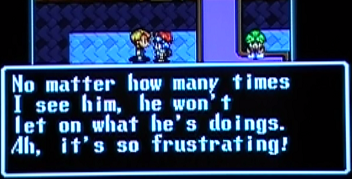
But I know what you're thinking: how bad is Robotrek's translation?  Heheheheheheheheh......... very<=(
...  It gets worse.
Sorry about the upper left corner of the dialogue box, this was while the game was under the "white bars in black background" glitch
<=O  ..................  My God!  Who was involved in the translation, Robert L. Jerauld?
This is downright embarrassing for 1994, even for your standards!  This makes not just the botched translation of Quintet's Illusion of Gaia look reasonable but the inept translation for Produce's Brain Lord look competent by comparison.
And frankly, that says a lot.  I would've thought that a better job would've been done since Brain Lord months prior, but oh, you proved me wrong.  Nothing personal, but Robotrek has got to have the worst "Jerauldslation" I've ever seen.

Quintet was a company that was going strong in the '90s, but since then they haven't frequently appeared, initially believed to have been due their company being defunct in the early 2000's.  But from time to time they have been involved in the making of some games, but with zero mention of Quintet whatsoever.  There's no telling what happened that made them go largely silent, and it's a shame because they were such a talented company--they wouldn't have their fanbase at all if it wasn't for their talent when it comes to RPG storytelling, and it's sad that we won't see any games like theirs again.  =(
Sadly in the past decade there has been a sick fixation on spoiling current-gen gamers by rereleasing Actraiser/ActRaiser over and over (the last occurrence being for the Nintendo Wii Virtual Console in 2007, by Square-Enix), Quintet's first Nintendo 16-bit game ever, and flat out ignoring the other five games Quintet made existed leaving them exclusively available to the SFC/SNES console; due in large part to the license holders' criminal negligence and greed, completely inconsiderate to the gamers who cannot afford the luxury to own a Nintendo-16 bit system.  >=(
It's shameless and reprehensible negligence like this that seriously aggravates me; they're basically saying that ActRaiser's the only Quintet-developed game worth giving a damn about because "it came out first" or "it's the more popular game" or "that it's left the largest impact" or "that it was revolutionary for its time".  Screw that crap, man, that's no excuse!  >=(  If they're using the Quintet license to only rerelease one of their games and not rerelease as many as they can, then frankly they should never have gotten their hands on the license at all.  If I was in charge of license holding Quintet's property then I would have all six games rereleased for current gamers to experience, no questions asked.

Ah, Robotrek's own xenomorph; H.R. Giger
would've been proud  =)
Had Robotrek's translation been better handled, the music better composed, the length been longer, and the personal customization not having affected the difficulty (if mismanaged) it would've been a great game; but sadly it comes up short and is the weakest of Quintet's 16-bit library as a result in my opinion.  But for what it is it's a decently solid turn-based RPG, and I'm glad I played it; even more glad because I recently beat it for the first time.  =)  I liked its goofy lightheartedness, I liked its in-jokes (i.e. "Planet Quintenix"), and the story (as wafer-thin as it is) was a bit enthralling; and considering it was made by Quintet it's funny that out of the six SNES games this is the one that doesn't address things like mortality, life, death, religion, dark complementing light, or incarnation.  On one hand it's refreshing, but on the other it's completely innocent and lighthearted so I can understand why Robotrek doesn't go for that.  It's also got a lot of innocent childlike charm and very fun characters, which also helped (except for Kotetsu who I thought for the most part was completely pointless, making only a handful of appearances).  =)

Forget the three blind mice, how about the
three blind boys instead... oh, and throw a dog
in there too
I liked Robotrek and for the most part I thought it was fun and enjoyable.  And as much as I harp on the customization I liked how you could name your robot, change its colors, and give it their own special battle attack.  It does add plenty of replay value, and during some battles you may notice how there are some capsules scattered about (and a timer in the upper right corner, and counting to zero will deplete the battlefield of all capsules); the only way to open those is using your special attack, and if you press the button at the exact moment it makes contact you'll receive bonus Megs, an item, or even completely refill a robot's energy.  There are fun moments in the game as well: like infiltrating a secret underground base, becoming a mouse exploring the vents, flying to space, exploring a haunted mansion, going to new places, and even having the ability to speak to animals.  =)  It's moments like those that I feel make up for the flaws that Robotrek has got.

This is a cool advanced society!
While it lasts it's decent fun, and knowing that I do feel bad that I don't like it more than I do now; I once stated that ActRaiser 2 was the weakest Quintet-made SNES game, but in years past I've since changed my mind on that notion (in fact I'm more into that one, personally).  The final few bosses consist of a ton of HP, so it's best to stock up on as much Cures and Repairs as you can carry; in the end I beat the game at Level 60, with all three of my robots well-equipped for battle.  Robotrek, while a good game, is not for everyone and the ability to customize will be the main deciding factor on whether you want to experience it or not.  But even if it's not among Quintet's best work there is still a lot to like about it, and the ending once you reach it is well-earned.  If you're an RPG (or Quintet) enthusiast like I am I think you'll enjoy this game enough.  If you want to play an RPG where more than one character battles at a time I suggest you go for another turn-based RPG instead.  If you want to enjoy an RPG that's got a lot of charm and replay value then this game is worth a look, even if it not might entirely deliver.  If you could care less about little issues like translation and music you'll have a good time.  Robotrek may not be great Quintet (or Ancient), but it is fun while it lasts; and if I'm in the mood I wouldn't mind playing it again.  =)
7.0/10
<(^o^)^TO EACH THEIR OWN^(^o^)>
P.S. Since I made the allusion to the series with one of the captions, I have recently watched for the first time Russell Mulcahy's widescreen Renegade Cut of Highlander II: The Quickening on YouTube (on December 18th).  Now I'm wishing I hadn't.  ={  I knew it was going to be a colossal train wreck going in, but I never realized it would be beyond awful.
 
P.S. 2
To Turbo, the staple of Quintet's games and a great trooper.  =)
 
P.S. 3 In speaking of inside jokes:
There's only so many things to say to this:
1. What?  They have ActRaiser 2 and Illusion of Gaia but no SoulBlazer?  Boooo, zero stars, worst in-game store ever!  XD
2. You know it's a problem when even Quintet manages to misspell their own game.  When everyone else does it it's not their fault; they just feel that the usage of the first "r" in ActRaiser is of little consequence.  Both versions of the second game had the first "r" capitalized, and the only time that it wasn't was in the Japanese version of the first game Actraiser.  It's not major, but it's a bit of a personal pet peeve for me.
3. Yeah, Illusion of Gaia is great and all, but if you have to play the definitive version of it then I suggest you try Gaia Gensōki instead.  I should know, I've played both versions.  =)
4. I don't get its "No Carrier" message in the end.  =/
 
P.S. 4 I gotta say, that is an awesome portable version of the SNES console in the R & D room; why couldn't those be a thing?  =(
 
P.S. 5 The glitch with the white bars in the black background: I don't know what causes it, but it's happened to me twice (once in separate playthroughs).
 
P.S. 6 Seriously?  Only one female cop, and she's in the intro cutscene?  Tenchi Sōzō had female cops in-game as opposed to just males.
 
I'm StarBoy91, and may your day shine brightly!  =)
Thank you for reading my review, my readers, please leave me a comment and let me know what you think.  Take care!  =)
Merry Christmas!!!!!!