Saturday, June 13, 2015

Bonkers (SNES) Review

Received: January 20th, 2015 / Written: June 11th-13th, 2015
Year: 1994 | Developed and Published by: Capcom
 
Hello everyone, StarBoy91 here; passionate about video games, big retrophile, and fan of all things 16-bit.  *sigh*  I suppose I have to explain myself, so here goes.  =(
7/19/22 Update: Link to page has been disabled because I've deleted it
You might recall that last April I compiled a list titled Top 13 SFC/SNES Games I'm Reluctant to Play, and one of the reasons I made said list was because I was having a hard time finding many games to talk about individually (something which I fixed months later) and I didn't want to wait a few weeks without talking about something so that's what I came up with (that's what I get for publishing stuff on my blog at infrequent periods of time).
Why do I bring this up?  Because the very game I'm going to talk about today was positioned at #12, pretty low on the list.  I've stated reasons as to why I'm reluctant to play the games, and while it's true there are some games out there that I don't feel confident in giving a go, some of the games on the list I hard time coming up with on the spot at the time because the Nintendo 16-bit machine's library is huge.  So basically I came up with the list on a whim, which is something I felt bad about considering the game in question.
 
I guess the thing I sometimes worry about when it comes to new games or games I haven't played before is if it's worth my time and if I can handle it.  But lately I thought it's pretty much best to just play said games instead of avoiding them out of worry; if it turns out in the end that I don't like it, hey, at least I can say I tried instead of second-guessing what they are going to be like.
 
So mere months after the list was made, I had considered giving Bonkers the benefit of the doubt, not just because one of the commenters on my blog (Bard Oly, if you are reading this, I'm sorry) asked me to give it a chance, but because I wanted to.  I wanted to know firsthand its quality, but there were some things that kept me from trying it sooner, but first, a little background on the show it's based on.
Image from Wikipedia
Bonkers was a Disney animated program that ran from September 1993 to February 1994, lasting only one season which comprised of sixty-five episodes.  Originally having appeared in the 1992 series Raw Toonage, this Bonkers D. Bobcat (voiced by the ever excellent Jim Cummings) star vehicle was a spinoff of that exact CBS network program; initially conceived as a show about him he actually started off as a side character alongside the classic André Franquin long-tailed jungle-dweller Marsupilami (what do you mean you don't know who he is?) while each episode was hosted by familiar Disney characters.  I never actually watched Raw Toonage (and honestly only found out about it just now), but I have seen Bonkers... a little.
 
If you were like me, you grew with tons of animated shows (Disney and non-Disney), and before I actually saw it I remember seeing commercials for it on TV (and if I recall correctly VHS tapes) in the mid-to-late '90s and I remember thinking it looked a little fun.  I eventually saw episodes of it in either 2002 or 2003 on Toon Disney (long before it got changed to what is now Disney XD) when I was eleven or twelve, and... it was underwhelming.  I didn't dislike it, as I found the show okay, but it wasn't something I felt like revisiting often.  Back then I thought, "Yeah, this show is fine and all, but give me more DuckTales, give me more The Weekenders, give me more Pepper Ann, more Goof Troop, more Gummi Bears, more Gargoyles and Rescue Rangers and TaleSpin and Darkwing Duck, more Fillmore! and more Teacher's Pet please."  Thank God for reruns of these classic shows being shown on TV back then.  =)  I haven't seen any episode of Bonkers since then, and to date no episode has been put to DVD.
By the end of 1993 the Nintendo 16-bit powerhouse had three Disney games, all made by Capcom: The Magical Quest starring Mickey Mouse (Mickey's Magical Adventure), Goof Troop (Gūfii to Makkusu - Kaizoku Shima no Daibōken), and Disney's Aladdin, all of which were good games and were fairly successful.  The reason behind it was due the Nintendo exclusivity clause Capcom abided by at the time when it came to Disney licenses, but after Disney's Aladdin Nintendo decided to allow entries from different developers so Capcom wouldn't be the only one to craft Disney entertainment for Nintendo gamers.  I say that's a good thing because Sega had far outnumbered Nintendo in this category.  =)
So, with three 16-bit Disney games under their belt, Capcom figured why not make another one based on a show.  Despite Bonkers having ended its TV run in early '94, the show's episodes were being rerun so it made sense that by the time October '94 came around Capcom crafted a Nintendo 16-bit adaptation of the show (never came out in Europe); that and fan demand.  Thing is: that October also saw the SNES release of the Magical Quest sequel The Great Circus Mystery starring Mickey & Minnie, so I'm not certain which came first.  I know Japan got Bonkers later than Mickey & Minne: Magical Adventure 2, but in the US I'm drawing a blank.  Anyway, I've dragged this preface long enough; so, remembering not being impressed by the show, does Capcom's Bonkers prove to be that rare case of an adaptation that's better than the show it's based on?  =|  =)  Personally speaking, I'm glad to say that yes it is.

Man, I knew Kirby the vacuum cleaner hated kitty
litter, but I didn't think he had it in for cats as well  =/
The game's plot is not that complex and is actually really simple, which lends it an episodic feel, but for this game it works.  The story is as follows: one night the Toontown treasures--the Sorcerer's Hat from Fantasia, the Magic Lamp from Aladdin, and the Mermaid's Voice from The Little Mermaid--get stolen without as much of a trace.  As Bonkers D. Bobcat tells his human partner Detective Lucky "Don't Call Me Shirley" Piquel (also voiced by Cummings) about the news the police cruiser crashes, leaving Lucky seriously hospitalized and Bonkers fully intact and left to solve the case all on his own.  Can Bonkers succeed in his latest endeavor?

"A little to the left"
The Nintendo 16-bit Bonkers is a sidescrolling platformer, its gameplay is pretty good and the controls are simple.  The default control to jump is B, and like a lot of platformers you can jump on top of enemies and bosses; how high or low you jump depends on how hard you push the button.  If you want to dash just press the Y button once the dash gauge is full and flashing, however the steering and traction can take a bit of getting used to without knocking into enemies and walls.  To slip inside chutes or small gaps press down as Bonkers runs and he'll roll on by.  And to attack enemies from a distance, press X for Bonkers to throw one of his arsenal (should you have any) of bombs... heheheheh, it's a good thing it takes place a cartoon world, otherwise it would be quite awkward.  <=|

"Say, do you know a fellow by the name of 'Croc'?
Yay big, green, has blue eyes, savior of Gobbos, and is in
dire need of a third adventure?"
Littered in the game are objects Bonkers may find useful, one of them being badges.  For every ten badges that Bonkers collects the projectile capacity will augment itself by one, and should you run out of said projectiles and find a box of them you'll earn back ten.  Occasionally you'll come across heart containers from The Magical Quest which will increase your health by one; in order to replenish bits of it there are donuts to consume (of course), and to fill up all hearts just eat Mrs. Beakley's cakes from DuckTales; and to gain a life you must find a Bonkers plushie (a la aforementioned The Magical Quest and DuckTales).  And by the end of each stage (and game) you're shown how long it took you to beat it (like Goof Troop).  So many references to previous Capcom fare... it seems there's a pattern going on.  =<
After the first stage you have a choice which of the next three stages you want to proceed to, which is very refreshing and a sweet breath of fresh air since all Capcom's other 16-bit Disney fare follows a strictly linear stage paths (Stage 1 to Stage 2).  In Bonkers, you can select the second, third, and fourth stages, which lends it replay value.  And on a nice Magical Quest-like charted map, no less.  =)

Rolling, rolling, rolling...
Capcom's 16-bit games have always been great to look at, even their lesser titles (*cough* Final Fight 2 *cough* *hack* Mega Man VII *hack*), and this game is no exception.  =)  Granted, in Bonkers' case the detail has taken a backseat for something a slight more colorful, but for what works it really works visually.  Some areas that stand out are the outskirts of Toontown with the building in both the foreground and backdrop, another is the mansion in the first stage where it's elegantly designed with the fountains seen in the backdrop windows and where there are nicely setup tables and occasional Donald Duck paintings (is it his mansion?), and for a last example the ship stage is visually great where it rains outside at one point until eventually you reach the freezing cooler with color-layering mist.

Bombs away
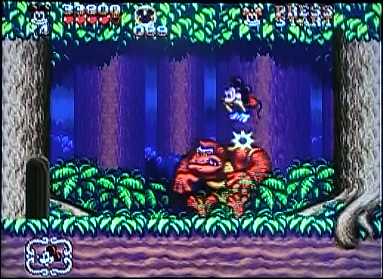
The character and enemy designs have got that trademark Capcom charm about them, which I thoroughly enjoy.  Some of the enemies you'll contend with are anthropomorphic gorillas, wolves, bats, goggle-wearing alligators, sentient candles, sentient bags, and even kangaroos to name some.  There are two occasions when Mode 7 is used: once during the title and the other during the helicopter boss fight.  The bosses themselves have got decent designs, but the final one trumps them all out of sheer ingenious levels.  Bonkers himself has got quaint design and fittingly cartoonish and fluid animation, but is it just me or does he look like an 8-bit figure turned 16-bit?  Maybe it's how small he is, I don't know; but I also like his idle and walking animations too.  =)  Also got to give props to the hat slowly following the character who ducks gag making homage to DuckTales and Disney's Aladdin; that never gets old.  =3  Oh, and before I forget, I just have to ask:
what are you?
 
Wow!  That framed Donald Duck cameo is almost
as big as the Roy Scheider photo cameo from Jaws:
The Revenge
The soundtrack really lends a sense of atmosphere to the stages, and is once again an improvement over Goof Troop's score.  The music is a bit silly and over-the-top, though given the game in question I do find that it works; it can sound a bit bombastic sometimes, but at least each track sounds less repetitive and annoying than the ones in Goof Troop, which I appreciate (despite really liking that game).  The one Bonkers song that threatens to be annoying to me is the regular boss theme where the first half sounds rambunctious in terms of instrumentation but makes up for with decent string flourish in the second half.  Everything else, in my book, works fine.  =)
 
Uh oh, a barrel; Donkey Kong must be around
Some of the standout pieces are the ship theme with the cheesy-sounding aura that's both engaging and relaxing, especially as you enter it and explore its fancy lobby.  Another one that pops to mind is the playful piano jazz melody in the very beginning transpiring in the entrance with the fountains and what presumably is Donald Duck's mansion which sounds cute.  The title theme, while brief, is playfully instrumental; and the map theme, which is my second favorite, is soothingly enchanting and takes me back to The Magical Quest.  My favorite song in Bonkers, however, is the final boss theme where it is fully instrumental and riveting, being the closest the game got to sounding epic.  =)  The sound effects are all right, and while some were lifted from previous Capcom games they're not badly selected; but whenever Bonkers sustains damage his "Ow!" sounds like a chomping sound.
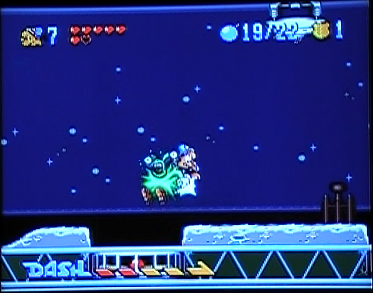
 
Pounce
Since Bonkers on the Nintendo 16-bit is a Disney Capcom title, three obvious things to expect from it are a) easy difficulty, b) brief length, and c) despite either setback it doesn't detract from the enjoyment (though I'd be remiss if I didn't say it almost becomes the case here, and I'll explain why soon).  Bonkers is non-demanding entertainment from beginning to end, with good area designs, fun and intuitive gameplay, fun boss battles, and a gradual degree of challenge within each stage while not completely abandoning its set difficulty.  Thorough exploration in specific areas can lead to heart containers and even lives, and I liked how whenever Bonkers consumes hot tabasco sauce (I think) he becomes red and automatically runs, though what was interesting was that despite being red it doesn't necessarily make him invulnerable; as one knock against him in this state will render him back to normal.
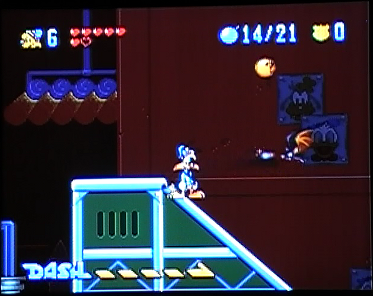
 
Tossed a bomb at a flying bat
I also liked how for the most part there was no one way to defeat an enemy or a boss, whether it be by jumping on top of them or throwing explosive projectiles at them.  If there's one blemish working against the game in this regard is that there's only one difficulty setting.  =(  It wouldn't be such a bad thing if there were more reasons to come back to it aside from selecting the second through fourth stages and certain secrets, of course; Disney's Aladdin had one difficulty setting yet there were plenty of reasons to come back to it now and again.  The Japanese version of Goof Troop, Gūfii to Makkusu - Kaizoku Shima no Daibōken, had two extra difficulty settings, which was helped by the twelve-month gap between releases.
 
Phweeeeee
Actually, when I was considering getting the Nintendo 16-bit Bonkers in late 2014, I actually considered importing the Super Famicom version as I was under the impression that it may have had more content like Goof Troop's Japanese counterpart.  Unfortunately a couple things prevented me from trying it sooner: the fact that I'm a collector, first of all, and how sometimes when I think I'll get a certain game I'll wind up getting something else on a whim because it either catches my attention or due to my sometimes indecisive nature when buying games (being a gamer is hard).  =(  The second reason was that when it comes to ordering games I like to receive them as soon as possible, but the problem was that the Super Famicom edition was not as common as the NTSC SNES cart and that it would've taken far longer for it to arrive.  So after several failed attempts at importing the SFC version (and realizing that not much would've been implemented between October '94 and January '95 for Japan), I just gave up and ordered the SNES cart this January instead.  ...Yeah, not a flattering backstory over how I got this game, I realize.  =(
 
"Lumiere?  Why are you helping the dark side?"
Lumiere: "Becuz Cupcom neveh devehlohped a
veedio game bezed on our movie."  >=(
 
Bonkers is the only Nintendo 16-bit Disney Capcom platformer outside of The Magical Quest starring Mickey Mouse where it's required to be played in one sitting, but that's not a problem since the game is not that hard anyway.  I'm not saying a game necessarily needs more than one difficulty mode to be great, but a little more would've been appreciated.  I would've gladly overlooked that if the game wasn't so short; most stages are divided in two segments, and depending on how you play it may take roughly a half hour to beat (longer on your off-day).  Some area designs are creatively set up, and there's a moment where you must be quick otherwise you'll have to open the gate again; but once you know what to do it's no longer a problem.
Something I couldn't help but notice is that Bonkers was a sidescrolling platformer with a dash gauge,...
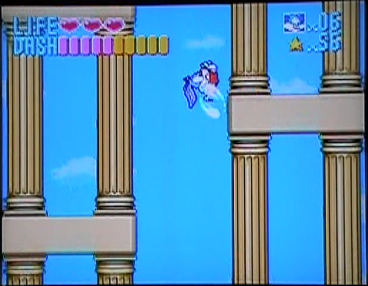
A painted over main character?  I wonder where I saw that before?  Sparkster (SNES)  No clue!
There were a couple moments when I thought the area design was similar to something from The Magical Quest and Disney's Aladdin, and maybe it's just me but Bonkers' jumping animation felt like an altered swap of Mickey's animation from the former title.
Bonkers is also a speed-based platformer where the main character is a bobcat.  Hmm... you know who else inhabited the SNES in the form of a bobcat in a speed-based sidescroller?
Bubsy!  Accolade's very own Bubsy the Bobcat.  Interesting coincidence.  I would say that Capcom successfully out-Bubsy-ied Bubsy with Bonkers...... but knowing that series' reputation and not wanting gamers to take that statement the wrong way, I'll just take the easy way out and say that Bonkers is better than the Bubsy games.  *looks around and laughs awkwardly, then looks to audience*  Can we go now?  <=(

Run away!  It's the sentient vehicle from Who
Framed Roger Rabbit!
I hope I'm not sounding like I'm nitpicking, because I actually do like this game.  =)  Yeah there were moments here and there when I was reminded of other games due to similarity reasons (and the fact that this may have been Disney Capcom at their least original), but that in no way diminished my enjoyment of the game.  My only major beef with Bonkers is that I wish it had a much higher replay value than what it's actually got.  If I had insignificant qualms to discuss, it's few; for starters, where is the credits sequence in the end?  Were the people at Capcom ashamed of their involvement in Bonkers that they wouldn't state their names?  0_O  Same thing happened in Kemco-Seika's SFC/SNES port of Zoom's Lagoon, and I'm still worked up over it.  Another is the Game Over screen (should you get it in your off-time): should you wish to continue from where you left off, you have to pretend that another character's not all that funny joke is funny.  ...Not sure that's a good message you're conveying.  =/  I forget if it was a thing in the show or not, but I couldn't help but find it off here.  Last, but certainly not least:
Oh, look!  Mickey Mouse is not showing his face, just like the show.  I know this 'cause it's really the only episode I remember from Bonkers long ago  =(
Donald Duck is in the game... sorta.  There were pictures of him early on, but during the cast portion you see him in the flesh, sleeping in his QuackShot attire.  Yes, we get it, Capcom, Donald Duck didn't have his own Nintendo 16-bit game prior to 1995.  It was bad enough we were reminded of this in four Mickey Mouse titles, but now you have to rub it in people's faces in a non-Mickey Mouse title?  Bad form!  >=(

Boy, those swordfish look pretty happy
considering they're encased in frozen blocks of
ice  O~o
Sorry, no more rants in this review, I promise.  I liked the various locales, I liked the gameplay, I liked its music, and I liked Bonkers' fluid animations and how humorous it looked whenever he took a pratfall or got stunned cartoon-style.  XD  I even enjoyed battling Bonkers' big bosses, the last one especially.  As far as how good it is in terms of 16-bit Disney Capcom, it's right at the bottom for me (below Disney's Aladdin, below The Magical Quest, below Goof Troop), but that by no means makes it a bad game.  =)  It could've been slightly longer and exhibited more content, but for what it is it's not too shabby and I feel bad about adding it to a list I feel even worse for making in the first place (especially since it's moot now).  Considering my initial reluctance I'm glad I played it eventually.
Technically in only a couple spots for Ardy Lightfoot, but I'll count it anyway
It also joins the league comprised of Tiny Toon Adventures: Buster Busts Loose!, Ardy Lightfoot, and TwinBee: Rainbow Bell Adventure of speed-based SFC/SNES games that are better than half of Sonic the Hedgehog's recent outings.  =)

Jump in!
So do I recommend Bonkers?  Well that depends on many factors, one of them being if you liked the show it was based on or not.  But all things considered, even if you had zero affiliation and/or acknowledgement of the animated show beforehand, I do think that it is fun while it lasts.  However, if you expect one of the best in the genre or expect there to be a lot of challenge or length you might come out disappointed, but if you go in not anticipating high challenge and just want to have good non-demanding fun, Bonkers is not bad to play once in awhile.  It might not have the biggest replay value out of all Disney Capcom's library, but the choice to select the middle three stages was a nice touch and depending on how you look at it may be replay value enough.  Not the greatest, but worth checking out if you're in a Disney platforming mood.  =)
We interrupt this game to bring you Yume Kōjō: Doki Doki Panic
"Trade ya!"
*BOM*
*in Dark Helmet voice* "Fooooled yoooooou!"
My Personal Score: 7.5/10
<( ^o^)^TO EACH THEIR OWN^(^o^ )>
P.S. Among "Capcom's lesser Nintendo 16-bit titles" I had considered adding Breath of Fire II to the list (personally speaking), but compared to Final Fight 2 and Mega Man VII it's not that bad and I'd actually rather play that than the other two.
 
P.S. 2 I'm so glad I found another opportunity to reference Ardy Lightfoot, as I never really find the chance to do so.
 
P.S. 3 Irrelevant: go watch Jurassic World (but not in 3D).  It's the true Jurassic Park sequel we've long awaited.  We salute you, Mr. Trevorrow.  =)
 
P.S. 4 It was hard to refrain from using that Christopher Lloyd "I WAS FROZEN TODAY!" quote for that one screenshot caption.  I feel like I may have used that meme as a joke way overmuch.
Thank you for reading my review, please leave me a comment and let me know what you thought.  I hope you have a great Summer, take care!  =)
------------------------------------------------------------
Sooooo, are they going to make out?

Sunday, April 5, 2015

My Special Easter/Birthday Review

Written: March 30th-April 4th, 2015 / Published: April 5th, 2015
 
Hello everyone, StarBoy91 here; passionate about video games, big retrophile, and fan of all things 16-bit.  It is April 5th, and today is a day that we celebrate Easter, a day to spend time with family and celebrate new life plus the resurrection of the Lord; as well as try to locate Easter eggs that are scattered about for some families.  ...............  And it is also
MY BIRTHDAY!!!!!!!!!  =D
How often does it occur that a birthday should fall on an important calendar day?  Once every several years I suppose, but even so that's awesome!  Today I am another year older, as I turn 24 (which now that I think about it, flipping it around makes it "42", which is a lucky number).  =)  It is that time of year again that I review a video game that I enjoy, and while this one in particular is not one of my favorites, it doesn't make it any less special in my book.  For those of you that may be new to this blog, I started these birthday reviews in 2013 with the SNES cult classic Skyblazer, then followed in 2014 with the SNES version of The Great Circus Mystery starring Mickey & Minnie.
For 2015's edition of my Special Birthday Reviews I had been contemplating which game to talk about, and I didn't want to discuss another game made by the same company so as to keep it fresh and unpredictable.  After a bit of time I have finally decided, I'm happy to report; and what better way of expressing Easter joy: than by reviewing one of the lesser received video game titles of the '90s?  =)
 
Received: April 13th, 2012
Console: SNES | Year: 1989, 1991 | Developed by: Infogrames
Published by: Kemco-Seika
 
So our heroes start their quest for peace
This game has got a bit of history behind it.  In 1989 a company called Infogrames (yes, as in the same Infogrames that would later make PAL-exclusive SNES platformers based on beloved European comic book characters such as Astérix and Tintin) released a little RPG by the name of Drakkhen for the Amiga and Atari ST computers, finding itself in the American market the following year by the Data East label Draconian (fitting name considering there are dragons in the game).  Back then it was very successful, and due to its success in its native systems Infogrames saw it through that they would release it on other formats; the MS-DOS, the NEC PC-98, the FM Towns Marty, the Sharp X68000, and more famously on the Nintendo 16-bit console as a Generation One game in 1991.
 
Lovely view
Gamers seemed to think it was a good idea at the time, as the Super Famicom and Super Nintendo consoles were proving to be quite powerful in their visual and sound capabilities, but the company that converted the game to this format--a duo collaboration from Kemco and Seika--may have gone over their heads, as it didn't turn out quite like many had expected, and few gamers who had owned the Amiga that experienced this console version were massively disappointed.  The SNES conversion of Drakkhen was deemed a failure by many people, right down to its execution, and it has since developed its reputation as being one of the worst, if not the worst, games you could play on the console; which is a pretty harsh sentiment to be honest, but some of the complaints geared towards it aren't entirely unfounded as I'll explain later on.  Even so, that doesn't mean it's deprived of worthwhile content.


Follow the icy path
The game takes place in the Isle of the Drakkhen, which is divided in four segments: ice, marsh, forest, and desert.  It is now threatened by four dragon kings who control nature's forces of Earth, Fire, Water, and Air; each having one son and one daughter who reside in the four segments.  The eight gems, representing all kinds of magic, have been stolen and were handed to all eight dragon heirs to the throne, and it is up to four human adventurers--a fighter, a magician, a scout, and a priest(ess)--to retrieve the gems and restore universal control to the magical Drakkhen.  Making things complicated in your journey is the fact that there are two differing groups which will either try to impede your progress or aid you.  They are the Alliance of Fire, who would rather do all that's necessary to prolong the evil ways of the dragon kings, and the League of the Ninth Tear, who sympathize with your cause and want the benevolent Drakkhen to rule once more.  The fate of the human race depends on you.

Customization time
If you're playing Drakkhen for the first time, or if you're starting anew, you have a choice to either take control of default characters or you could create your own.  And in case you are wondering if you've never heard of this game before: no, you cannot have more than one of the same class in your party.  You can, however, choose which gender each member of the foursome can be; and on the bottom you'll see some numbers, the yellow one being the one you're currently assigning to the stats (of your choice) for power, agility, intelligence, knowledge, and physique.  And since it's a customization screen, it of course means that you can assign names to your party.  I did it for the first time in my recent playthrough of it; the fighter I named Ark after Tenchi Sōzō's protagonist, I named the magician Lucca after the young inventor from Chrono Trigger, I named the scout Subotai after Conan's sidekick from Conan the Barbarian, and I named the priestess Mae... because Mae Whitman is awesome.  =)

Oh great, the giant sandworm from Planet Arrakis
is attacking again!  Where's the Kwisatz Haderach
when you need him?
Drakkhen's controls are fairly simple the more you play it, but for first-timers it may take roughly an hour or two of playing to get the gameplay down pat.  In the overworld you can move forward, step backward, or turn around in 360 degree angles from either the left or right side, and when moving it's seemingly viewed in first-person perspective with nothing but the landscapes around you.  If you press A then you'll access the menu options on the right side as well as seeing your characters on the screen, but only during static moments; should you want them to recede back to the offscreen world and exit the menu then press B.  The battles are random, and you'll know when it's time when the screen suddenly stops and your party emerges to take action on varying kinds of enemies; if you don't feel like fighting you can always tap the shoulder buttons to avert battle.  If you feel lost or are uncertain which direction you're heading, you can always access the map by pressing the Select button where it'll pinpoint your exact position and the compass is your guide with the red arrow being where you're currently facing.

Coming face to face with the first dragon prince
Inside the castles your party is visible at all times in third-person format, and the interior of these places are a collection of screens whether you enter doors in front of you, behind you, or on either side.  When battles occur (inside or out) your party attacks automatically, and of the four you only have manual control of one.  On the HUD whoever has the marker will be the one that you'll control, for the controlled member of the foursome can walk in all eight directions; but if there's nothing going onscreen then the other three will remain still.  To select a character of another class just press the Y button until the marker falls on them; if the marker is still red then they will follow you wherever you go, but if you press the X button the marker will turn blue, which renders the selected character as the only one that moves forward while the others stay behind.  Personally, I'd rather stick with the red marker, though the blue marker might come in handy in one rather optional moment in the game.

So unusual a floor design it gradually
sucks out your energy
When pressing A you have a choice to select one of nine icons on the right.  The face icon is the status and equipment screen for all four characters where you can have them change equipment, give items to other members, use or drop items, or cast magic; the mouth icon can be used if you wish to speak to any one of the dragon heirs; if you need to freshen up or have forgotten how some of the controls work then the controller icon will be your (thoroughly extensive) guide; the open hand icon can be used if you find items or equipment you can grab (such as swords and shields) inside castles; the sword icon will send you to a screen where you can set your characters' attack and defense magic (you'll know it's been activated when the MP sword on the left has got lines); the touch icon is used to press buttons or switches; the eye icon can be used to look at anything in peculiar (like tapestries); the door icon can be used to send your party immediately out of the castle if you don't wish to manually go all the way back yourself (lucky); and finally the Super Famicart icon allows you to save your progress wherever you wish (like in Ys) except during battles and while you're venturing the interiors of a castle.

Look at that sunset!  <=O
The biggest selling point of Drakkhen upon its initial release was two-fold: its 3D world and its day-night system.  The game was one of the first (if not the first) RPGs to transpire in a 3D environment, what with the lakes, grass, trees, spires, castles, and cottages scaling in and out as you approach or back away (especially when a series of them are in the same screen at once).  In this day and age the visuals have aged a lot, but in 1989 and 1991 they were like nothing that was seen before and were impressive for its time.  The Mode 7 rotating and scaling effects were put to extensive use here, allowing the ground to rotate and scale as you move plus the objects to scale possible.  During battles many foreground objects are peeled away (likely to conserve memory and power), but when nothing happens they can be a sight to behold.  The 1985 Sega arcade Space Harrier may likely have been what inspired Infogrames to brandish a 3D world, right down to the structure of some of its enemies (with the multiple layers ranging from farthest to closest, like the eagle and sandworm for example).  It's also incredible the way the environments change color the moment you step into another segment of Drakkhen Island.

Creepy environment
What I like about each castle is how depending on the region you're at they have a different look not just on the outside but on the inside as well.  Even though they are simple in terms of design, they are effective to look at in their own right.  In the desert castles there's a graininess to it that gives it a sandy feel, but the way they made the rooms have a gradient look make them genuinely feel ominous.  The ice castles also have a clever way of having an icy floor with occasional glimpses of windows looking outside.  Another great aspect is how at times the rooms will actually be dark, unless you use a torch or cast a Light magic spell; that lends the game a mysterious sense of atmosphere.  And speaking of atmosphere, one of the best things about Drakkhen is how after awhile day becomes night and night becomes day, with nice little touches such as the sunset or sunrise and the constellations and formed moon in the sky during the night.  What I like about that is how both the characters and enemies blend in to the light of day and the dark of night, which adds a lot and I like how Infogrames and Kemco-Seika went the extra mile to make the SNES game immersive (as most games would opt for the character to remain in the same color scheme regardless of how bright or dark the area is).  =)
And considering this was four years before SquareSoft's 16-bit Magnum Opus and best game in the Mana series, Seiken Densetsu 3, would hit the Nintendo 16-bit console, that's mighty impressive.  Kudos!  =D

We interrupt this game to bring you The Last
Unicorn
All the enemies have got interesting designs and are high on variety.  Some of the enemies you face are witches, will of the wisps, sentient flames, giant vector swordsmen, pink female silhouetted upper torsos, naked she-devils, cobras, mice, centaurs, and bats among other things.  A common enemy you'll fight are lizardmen, from ones adorned in soldier or warrior get-up, to naked ones who are designed in a way that I'm surprised they slipped past Nintendo of America's censors.  The real stars in this category are the dragon heirs, both good and bad, who are gigantic and animate decently, while all the other enemies animate in a choppy way.  I like the way the main party is designed in the HUD and I love how they will change appearance depending on what equipment you have them wear.  Unfortunately their in-game sprites are less impressive and look more like they belong in an 8-bit title, and their animation speed is inconsistent--when walking they animate slowly but when attacking or shooting projectiles their animation is swift.  Everything else, however, is designed remarkably well.  There are occasional moments when there's neat-looking still-shots when you enter cottages and ANAK shrines, and despite their gradient appearances they are engrossing to look at.  =)

Hooray for acceptance and tolerance!
The original Amiga version of Drakkhen had little music in it, which Kemco-Seika rectified for the Nintendo 16-bit edition, for it is the most incredible aspect of the entire game.  Incorporating electric piano and slap bass throughout, it's not like anything you've heard from other RPGs, and they do a good job of augmenting a sense of atmosphere.  =)  The traveling themes are a great listen for they fit their respective sections of Drakkhen Island well, and the best part is how the day theme will be replaced once night sets in.  Some of my favorite traveling themes are the nighttime Fire Area theme with its relaxing and wonderful melody, the daytime Water Area theme, and an appropriately cold-sounding Air Area theme at night in an icy environment.  Each segment of the island has their own individual house themes, like in the Air Area's igloos and in the Fire Area's tents.  There are a couple truly dark-sounding and thundering pieces in the game, for they are for the ANAK Shrine whenever you enter one, and the title theme which is so purely evil-sounding it can almost be unbearable to listen to; but it does set the tone for the game.

The wandering merchant approached and
offered you a keg
Each dragon heir has got their own castle theme, and they all sound fantastic.  =)  Once you enter Prince Hordkhen's castle you're treated to this mysterious yet moody theme, and Princess Naakhtkha's castle has got a menacingly cold and ominous aura (just like the character herself).  And in Princess Hazhulkha's castle there's an eerie sense of tragedy and emptiness in its theme.  In a tavern not located in the map is a jovial-sounding melody that's uplifting and unlike anything else that's heard in the game.  If anything is disappointing about the soundtrack it's the battles and the majority of the dragon heirs themselves.  =(  When a battle with a regular enemy begins the music stops and is replaced by enemy sound effects (largely grunts and groans), and when battling the dragon heirs they are accompanied by banging pots and pans, and when you put it together they all sound the same.  Every other music, though, makes up for that, and the ending and credits themes are rewarding to listen to when the game has been beaten.  =)

Time for battle!
I first heard about this game on FlyingOmelette's website back in the mid-'00s, and I remember finding some of what I've looked up on there very interesting, and some of the music I listened to in said site impressed me.  It wasn't until after she started making a shrine for it that I was compelled to give Drakkhen a personal try shortly after I turned twenty-one back in 2012, so I ordered the SNES cart along with its manual on eBay.  I did not expect a masterpiece upon playing it (being aware of its reputation), but what I got was something unique and unlike anything else I played on the Nintendo 16-bit console before or since.  And despite its issues (and there are many) I actually enjoyed it a lot during my first playthrough which lasted for the next two days.  Once in awhile I still personally enjoy playing it, actually.  =)

Fighting a wave monster right now
So where does all the hate for this game come from?  Well, there are many factors that attribute to this, namely Drakkhen's gameplay structure on the SNES.  The Amiga was a computer, which meant that it required the usage of a mouse, but because the Nintendo 16-bit edition was made before the SNES Mouse was created alongside Mario Paint in 1992 it was relegated to controller only.  But that's not so much an issue so much as the way it was handled, for every time you access the side menu you have to wait until all (live) characters emerge onscreen and if you're done with it you must wait until they leave the screen in order to begin traveling again in the overworld.  Most A-RPGs have got a simpler status screen where regardless of the character all items were collectively kept, but in the case of Drakkhen each character has their equipment, their magic, and their items; meaning that any time you want to equip a character, use magic, or use certain items you must select the right character to do all that, and if a character is starting to lose room for items they can always give it to another member or just drop it entirely; and frankly, that's just a time consuming hassle.  =|

Huh!  I didn't know Vector Man was in this
game
Other complaints pertaining to Drakkhen had to do with the characters battling automatically and the fact that walking on water will make you drown.  I can understand how some might be against the former, especially since depending on how leveled up they are or how weak the enemy is the battle would last a few seconds or several seconds or longer; and if you're not careful you might lose some health or your equipment even.  This is especially true when characters are equipped with attack magic, which must be enabled again if you turn on the game from your last saving point.  And as for drowning in water, there is a simple way to avoid that, and it's the same tactic that's used to escape from battle: tapping the shoulder buttons.  If a random battle should pop up near a body of water on either side, it's important to take that advice to heart.

"HAK HAK DRAKKHEN"
And yes, you did read correctly: it is possible to lose your equipment in this game; primarily armor, shields, and helmets.  Even when you're leveling up, if enough hits have been landed on a specific character then they may lose a bit of their equipment, and when that happens then the only means of augmenting defense and protection is by hoping a downed enemy will leave behind something helpful (for some reason), grabbing equipment inside castles, being stopped in your tracks by a wandering merchant, or by meeting said merchant in the tavern.  And when it comes to buying weapons and equipment it costs a specific amount of Jade, which most enemies will leave behind once defeated, and if you have something to sell you'll be paid a handsome amount.  But should you lose the best equipment and want to avoid being stripped to your most vulnerable bare essentials, you'll have no choice but to rely on weak outfits and shields, for at the end of the day it's better than wearing nothing to protect you.

Meeting Princess Hordkha, the good dragon
heir
The biggest problem that Drakkhen suffers from the most is that it feels incomplete, not to mention that it is sorely devoid of depth and challenge.  I never played the Amiga original, but I heard that it was difficult and complex, whilst the Nintendo 16-bit port instead veered towards being easy and simple.  For first-timers, and those who have a tendency to blindly rush through their games, it may seem very difficult at first due to its structure and gameplay; but if you know what you're doing, go at a slow and steady pace, and get the controls down pat then much of the game's difficulty will be stripped away and may cause no issue.  If any of your party members die you can enter an ANAK Shrine to revive them and restore health without paying a fee, which is unheard of.  Drakkhen is also too short, for once the first gem is collected the other ones will be gathered with ease if you play this game cautiously (and two of them are gotten at once), and before you know it the game is over; it makes for a shallow game.

Thank you for that cryptic message there,
that... helps  O~0
Fortunately, its main saving grace is that it succeeds as a tech demo more than as a game itself, plus the music and endless anomalies absolutely make this game for me.  =)  As a Generation One showcase of what the Super Famicom and Super Nintendo were capable of in terms of visuals and sound, it's actually very good, for the Mode 7-driven overworlds and areas have a style unlike anything seen in other games of the same genre at the time of release.  The electric piano and slap bass music may not seem like something that belong in an action-oriented RPG, but for all its atmosphere and moments of immersion I think it works spectacularly well thanks to its moodiness.  It also helps that Drakkhen Island is fully imbued in its own odd mystery, with a high amount of enemies including ones you do not expect (like Henri Matisse's Icarus appearing as a Shade of Doom, for instance, and for another the constellation monsters) to appear in the genre, and there is an eerie nature when it comes to entering castles that occasionally have mysterious references and clues.  It's those qualities that make me come back to Drakkhen once in awhile, and without them the game would be very forgettable.
While fellow SFC/SNES Generation One tech demoes F-Zero, Pilotwings, and Hyper Zone were received more favorably and had no problem finding their audience (well, most of them anyway), Drakkhen was given poor word of mouth and was branded as one of the worst games for the console, which honestly seems like a kneejerk reaction to me.
Drakkhen may not rank among the top echelon of Nintendo 16-bit A-RPGs such as Seiken Densetsu 3, Tenchi Sōzō, Secret of Mana, Gaia Gensōki, or even Ys IV: Mask of the Sun, and it is no great game by any means.  But I would never hate it--let alone place it among the likes of Batman Forever, the SNES port of Ultima VII: The Black Gate, or Bubsy II--and even though it's got its flaws I don't think Kemco-Seika's effort is awful.  <=(
Yes, it could've benefited itself with a lot of polish and with an easily approachable gameplay structure, and it would've been better had there been actual depth and challenge; but with that said, I think its abundance of strangeness makes up for all those shortcomings for they are part of Drakkhen's charm in my book.
 
Not the best, but far from the worst as it's
often clamored to be
Drakkhen is not an A-RPG for everyone, and if you play it expecting it to be an easy pick up and play kind of game, or if you expect it to be a game period, then you are going to very mad and disappointed in it; as initially it will seem hard but once you know what you're doing then it starts losing its difficulty.  If you're looking for a Generation One Nintendo 16-bit showcase of what visuals and sound the console was capable of presenting, then it may be a treat to behold once in awhile.  Looking for a challenging and highly polished adventure game?  You may have to look somewhere else.  Craving incessant amounts of absurdity and mystery in one package?  Then look no further than this title, and if you play it slowly and steady with an open mind, then all the better.  Drakkhen is a strange oddity among the Nintendo 16-bit RPG library; but it is a beautiful oddity.  =)
My Personal Score: 6.0/10
<(^o^)^TO EACH THEIR OWN^(^o^)>
P.S. Since I didn't want to leave any screenshots I gathered unused, I had to shoehorn them in without resorting to creating more paragraphs than usual.  It's a sacrifice I have to make to ensure that I present them all regardless of how many I procured.
 
P.S. 2 Ironically, Drakkhen still manages to have superior and more memorable music that works in and out of context than Seiken Densetsu 3 which had music that largely worked in context only.
 
P.S. 3 I absolutely love how regardless of which angle you come from the entrance of the castles and houses will always be right in front of you.  =3
 
Thank you for reading my special Easter/Birthday review, please leave me a comment and let me know what you think, and feel free to wish me a happy birthday and/or a happy Easter.  Hope you have a great day, take care  =)  And until next time
 
I'm StarBoy91, and may your day shine brightly!  =)
HAPPY EASTER!!!!!!!!!  =D
-----------------------------------------
Unlike most sequel baits that went nowhere at least this one was more honest...........ish  =/