Friday, August 7, 2015

Tokyo Disneyland: Cinderella Castle Mystery Tour (GB) Review

Received: November 26th, 2014 / Written: August 4th-7th, 2015
(As played on the Super Game Boy)
Year: 1995 | Developed by: GRC | Published by: Tomy | [|O|]
 
Hello everyone, StarBoy91 here; passionate about video games, big retrophile, and fan of all things 16-bit.  I think it's high-time I ask you all a very serious question: who loves sequels?  =D  ......or rather, tangentially connected spiritual ones anyway?
 
This game was ghoulishly good fun  =)
In late 1994 the Super Famicom received a Mickey Mouse-licensed platformer, Mickey no Tokyo Disneyland Daibōken, a game made by GRC and published by Tomy that actually transpired in Tokyo Disneyland.  In it Mickey Mouse had an unlimited arsenal of balloons--both air- and water-based--that helped him keep going and progress further as he battled Pete's cronies and Pete himself in well-known rides and segments of Disneyland; like the Pirates of the Caribbean-themed Adventureland, the surrealistically futuristic Tomorrowland, eventually culminating itself in Cinderella's Castle.  But because the titular location would've been inaccurate had it been released outside the Land of the Rising Sun, the game sadly remained there.  =(
 
Actually challenging Disney fare, but still a
solidly good game in its own right
I have a lot of fond memories of Mickey no Tokyo Disneyland Daibōken as it was not only the second Super Famicom cart I imported in the Summer of '12 (after the really fantastic Alcahest), but I also consider it to be a really enjoyable Disney game.  While it may not equate in quality to the 16-bit trilogy of Mickey Mouse's Magical Adventure platformers made by Capcom, his Tokyo Disneyland adventure was a delight to play and it did a nice job of transporting you there.  =)  What set this one apart from the other Mickey Mouse platformers at the time was the fact that it was actually quite challenging, part of it being attributed to the way the alright balloon controls were implemented, which I found rather refreshing after all the Disney Mouse games that were fun but admittedly on the easy side.  Its locales were immersive, the gameplay was fun despite its slight imperfections, it had a magical lighthearted charm going for it, it looked and sounded good, and it bookended itself with the best fight against Pete ever!  =D
 
To this day I've still never been to either Disneyland or Disneyworld, but I hope that one day that'll change.  Mickey no Tokyo Disneyland Daibōken for a while was the only real game I played that took place in Disneyland, but upon curiosity last year I decided to go ahead and try another Tokyo Disneyland game, which just so happened to be made by the same company which just so happened to star the same main character which just so happened to share the exact balloon controls (to some extent, anyway).  Ladies and gentlemen, GRC's spiritual 1995 handheld follow-up: Tokyo Disneyland: Cinderella Castle Mystery Tour.  Wow, that's a mouthful!
 
In Tokyo Disneyland Mickey and friends are preparing something special for the tour, but just as they are in the planning phase Mickey's pet dog Pluto gets dognapped and disappears.  Mickey asks that his yellow pooch be returned, but he's told that the only way he can get Pluto back is to enter inside the Cinderella Castle and defeat the forces behind it all.
So to ensure that Mickey does not go unprepared in his newest venture, Minnie suggests that Mickey pack a dual helium/water-pack with his neverending supply of water and air balloons; just like the spiritual Super Famicom predecessor.
So not only did GRC make the same game with the same balloon-natured controls, but they both share the same story pretty much?  Minnie's in the intro of both and evaded kidnapping, and Pluto is saved last both times; the only difference is that these are the only main characters this time around and Pete is not responsible for any of it.  =/  ...right.

"Take that!"
In Mickey no Tokyo Disneyland Daibōken the Cinderella Castle was the very last stage that you got to play in, but in this spiritual sequel the entire game transpires in this not so friendly locale.  If you've never played the game and are curious as to how it plays, the controls are as follows: you move left or right with the Control Pad, to look above or below you (ducking) hold down the up or down respectively, and you use the balloons with the B button; to throw regular water balloons you just press it once, to drop or place big water balloons on a button you press down and B simultaneously, and to fly upward (or glide in any direction) with the helium balloon just hold up and B at the same time until you let go by... letting it go.  When doing the very latter action just make sure you have enough air in your gauge to make it to a hard to normally reach target.
From time to time in each area there are doors you can enter, some leading to the next progressive segment of the area, some leading to exits and/or different rooms, and others leading to (mid)boss fights.  But there are a few particular doors to take note of: if you take the white mirror door, you'll be led to a room where the mirror gives you advice; the black mirror door is not all that friendly; and certain rooms have a character for which you can shop for items with... umm, chocolate chip cookies?  Crackers?  I don't know exactly, but some items you'll find useful in your journey (should you afford and/or find them).

"Hi ghost!  Bye ghost!"
One thing that's very apparent in this game compared to the previous Tokyo Disneyland platformer is its structural layout.  The Super Famicom game focused mostly on being linear, with some branching paths to discover once in awhile; while the spiritual Game Boy follow-up is a bit less than linear unless you're familiar with each areas' layout.  What I mean by that is that since most doors have no symbols on top of them, it's not immediately clear which one will lead to the right path or even which ones will take you to the end of each area.  Each stage consists of two different parts (the stage boss being fought at the end of the second part), and what's interesting is that even if you finished the area in your playthrough you can still go back and revisit it if you wish.

What kind of a tour is this that has sentient
suits of armor trying to endanger your life???  =|
There is a reason for that, and it largely amounts to how you'll stumble across very important items in the game that you can gather in your inventory, accessed via the Select button.  This is actually necessary to prolong your survival and find items that you had no access to before, so make sure to keep an eye out.  On the normal difficulty setting you start with considerably low health and a small balloon gauge, but if you manage to find (or earn) hats with Mickey Mouse ears (I think?) and a couple balloon icons you'll be able to augment your HUD on both counts.  =)  Oh, and be sure to collect those... (bags of) cookies(?) for when you buy things in shops, as they act as your currency.

There's something strange in the neighborhood,
who you gonna call?
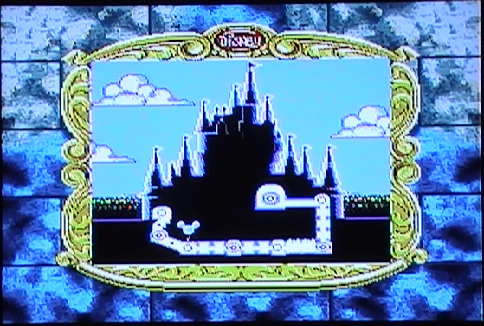
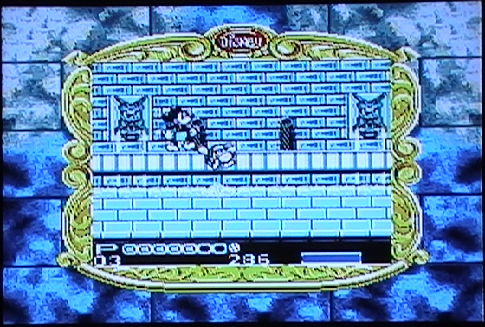
Considering the Game Boy's limited technical capabilities, Tokyo Disneyland: Cinderella Castle Mystery Tour has got some of the most incredibly in-depth visuals I've seen on the handheld and it actually looks very great too.  =D  What's cool is that virtually every area has got their own distinct look about them with each subsequent area rarely looking anything like the last.  What especially helps as far as I see is how Cinderella Castle's rooms have got a myriad of wall patterns, with just enough touches of the lighter and darker shades to create a neat sense of lighting and shading.  This is also true of slightly darker rooms and ones that have got lamps.  =)

Fire drakes to be encountered as well
Some of the patterns you see on the walls are bricked ones, others might be made of solid rock, and most times the décor is cleverly designed.  Occasionally, to prevent the wall from being the only thing your looking at, there are lights (which actually emanate light around them) and some objects on the wall, like chains and shields to name a couple.  The handful of times that you find yourself outside the castle might not exactly have all too detailed skyline, but at least the exterior shots are pretty.  It's even better when played on the Super Game Boy peripheral cartridge on the Nintendo 16-bit console, which has different preset monochromatic color schemes for pretty much each room you enter, with a gradient border surrounding it with all the action contained within a neat golden frame.  =)

Enemy goon incoming
Admittedly, if everything was detailed in this monochromatic game it would be hard to make out the characters and enemies, so at least GRC made it easy to tell where the foregrounds and platforms were as well as what said characters and enemies looked like thanks to their simpler designs (by comparison), which is a fair visual balance.  Mickey looks and animates greatly here, with much of his walking, jumping, ducking, and ballooning being lifted from Mickey no Tokyo Disneyland Daibōken to solid effect, albeit looking like he popped in from a Kemco-fied Mickey Mouse game.  =)  The cinematic stills are fun to look at, and the roster of enemies you fight are decent-looking too: such as ghosts, fire drakes, spiders, crows, living suits of armor, and even mimic chests.  The (mid)bosses are designed good as well, like the queen turned witch from Snow White and the Seven Dwarves, the boss with the ghosts in the crypt (being preceded by footprints walking downwards to let you know they're coming), the huge dragon boss, the Horned King, and you even (optionally) fight
the one and only Maleficent, who makes a great entrance!  =)  Oh yeah!
 
Creeeeeepy  O~o
The music is good in its own right, and considering its sound quality and the instrumentation of their songs they do a sufficient job of lending atmosphere to a world already brimming with plenty of it.  =)  The Disneyland theme park cue sounds fun in Game Boy format, and works just as perfectly as a way of bookending the game as it is of introducing the title.  The shop theme is playful and fun, the white mirror theme is engaging and welcoming, and the black mirror theme is slightly discouraging (maybe appropriately so), but the real selling point in this aspect is the music for the interior halls of the entirety of Cinderella Castle.  Some of them are of the upbeat variety, but others sound sinister and intense.  The regular boss theme sounds okay, but the best battle theme is the one that plays during the (decisive) second form of the final Horned King battle.
 
No, I missed his head by this much!  =(
Cinderella Castle Mystery Tour has two difficulty settings going for it, and both are substantially different to a certain degree.  The normal difficulty mode, as aforementioned, begins with a small health of five and a small balloon gauge; while the practice mode has you start the game with a full level three balloon gauge with a health of ten, thereby beginning with a small bit of percentage in your inventory.  Other differences include how many balloons it takes to take down enemies and bosses alike, and the normal difficulty (should you find the important item that unleashes the Horned King's true form) has got the full ending with the fireworks on display.  Aside from those small differences though, really, the difficulty honestly feels pretty much the same regardless of the mode you choose: easy.  =<
 
You must be wondering by now why I keep referring to this game as a spiritual follow-up as opposed to just a direct one to Mickey no Tokyo Disneyland Daibōken on the Super Famicom, despite the very similar elements.
It's basically for the same reason why Quintet's Gaia trilogy of games are considered to be spiritually connected to each other and not direct: and that is despite the handful of subtle elements that tie them together, they are otherwise their own separate entities and can be viewed as such.
 
Take me away, Marahute!
Even though both platformers star Mickey Mouse and have got balloon-natured controls to help you progress, really the only thing that connects the two (aside from the same developing team) is the fact that they both take place in Tokyo Disneyland, or more specifically its Cinderella Castle--which the spiritual Game Boy follow-up has for the bulk of the setting as opposed to the Super Famicom game where the titular area is only in the very last stage.  I'm not saying it makes the game bad if the connection is more indirect, but the point I'm trying to make is that even if there are a couple elements that tie the two together they can still be played and/or enjoyed as I feel it doesn't bring too much attention to the preceding spiritual game to the point of being distracting, which is good.
 
Funny story: months before I imported this game, last Summer I imported Tokyo Disneyland: Fantasy Tour (presuming it was the platformer), under the previous presumption that the original Game Boy had a single Tokyo Disneyland game.  But imagine my immediate surprise when I found out that there were twoXD
Tokyo Disneyland: Fantasy Tour is a series of mini-games made by TOSE and published by Tomy in 1998, and one day I might cover it.  But if you were curious about and wanted to try Cinderella Castle Mystery Tour but could only identify it by cart, go for the one with the orange and chartreuse background.  But from what I noticed it's not as common as Fantasy Tour, so keep an eye out for it.
 
The first time I played Tokyo Disneyland: Cinderella Castle Mystery Tour my initial reaction, considering how much I enjoyed the Super Famicom game, was that of a mixture of satisfaction combined with disappointment.  But after that first time the spiritual Game Boy sequel began to grow on me and I like it quite a bit.  =)
Mickey no Tokyo Disneyland Daibōken was a very enjoyable game, and part of what made it enjoyable was the widely spacious areas to explore and all the cool tricks you could do with the balloons, especially launching yourself sky high through any of the eight directions.
The initial disappointment with Cinderella Castle Mystery Tour had nothing to do with expecting it to be just like the tangentially connected Super Famicom predecessor, as I knew it was going to be its own thing; yeah, I was a bit sad that that the super balloon throwing and balloon zipping controls were no longer put into effect, but I got past that. =(  But I understand why the controls were simplified: the Game Boy's aspect ratio is considerably smaller than that of a Nintendo 16-bit title, and the areas this time around were smaller and simpler by comparison. 
But by doing so the challenge level was reduced to the point of being easy regardless of the difficulty setting you played, which I began to not mind after awhile.  No, the real thing that drags it back, however, is that it is incredibly short.  The Super Famicom game was at least around two hours long, but this Game Boy title is around thirty minutes in length; frankly that's quite a stark contrast.  Still, I like it for what it is and I do find it fun to play while it lasts.  =)
I liked that the final boss paid a neat homage to The Black Cauldon, and while the Horned King may not have been as epic a battle as that of Horned Pete from the game before it, making up for that was how cool Horned King's second form was (if you got the vital item that makes you access it), brief though it may be.
What I especially appreciated about GRC's spiritual follow-up was how once in awhile there were callbacks to their Super Famicom game; I liked that they brought back the ice-laden room near the end where the only way to cross was by freezing water balloons on the icy spikes, one by one if you had to.  =)  What was also neat was the return of certain enemies, such as the mimic chests and the skeletal warriors.

The outside, it's refreshing
Tokyo Disneyland: Cinderella Castle Mystery Tour is a fun game in its own right, and while it doesn't hold a candle to the preceding Mickey no Tokyo Disneyland Daibōken in terms of overall quality and challenge, it is good despite its shortcomings.  But as fun as it is, its brevity ultimately is what holds it back from being great, and had there been a few more areas to venture in it would've greatly benefited the experience.  Either way, I liked perusing what areas were available and discovering what you could find when searching thoroughly; and I especially liked how the Super Game Boy added so much with its preset color schemes.  What's even cooler is how once in awhile you would meet up with notable Disney characters--even Marahute (what do you mean you don't know about the Rescuers' Down Under sequel?  You need to watch more '90s Disney movies... the good ones).  =)

Ummm, reflections don't work that way  =/
If you wish to play a good Disney platformer on the original Game Boy then Cinderella Castle Mystery Tour isn't a bad choice to play; not only that, but as far games starring Mickey Mouse games go in said format this is the best one out of all of them in my book (better than anything Kemco Mickey).  If you're craving a long game that's got lots of challenge, you're not going to find it here; but if you're in the mood for non-demanding fun then I'm sure you'll have a good enough time with it.  =)  I've never been to Disneyland, but the game gives a cool idea of what its like,... or rather one of its areas.  It's a tour worth taking.

My Personal Score: 6.5/10
<( ^o^)^TO EACH THEIR OWN^(^o^ )>
P.S. As far as games that are also celebrating their twentieth anniversary are concerned: there's Tenchi Sōzō/Terranigma too!  =D  ......... aaaand a certain Mickey Mouse platformer I still need to talk about.
 
P.S. 2 I wish I came up with the anniversary ribbons years ago.  =(  There were opportunities I could've taken advantage of certain games I reviewed on their anniversary years in years past but I didn't.
 
Happy 20th Annivesary,
Tokyo Disneyland: Cinderella Castle Mystery Tour!  =)
---------------------------------------
Thank you for reading my review, please leave me a comment and let me know what you thought.  I hope you have a great Summer, take care!  =)
---------------------------------------
"Once I destroy my number one enemy and conquer the planets of the entire universe, I, Lord Hater, will become the GREATEST IN ALL THE GALAXY!!!!!"
;-)  That was for the Wander Over Yonder fans  =D

Saturday, July 25, 2015

TwinBee Portable (PSP) Review

Received: September 3rd, 2011 / Written: July 25th, 2015
Year: 2007 | Developed and Published by: Konami | [|O|]
 
Hello everyone, StarBoy91 here; passionate about video games, big retrophile, and fan of all things 16-bit.  =)  And I think it's about time I discuss one of my favorite video game series via the PlayStation Portable compilation TwinBee Portable; but first a little backstory.
 
In 1982 Namco developed a vertical coin-operated shoot'em up named Xevious, where the object of the game was to shoot and drop bombs on the targets below you and... well, that's it really, nothing more complex than that.  It fared well back in its initial release and is regarded in a few circles as an important title in video game history, but personally speaking Xevious was never really my favorite as I found it to be quite dull, boring, and repetitive and I don't think it's aged all that well.  But just because I don't like Namco's game it doesn't mean that I wish it doesn't exist, and if people like it then that's cool, different strokes for different folks.  And besides, if not for that, we wouldn't have TwinBee in the first place.  =|
 
System: Arcade | Year: 1985
Three years after Namco's coin-op Konami decided to make their own Xevious with the same controls albeit in a more colorful and lighthearted fare.  What helped significantly is that TwinBee had secondary power-ups that would aid your gameplay and keep things fresh, which Xevious simply lacked.  In the series you take control of the titular anthropomorphic bee-shaped jet TwinBee (or WinBee if you're the second player), as you must take down a horde of enemies in flight.  Every now and then you'll come across clouds, and when you do shoot them to make bells pop up, and should you shoot the bell just enough it'll change color; and depending on the color it is when it falls on you you'll get a different power-up (i.e. speed, double).

A few power-ups can also be found after having dropped a bomb on enemies at ground level, such as fruit, three-way ability, and a star to wipe out all onscreen enemies.  What makes this series especially different from other games in the genre is getting shot won't necessarily kill you (unless it's in the center) but take off one of TwinBee's (or WinBee's) arms; and if you're armless then an aerial ambulance will pop up which will restore you full (when you get to it) the first time it happens in your current life (won't start again until after you lose one).  At the end of each stage is a boss battle, and defeating it will grant you access to the next area.

TwinBee is a very fun game and a really solid start to what would become a great series.  =)  After enjoying its successful arcade run it would be ported to many consoles such as the MSX and Famicom and even garnered a 3D Classics edition of it on the Nintendo 3DS in 2011, but it remained a Japan-only game up until the 2007 Nintendo DS compilation Konami Classics Series: Arcade Hits came out, oddly enough named RainbowBell for America while the European version retained the real title.  Odd.  =\

But no matter, its 1985 success led to two Nintendo 8-bit console sequels: Moero TwinBee: Cinnamon-hakase wo Sukue! (Stinger in a rare occasion when American audiences got to play a version of any game of the series during its heyday) in 1986 and TwinBee 3: Poko Poko Daimaō in 1989.  When Konami saw the success their cute'em up series was enjoying up to this point, they decided to craft another TwinBee arcade game.

Alternate Arcade Title: Bells & Whistles [|O|]
System: Arcade | Year: 1991
Taking place after the events of the original TwinBee, Detana!! TwinBee (reportedly renamed Bells & Whistles in a limited European release) not only updated on the Xevious-styled controls set by the original game, but it also became a pivotal and important entry in the series in 1991 (my birthyear, yay!).  The TwinBee and WinBee jets were redesigned completely and became what we associate with the series today (thanks to Shuzilow.HA's involvement from this TwinBee onward), there's loads of lighthearted charm sprinkled throughout, and for the first time in the series there were brief cutscenes between each stage.  =)
But those were the icing on the cake.  The areas looked great thanks to the pastel-toned visuals, the bosses were different and involved interesting strategies, holding down the fire button until the gauge became full would unleash a massive (cleverly TwinBee-shaped) barrage of fire, and GwinBee (introduced in Moeru TwinBee) got put to great use here; if you latched on to the green bee you could augment your firepower (so long as he's not been taken out).  What's also neat is how once the first mode is done there's a second much harder quest that follows and will eat up lots of credits.

Detana!! TwinBee is a really good cute'em up, and it is a very likably charming game all throughout with very intuitive gameplay to back it up.  =)  It did so well that Konami ported it to the Sharp X68000 and the NEC PC-Engine, the latter of which got released for the first time for America and Europe on the Nintendo Wii Virtual Console in 2009 (and it was how I first experienced the cute'em up before importing this compilation, making my foray to the series; it's good for what it is, but the original arcade version is superior).  It's easy to see why many gamers clamor this to be one of the top quality titles in the franchise, plus the Shuzilow.HA-influenced anime style is really appreciated.

This was a really good point in the series, with several entries waiting to be made (both cute'em up and spinoff) as well as an anime and radio drama series afterwards.  Of course, Detana!! TwinBee was great and all, but could the very following arcade entry top it off in terms of quality and fun?

System: Arcade | Year: 1995
Made in celebration for the tenth anniversary of the original TwinBee, TwinBee Yahho!: Fushigi no Kuni de Ōabare!! follows the events of the previous games and anime/radio drama series, with voice clips being used occasionally.  What I liked was how you got to see the profiles of the characters talking in the middle of each stage, and because it's only for a second or two it doesn't detract from the gameplay at all.  And speaking of gameplay, Konami's pulled off a lot of intuitive gameplay modes for this installment.  =)
Any time you use up a credit you have a choice of which attack function you want: the supercharge shot from Detana!! TwinBee, the rock'em-sock'em extendable punching gloves, the chibi bomb from the next cute'em up in the compilation I'll talk about, and homing targeting bombs; it really gives TwinBee Yahho! a sense of variety.  GwinBee is back, and this time you can swing him around until you let him go in which case he ricochets off each side of the screen taking down onscreen enemies.  Sometimes after a ground enemy has been ousted they'll leave behind a side weapon which TwinBee or WinBee can carry on either arm (like the flamethrower and the four-way shot, to name a couple examples).  And there are three difficulty choices (Practice, Normal, Special) to increment even more replay value.

TwinBee Yahho! is an incredible cute'em up that's got lots and lots of replay value, it's bundles of fun, its adorable lighthearted charm is enjoyable, and is the most visually impressive in the series.  =)  I just adore the look of each area (the mines spring to mind) and the way the effects were done, particularly in the third stage where it shifts from top-down ocean to side view the ocean on the bottom side while the sky and clouds can be seen even for an instant.  There are even cameos from Michael and Koitsu!  ...  Oh, they're obscure Konami characters, mainly playable in a Parodius game or two.  On the PlayStation One and Sega Saturn Yahho! got bundled together with Detana!! TwinBee (only in Japan though), which I think is a good choice as they go well hand in hand together.  =D

TwinBee Yahho! is tied not only as my number one favorite cute'em up I've played (aside from Star Parodier) but also tied as my number one favorite TwinBee game of all time.  =)  But let's backtrack just a little: while the series was still doing good in the early '90s, what game propelled the franchise to inspire both an anime and a radio drama, you must wonder?

System: Super Famicom | Year: 1993
Now I know what you're wondering: "Hey, wait a minute, what's a Nintendo 16-bit game doing in a compilation for a non-Nintendo system?"  Well, the reason behind that is twofold, the first one being that it's the property of Konami, they can do whatever they want with it... actually, that doesn't sound all that positive now that I think about it.  =(  The second is the fact that Nintendo 16-bit games have a tendency to have arcade-like visuals and can seem and feel like an arcade game (depending on the title), so it's understandable how those games would be accepted and get away with being on non-Nintendo systems.  That's basically the same reason Capcom's Super Ghouls'n Ghosts is available on Capcom's compilations along its two older brothers despite its Nintendo 16-bit origin (aside from the then trilogy being incomplete without it).
Anyway, Pop'n TwinBee is that game that ties with TwinBee Yahho! as my favorite in the series (and the main reason I imported the compilation), and true to its predecessors' origins it's got that lighthearted arcade charm and feel the TwinBee games are known for.  Konami's 16-bit foray to the series distinguishes itself from its fellow kin for various reasons: you actually input your name as you start the game, you cannot add anymore credits in the compilation (lest you stumble across a fairy), and each credit comprises of one life.  No longer do you lose arms in Pop'n TwinBee, but you do lose health which can be replenished slightly once you grab a heart item found after every several ground enemies have been taken out.  The gameplay is really great and the locations you fly to are well-chosen; particularly in the deeps of the water, above the soaring clouds, the land of toys, and China.  =)
Pop'n TwinBee is one of the greatest from Konami in my opinion, and one of my personal favorites.  The music is fantastic and atmospheric, the gameplay is solid and versatile, it's got seven difficulty settings (eight if you enable a code), and the pastel-toned visuals are a delight to look at.  I loved it so much I decided to import the Super Famicart last year (just to see what it would look like on my TV); it's also a game where you actually deflect projectiles with your punch and one where panda avalanches occur, how often do you see that in the genre?  =D  Well-received in its initial 1993 Japanese and European release, Konami decided to make these continents relive the experience via the Nintendo WiiU Virtual Console service in 2014 (alongside its platforming spinoff/follow-up TwinBee: Rainbow Bell Adventure).  Us Americans, however, are still disallowed from experiencing it without resorting to import despite currently being in the 2010s.  =|

I know America, Europe, and especially Japan live by different cultures, have different tolerance levels, and have different sensibilities when it comes to certain stuff, and how standards change within each decade; but I just don't understand Konami's unwillingness to rerelease Pop'n TwinBee here in America this decade (you'll introduce Americans to the PC-Engine Detana!! TwinBee but you won't introduce this game?).  I checked every nook and cranny, and I just don't see what could be so objectionable as to not let America join in the fun (I mean, if Europe is okay with it, why not us?).  This isn't like the Parodius series where I understand why America never got them (American eagle enemy and satirically over-the-top zaniness that occasionally pushes boundaries).  It's charming, harmless, lighthearted, escapist fun!  =(
But then, I probably shouldn't be surprised at this point.  This is, after all, the same company (living in the past) who doesn't have any recollection of their creation (Sparkster), denies rereleasing the trio of games to gamers who do not have the original format to experience them for the first time (despite not being based on a licensed property), uncharacteristically disregards and abandons that character, and has no plans of any kind to make any more games with him (and if they're asked, just let another company do it for them, because that worked so well).  -_-

I know those three games didn't do that good at the time, but all of them have a cult followingSurely that would get their attention at least?  Nope!  Ditto for the Gaia trilogy and the selfish ActRaiser-obsessed Quintet license holders (if they still exist, anyway).  In the very small off-chance that you've been holding your breath this entire time for these games' rereleases, you can stop now and save up for the original two-and-a-half decade-plus console (if you don't already own it), 'cause I'm sorry to say but that is not going to happen=(

*sigh*  I'm sorry, I trailed off.  Last game!  After TwinBee 3: Poko Poko Daimaō and before Detana!! TwinBee there was another game that Konami made a small entry that kicked off the '90s for TwinBee.

Alternate Game Boy Title: Pop'n TwinBee [|O|]
Original System: Game Boy | Year: 1990
Remake System: PlayStation Portable | Year: 2007
Funny story about this one: in 1990, back when the original Game Boy was going strong, Konami decided to make the sole individual handheld iteration of the franchise TwinBee Da!! in Japan, which essentially is a remake of the original TwinBee.  When it came to the Nintendo 16-bit Pop'n TwinBee Konami's European distributor Palcom thought that that would make for a good series name for the PAL market (despite Detana!! TwinBee's European counterpart Bells & Whistles preceding it). 
On one hand, I can see how they thought that giving it that name would be a good idea; on the other hand, it did not come without consequence: as four years after the Japanese debut, the European version came out with the same exact title as the 16-bit cute'em up that came out a year prior.  It wouldn't be a bad thing if either game was not specific or was the same game, but that's the problem: it wasn't the same, which led to people not knowing any better being confused.  I mean, can you imagine if Super Mario Land was given the same title as Super Mario Bros. despite both being different games?  There would be an uproar!  D=
Flashforward to this compilation seventeen years after the original Game Boy edition, and TwinBee Da!! would be given the PlayStation Portable treatment.  So in the long run this is a remake of a remake of the original, and boy is it a great remake!  =)  I only played the TwinBee Portable version, but it does make me want to give the Game Boy edition a try because as it is it's a very enjoyable cute'em up.  While it uses music from the original TwinBee, this is the crystal clear-looking game in the compilation, and the gameplay is smooth and versatile.  Despite everything happening so fast it's the most manageable of the five TwinBee cute'em ups, and because it came out before Detana!! TwinBee you get to see both TwinBee and WinBee in their pre-Shuzilow.HA forms, which feels slightly weird but adequate.
Like most games you lose your arms and die if you get shot straight at the core; but this time around if you lose a life you'll regenerate but if you reach your soul before it flies offscreen you'll retain the power-ups you had before you died (a la TwinBee 3).  =)  Now that's pretty cool; advantageous, sure, but cool nonetheless.  The worlds look colorful and lighthearted, and many bosses have neat designs (especially the final one); plus reaching the end can be rewarding.  TwinBee Da!! may be surprisingly short (at around twenty to twenty-five minutes) but it's fantastic fun while it lasts.  =)

The fact that the series lasted for over a decade, including a platforming (TwinBee: Rainbow Bell Adventure) and puzzling (TwinBee Taisen Puzzle-Dama) spin-off, is rather impressive and the fact that it was at its highest peak back then meant the series could do no wrong.  But then Konami had to bring it to an end.  =(  In 1998 the PlayStation One received one more TwinBee spin-off simply titled TwinBee RPG, and considering TwinBee also had a radio drama there was no doubt that there was material to work from.  However it received mixed reviews, not going at all like Konami planned, resulting in it being their last physical solo game of the series, thus officially ending the TwinBee reign after thirteen years.

Notice that I said "officially" since technically there have been games made since, mostly for phones, including a Mystery Dungeon-themed game, as well as a pachislot machine.  And of course there's the PlayStation Portable's TwinBee Portable that I've covered today, but officially speaking the series truly ended in 1998; all things considered, though, TwinBee had a good thirteen-year run and it lasted slightly longer than the Jaws franchise did.  =)
TwinBee Portable is a very fun compilation to go back to every once in a while.  The games are well-selected and a lot of fun, the ability to set up how many lives and how easy or hard you want each individual games to be is a plus, and I like how you can choose the size of the game's screen (original is the best option).  I especially love the inclusion of a music gallery where you could listen to all the songs from the games, even ones from the Sharp X68000 version of Detana!! TwinBee that sound absolutely beautiful (despite said version not being available to play).

I love how colorful the TwinBee cute'em ups are, I love how charming they are, I love how manageable yet challenging they can be in their own right, I love their lightheartedness, I love their fun quality, and basically I just love them, I can't help it, they make me feel happy.  =)  I know not everyone feels the same way about the series, and I do understand; but I just can't get enough of these cute'em ups, and because it both had been years since I had previously gotten a PSP game and the fact that I was at the point where I wanted to start importing games in 2011 I'm glad I got the opportunity to order TwinBee Portable.  In my opinion it's one of the best compilations I've played, right next to Namco Museum Volume 1 which is my number one.  =)

I hope I gave a good description of each of these games (summaries are my weakness) and of this collection itself, for I absolutely love it.  If you're in the mood for lighthearted/feel-good cute'em ups there are so many to recommend, but if you want to play them all in one package then this isn't a bad choice.  It's fun, it's quirky, it's lighthearted, it's engaging, it's colorful, it's got just the right amount of challenge with a good balance.  What more could you ask for?  =)

My Personal Score: 10/10
<( ^o^)^TO EACH THEIR OWN^(^o^ )>
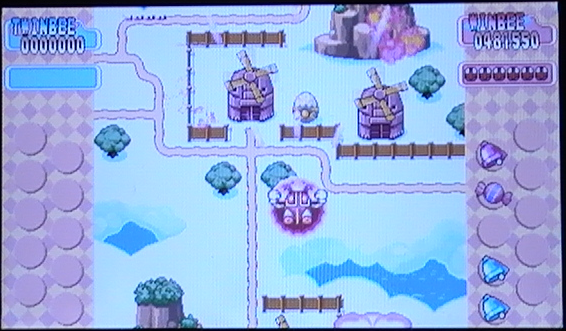
P.S. Surprisingly the snaps I got from using my camera on the PSP turned out a lot better than I had anticipated.  =)  I'm glad about that, because I was worried they were going to look awful.
 
P.S. 2 I don't know what I love more: the fact that Konami actually used both regional title designs for Pop'n TwinBee (in-game having the Japanese original), or the fact that the European title design was used twice?  XD
 
P.S. 3 I hope to go more in-depth with the games individually someday, but right now I'm good with what I covered.  =)
 
P.S. 4 You know what other Pop'n game is great?  Magical Pop'n!  Great platformer!  =)
 
P.S. 5 I was wondering if I'd ever hand out my anniversary ribbons to any of these games again any time soon, it's been so long since the last time.
 
Happy 20th Anniversary, TwinBee Yahho!
Happy 25th Annivesary, TwinBee Da!!
HAPPY 30th ANNIVERSARY, TWINBEE!  =D
-------------------------------------------------------------------
Thank you for reading my review, please leave me a comment and let me know what you thought.  I hope you have a great Summer, take care!  =D