Friday, July 8, 2016

Dragon's Curse (TG16) Review

Written: July 4th-8th, 2016
Alternate Title: Adventure Island [|O|]
Year: 1990 | Developed by: Hudson Soft
Published by: NEC | Licensed by: Westone

Hello everyone, StarBoy91 here; passionate about video games, big retrophile, and fan of all things 16-bit.
Wonder Boy flyer image from Wikipedia; happy 30th anniversary Wonder Boy (and Adventure Island)
In 1986 a newly formed company called Escape developed the arcade sidescrolling platformer Wonder Boy which was published by Sega.  While the developer owned the rights to the game Sega owned the rights to the names, characters, and bosses.  This is relevant because when it came to the Nintendo 8-bit conversion Escape teamed up with Hudson Soft when it came to the Famicom conversion in 1986 with altered designs and names Takahashi Meijin no Bōken Jima (named after Hudson Soft spokesperson Takahashi Meijin), which when converted to the West would be christened Adventure Island (where the main character would be named Master Higgins).
Image from Wikipedia
After Wonder Boy became a hit the company Escape changed their name to Westone (a hybrid of the translation of Escape founders Ryuichi Nishizawa's first letter of his name which translates to "West" and the first letter of Michishitso Ishizuka's name translating to "stone"), so they went on to create the 1987 arcade sequel (published by Sega) Wonder Boy in Monster Land which retained the platforming elements of the previous game but also incorporated RPG elements which drew plenty of praise.  It was a modest success and was ported (as well as cloned) to various consoles, including the 1987 PC Engine edition by Hudson Soft titled as Bikkuriman World to get over licensing issues.
Image from Wikipedia
In 1988 Westone created Wonder Boy III: Monster Lair which only remained in Japan (but only the arcade original), combining elements of platformers and shoot'em ups into one.  It got converted to the PC Engine CD by Hudson Soft in 1989 and when converted to the TurboGrafx CD format in America dropped the "Wonder Boy III" from its title as well as the Sega MegaDrive in Japan and Europe in 1990 and 1991.
 
Then in 1989 Westone created an extensively covered console-exclusive iteration in the series by the name of Wonder Boy III: The Dragon's Trap for the Sega Master System in America and Europe, which would see a Japanese release for the first time as Monster World II: The Dragon's Trap in 1992 when ported to the Game Gear.  Hudson Soft was given the approval by Westone to convert it to the PC Engine in 1990 on the condition that no reference to the Wonder Boy series be made where Japan got it as Adventure Island (not to be confused with the same game as the Western edition of Hudson Soft's Takahashi Meijin on the NES Adventure Island) and America received it for the TurboGrafx-16 courtesy of NEC as Dragon's Curse (yep, major difference); Europe would play this version in particular in 2007 on the Nintendo Wii Virtual Console.
 
I figured that given the recent announcement that Lizardcube would be remaking this installment in the Wonder Boy franchise (which would end up being published by Dot Emu) for the Nintendo Wii U with series founder Ryuichi Nishizawa involved as consultant that I feel it would be appropriate to talk about this game.  So, how fares it?  <=)
 
If the beginning of this game feels like the ending of another then you'd be right because Wonder Boy III: The Dragon's Trap takes place immediately after the events of Wonder Boy in Monster Land, or in Hudson Soft's case Dragon's Curse transpires after the events of Bikkuriman World.  The human Wonder Boy (or Tom-Tom) has ventured to slay the Mecha Dragon, but as he does so a mysterious blue flame emanates from what was left of the creature and renders the victor into a Lizard Man as a curse.
At this point Mecha Dragon's domain begins to self-destruct to which the hero flees from, but as an anthropomorphic lizard.  In order to revert back to human form you'll have to venture forth as you defeat other dragons until finally you must defeat the Vampire Dragon and claim the Salamander Cross, the very thing you need to lift this curse.

Firing shots at a sentient anemone
When you start the game in human form it's pretty straightforward (for the most part) with all eight hearts, but once you escape from the castle in lizard form your health capacity is reduced all the way to one heart.  From this point onward it becomes a nonlinear adventure for you as you can only travel to places to which you currently have the capacity to, places you could not reach before you could get to later on.  With the I button you can jump and with the II button you can use your sword (or in the case of Lizard Man breathe long-ranged fire projectiles); both functions also have the Turbo setting in that you can do these things rapidly and consecutively.  You can only move left and right in your journey, but you can only crouch down as a human or a lizard.  Before reaching the Vampire Dragon if you face the other dragons and defeat them
you'll be cursed to different forms as well.  You could either be a Lizard Man, a Mouse Man, a Piranha Man, a Tiger Man, or a Hawk Man.
May or may not cause epileptic seizures to those with sensitive eyes
And if you wanted to change form in order to get someplace new or because you have no choice simply find this room and stand on the platform as you can change to your heart's desire, each requiring a single jump to enable the transformation, in the order that you got these curses.

NO, Krino Xandra, you'll dro--- wait a minute,
you're not Krino Xandra, WHO ARE YOU???  {=O
The other four forms are crucial in order to access certain areas and whatnot (once you obtain them, that is); as Mouse Man you can walk on checkered platforms and stick to either the sides or upside down (because mice can do that, apparently), as Piranha Man you can swim and explore underwater, as Tiger Man you can swing your sword from the top to the bottom (whilst all other forms except Lizard Man lunge the sword in a forward strike), and finally as Hawk Man you can fly up in the air.

"Look, man, Yooka-Laylee's already been delayed
to 2017 due to your bat-killing spree, must you persist?"
This adventure game reprises the RPG elements of Wonder Boy in Monster Land/Bikkuriman World where gold is earned by either defeating monsters or when stumbling upon a chest, for gold is the only way you can purchase medicine and equipment in shops.  With the Run button you can access your menu and equip your weapon, armor, and shield as well as select a subweapon (should you have at least one of a fireball, tornado, arrow, boomerang, or thunder in stow) with the I button so that way you can use it in-game by holding down and I.
 
Which I suppose is a polar opposite of how subweapons are normally used in games that involve their utilization where you hold down the up button and press a button in order to use them.

Well, that Amazing World of Gumball character
clearly hates me  =|
Upon the defeat of enemies not only will they leave behind random values of gold, but sometimes they'll drop you a small heart (which replenishes a small amount of HP), a big heart that refills your entire health no matter how low (sweet!), any one of the five subweapons (can only have up to ninety-nine of all of them, if you can manage), and on the rarest of occasions a vial of medicine (can only have up to three), or even rarer than that, a vital piece of equipment.  Every now and then you'll gather some stones which will augment your charisma points by one (because... charisma affects potency?  I guess?).  Any time you enter the church in the hometown you'll be given a password which involves one of four save files.  o_O  Was this a thing, PC Engine/TurboGrafx gamers?  I mean, really: doesn't a save file kind of negate the point of a password?  You don't need a save file to input your password (manually or automatically)!  You think password-driven games like The Lost Vikings and ActRaiser 2 would've benefited from the inclusion of save files in order to input them?  You either save or use a password, you cannot have it both ways; seems kind of a waste if you ask me.  -_-
Though I love how the merchants and password provider are chain-smoking pigs in this game that was aimed for ages young and old.  XD  Gotta love stuff developers could get away with at the time... though I'm baffled as to how nowadays even a mere amount of smoking in movies apparently result in an R rating (MPAA, making sense since never).

*pokey boop*
When playing Dragon's Curse you'll notice that there are two black borders in the top and bottom, resulting in a letterboxed format (at least that's how it was presented on the Nintendo Wii Virtual Console from what I experienced anyway), especially when stretched when played on widescreen TVs.  But since making a concerted effort to take these screenshots in their respected aspect ratios since the start of the year when I changed the setting on my widescreen TV from Wide to Normal for this game it went from letterboxing to something the equivalent of windowboxing (where black borders aren't just above and below the viewing field but on both the left and right side as well), and people like windowboxing, right?  ...well, as long as the original aspect ratio is not pan-and-scanned... TV network executives/airlines!!  >=(

Journeying through the forest
Dragon's Curse is a very colorful game, and on several occasions there's a good considerable sense of detail in certain places.  While the town is a welcome place despite the oddly fluoride-colored sky, it gets better afterward with the rightmost areas being abundantly green with blue water down below for example.  The underwater colors are good (especially in one moment where it glows brightly, and when looking at a sunken ship its round windows are reflective), the desert area has a good Egyptian motif going for it, and the forest displays a good sense of depth with all the foliage above and around you despite the black background.  =)  The interior areas look good as well, namely inside the various dungeons (one set in a cavern and another set inside a sunken ship) and the small rooms with chests and boss domains (where the walls are patterned in a neatly bricked manner).

Good thing you can breathe underwater
indefinitely here
I like the usage of the colors of red, green, and blue implemented here; in particular when it comes to the enemies whose roster comprise of snakes, crabs, anglerfish, anemones, octopi, bats, spiked balls who look like they could be Gordo of Kirby fame's cousins twice removed, skeletons (some of which have top hats), ninjas, and even samurai among others.  The dragon bosses have good designs, such as the zombified skeleton dragon and the pirate-themed dragon, and Vampire Dragon's design is cool (I wish I could say the same for the battle itself).  Which leads to the main character and his various forms; while animation-wise it is pretty choppy (excepting Tiger Man's sword swipe which has got more than one frame) the designs are likable plus there's a goofy lighthearted charm about them; the bubbles emanating from them underwater is a very nice touch also.  =)  I'm also grateful that Hudson Soft did not go the lazy route and flip the left and right sprites as the swords and shields actually stay in their proper place.  =D  Not sure what it says when an '80s/'90s game that has both swords and shields such as this make an effort to modify the left and right sprites while games like Neutopia take the lazy route and make the left sprites the same as the right ones.  =<
Piranha Man's design somewhat brings to mind Krino Xandra's from Xandra no Daibōken: Valkyrie to no Deai,... or so I had thought before actually replaying this game.  I hadn't played Dragon's Curse since May 2010 and all I remembered was Piranha Man's green body in this regard; I had forgotten the other details.  Not sure why I compared the two in my mind, although Krino's body is also green and has got amphibian features... maybe that's why.  o~o

"Looky looky, I got a hooky!"  >=D
The music for the Wonder Boy series was composed by Shinichi Sakamoto from Wonder Boy in Monster Land when he took over for Ryuichi Nishizawa (which Nishizawa found to be a relief given the infinite two-second loops of the original Wonder Boy soundtrack) until the 1991 MegaDrive/Genesis entry Wonder Boy in Monster World, which also got an official edition by Hudson Soft on the PC Engine Duo/TurboDuo in 1993-1994 in the form of The Dynastic Hero (whatever that title means); and as simple as the soundtrack is (and as brief as the songs in question are) it is very pleasant and likable to listen to.  =)  My favorite song in the game is the one that takes place during the rightmost segment of Dragon's Curse, but that's mainly because of how uplifting and joyfully bouncy it sounds (even if it tends to become infectiously happy, but I don't mind it here).

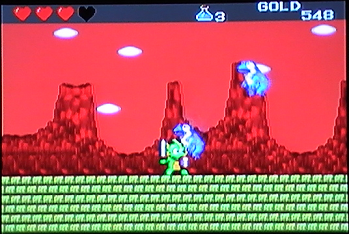
Without the Dragon Armor you shan't survive
the scorching hot lava
Other songs that are good include the playfully sinister music that takes place during the dungeons, the desert/lava music, and the music that plays when you enter inside secret rooms.  The sound effects are of the decent variety, whether it be the heart-refilling sounds, the splashing sounds for when you jump into or out of water/lava, and the sounds for when you use your sword against your enemies.  At least there's no constant beeping playing anytime you're severely low on health as was the case with The Legend of Zelda and Neutopia (whoever thought that was a good sound choice to alert you of your low health was misguided, to put it kindly; I'm still hung up over that).

Ninjas, of course!!!
As is normally the case when it comes to adventure games it starts off hard on account that your health is low and are equipped with the weakest equipment, but throughout the game the more hearts you add to your health capacity and the more powerful the equipment you buy the difficulty gradually becomes reduced.  There is a good sense of depth when it comes to the gameplay, and depending on the form you undertake you may have to change equipment (i.e. Hawk Man gets more defense with the Heavenly Shield while Tiger Man opts for the Master Shield) should you be required to; keeps you on your toes which I'm okay with.  =)  There are three kinds of all enemies you fight in the game, with red being the weakest and blue being the strongest.

Flying
Sometimes when you stumble upon chests you'll either find a piece of equipment, an extra heart's worth of health capacity, a key to unlock a door, medicine vials, and a string of items that will be granted to you (gold, stones, or any one of five subweapons); and some enemies will have a tendency to drop stuff that comes to your benefit, who will respawn when you enter the next segment and then reenter the previous segment you just came from.  This can help on account of the money farming you may end up doing which actually isn't bad for the most part but becomes a real exercise near the end of the game on account of the most powerful weapons' high costs.  Sometimes when you enter a shop you'll notice a spot with a "?" on it on account that it's not yet available to buy, but at least you can see how much it'll cost by the time it does arrive.  =)

Coriolis effect-shaped path
Like in the Ancient Ys Vanished diptych and Xak: The Art of Visual Stage you cannot access your inventory during boss fights, but the least you can do like Xak is pause the event.  If you do plan on using a subweapon during a boss fight you'd better select it before you enter that room otherwise you won't get a chance (namely the Vampire Dragon final boss) and will have to take the path all over to said boss in the event that you fail.  It would also help if you had at least one if not all your medicine vials on you should you expect a little struggle during said fight (or throughout the game for that matter) for the moment your health is empty a medicine vial will be used; the catch is that it might not necessarily refill it all for if it doesn't do that then it'll replenish one heart or four for it's all random.  Should you lose all your health and have no medicine vials at your stead it's game over with an unlimited set of continues, and when you choose to continue you'll get a chance to earn a medicine vial in roulette fashion should the icon end up on top of a red heart; you won't have your current gold reduced by half but your subweapon count will go down to zero as you return to the town with one full heart (figures).

Eeoeew
Most of the dragon bosses are very manageable for they've got rather simple patterns, and in the upper left corner you can see how much health they've got left which I appreciate.  =)  What I don't appreciate is the precariousness of the Vampire Dragon boss in the end of the game, because if it touches you then you lose a bunch of health and at this point you'd better hope that you both have all three medicine vials and that your health will be refilled fully (if not mostly) if your health turned up empty.  Not only that but you also better have a handy supply of boomerangs on your side and catch them for they provide a long distance attack as opposed to your sword (which would cause more damage); the problem with the Vampire Dragon is that he is all over the place which makes the battle feel like a battle of attrition.  Maybe it would've been better if this battle relied more on skill than luck.  It's also not helped by the invincibility time and the forceful knockbacks during these points which leave you in a vulnerable spot unless you're careful.

Here comes the hurt
Many years ago I played both Wonder Boy and Wonder Boy in Monster Land on one of my cousins' MAME CD; and my earliest recollection upon playing the former was how much it played and felt like Adventure Island (and when I found out that Wonder Boy came first I was floored, for I had played the Hudson Soft edition beforehand), while the latter I found to be interesting but didn't get too far on it because this was before I learned to play RPGs (and games with RPG elements) properly.  I never played Wonder Boy III: Monster Lair but since I own a RetroGen adaptor I have been contemplating importing the MegaDrive port of that installment.  During the first half of 2007 I downloaded Dragon's Curse on the Nintendo Wii Virtual Console after looking up good things about it, never having played the original Sega Master System version Wonder Boy III: The Dragon's Trap, and I had played it but to a point.

A-maze-ing layout
The farthest I remember getting in it back in 2007 was after I had gotten the Mouse Man curse and had a difficult time that made me shy away from it.  The reason I had a difficult time was because I did not update my equipment--a grave mistake--and giving Breath of Fire a solid try during 2008's Hurricane Ike (the lesser GBA conversion before I rectified that six and a half years later by downloading the SNES original on the Nintendo Wii U Virtual Console on April 2015) got me to habitually equip my character(s) not just in RPGs but also in sidescrollers with RPG elements such as this one and Castlevania: Symphony of the Night to name a couple.  On May 2010 I had decided to give Dragon's Curse another go and this time I would play it right and managed to beat it after several tries of being defeated by the Vampire Dragon, and I was pleased.  =)  When I checked my Backloggery's memory card I was surprised it had been that long since I last played it.

Sentient sunflowers and firespewing clouds,
oh no!
Dragon's Curse is a nice fun game to play once in awhile, with simple yet intuitive gameplay and a likable lighthearted charm going for it.  =)  And despite its sense of nonlinearity it's very easy to follow and know where exactly you have to head to next.  Also the ability to change your equipment depending on the form you choose to be in augments a sense of depth which is rather welcome, and except until the very end the money farming is not so bad.  While I wish the Vampire Dragon boss wasn't such a longwinded and precarious pain in the ass, the other boss battles weren't so bad in the long run.

Somewhere in this room is a secret switch opening
a secret door
What's sad to me however is that it's a very short game on account of how small it is.  =(  While it might seem big because of the places you cannot get to at first, the moment you have access to these places the smaller the world really is; I couldn't believe it six years ago because of how much fun I had with it.  That doesn't make Dragon's Curse bad by any means, but a little length wouldn't have hurt.  When you really get down to it though, today's game sort of paved the way to games like Wayforward's Shantae and Shantae: Risky's Revenge in that they're also sidescrolling adventure games made in a nonlinear structure which involved changing into different forms in order to access certain places you could not earlier on.  Yeah.

Anglerfish above you
Ever since the news about Lizardcube's remake Wonder Boy: The Dragon's Trap I felt like I had to replay Dragon's Curse, and I can proudly say that I'm more than ready to play said remake when it comes out on the Nintendo Wii U; I hope it improves upon the original like WayForward's DuckTales: Remastered did for Capcom's original DuckTales (and I love DuckTales: Remastered).  =)  I enjoyed this game a lot despite some shortcomings that I decided that I wanted to try Wonder Boy in Monster World (besides, my physical Genesis collection is small anyway); and while it's on the expensive side I hope I someday get to experience the 1994 MegaDrive bookend of the Wonder Boy series Monster World IV (the only installment to not receive a Hudson Soft edition).

It all ends in this elegant castle
If you like nonlinear sidescrolling adventure games like Popful Mail, Shantae, and Ys III: Wanderers from Ys I think you'll really enjoy Dragon's Curse.  If you don't like the idea of forceful knockbacks or money farming (especially since hospitals and medicine will go up in price the more powerful you get) you might not enjoy it as much.  If you like your games long you might have better luck trying something else (not like sidescrolling adventure games have much length anyway), but if you can forgive its sheer brevity and small size and are searching for a good dosage of innovative fun (despite some admittedly slippery controls) it's not a bad experience.  If you have the appropriate format then I say check it out.  =)

My Personal Score: 7.5/10
<( ^o^)^TO EACH THEIR OWN^(^o^ )>
Thank you for reading my review, please leave me a comment and let me know what you think.  Hope you have a great Summer, take care!  =)

Thursday, June 2, 2016

Breath of Fire (SNES) Review

Written: May 31st-June 2nd, 2016
Alternate Title: Breath of Fire: The Dragon Warrior [|O|]
Year: 1993, 1994 | Developed by: Capcom
Published by: SquareSoft

Hello everyone, StarBoy91 here; passionate about video games, big retrophile, and fan of all things 16-bit!  =D  Ah, RPGs, what a great genre; while I personally prefer the action-oriented kind of RPGs (for obvious reasons: action) I do have a big appreciation for the turn-based kind (in fact some of them are my favorites), and today we get to cover the game that made me fall in love with the latter.

Capcom is mostly known for making platformers, beat'em ups, and fighting games, but once in awhile they worked on games outside of the norm; on April 1993 the Super Famicom unleashed in Japan what would eventually become a franchise which at the same time was Capcom's initial take on the traditional turn-based RPG genre--Breath of Fire: The Dragon Warrior, or as it would be simplified as when translated to North American shores sixteen months later on August 1994 (courtesy of SquareSoft), Breath of Fire=)  Created by the team of designer Yoshinori Kawano ("Botunori") and producer Tokuro Fujiwara (of Ghosts'n Goblins fame), this was quite a departure for the company at the time; let's talk about it.

After a brief prologue that ponders the meaning of life it is revealed that thousands of years ago a goddess of destruction named Tyr (Myria in Japan) was responsible for the Dragon Clan fighting each other to the point that two different Dragons were formed: the Light Dragons and the Dark Dragons.  The reason: Tyr offered to grant any wish they desired, causing the two to vie in favor of her which segued to a devastating war which the goddess highly encouraged.  Just when things were deteriorating, this "Goddess War" was put to an end once and for all when a legendary Light Dragon imprisoned Tyr and sealed her away with the six goddess keys, which were then separated.

Or so it seemed, for the Dark Dragons persistently hunted the Light Dragons even now; little did the enemy forces know that long ago the Light Dragons sealed their own power away.  In the village of Drogen a young orphaned Ryu, a descendant of the Light Dragon with a dragon-shaped scar on his head, has been residing with the survivors of the Light Dragons, being raised by his priestess sister Sara who honed powerful magic.
One night Ryu dreams of a dragon telling him that he's in danger and should wake up lest he wants to be engulfed in flame; once he wakes up he discovers that there's fire everywhere and convenes with the others.  Sara, in order to protect her brother and the other villagers, turns them into stone so that the fire will not touch them and that they would be safe from the Dark Dragons, who take her hostage by order of Dark Dragon Emperor Zog (Zorgon in Japan).  Learning of Zog's plan to take over the planet by the Dark Dragons' "birthright" by wishing for it once he has all six keys (when instead it'll be his own and everyone's downfall), it is up to Ryu to embark on a big journey to collect these goddess keys along seven other companions he meets along the way before Zog does and unlock his inner power in the process.  Only you can restore peace to this war-engulfed world and save it before it is destroyed.

"Say, did that old man look familiar to anyone?"
"No, of course not, he's much too wily to be famous"
In the overworld you only get to move in a four-square pattern, and with the Select button you can access the menu.  Because it was Capcom's first traditional RPG their menu is laid out in a way that is uncommon with other ways in the genre which might take a bit to accustom to but after an hour or two of play you'll get it down pat: the bag icon lets you access the items, the helmet icon lets you put equipment on your characters, the cane icon will let you conjure magic (if you can during the overworld provided you have enough AP), the left and right arrow icon lets you change battle formation, and the up and down arrow icon will enable you to switch the order of characters (especially who takes the lead, once Ryu finds his companions).  Once you find the map you can look at your whereabouts with the Start button outside, and with the A button you can open chests, find items inside drawers, talk to NPCs, and perform a special skill depending on who takes the lead (up to four characters can form a line a la Phantasy Star).

Rang weapon utilized!
When walking in the overworld or in a dungeon there doesn't appear to be an enemy in sight, but like Final Fantasy IV and V before it there will be random battles aplenty (there are some exceptions).  And just like the menu, so too does its battle interface take a short time to experience before it's mastered; the main choices are to attack (sword icon), protect yourself (shield), conjure magic for anyone in your party or against your enemies (cane), or use an item during battle (bag).  But the first row of options once it's your turn will comprise of the sword icon, the Run icon should you wish to abort battle (should you be allowed to), change formation and/or bring a member from your back row forward; and should you feel very confident you can choose the AB icon to watch the battle unfold automatically which can always be disabled with the B button.  When you start the game there are one of three save files you can choose from, and to save your current progress you must tell the story to the Dragon Lord's statue largely found inside a small temple.

Just think of the Choppers as this game's own
Mettaurs  =)
Breath of Fire's characters were originally designed by Keiji Inafune (who also did character designs for the early Mega Man installments), but during development his supervisor took him off the project (for reasons) and replaced him with Tatsuya Yoshikawa; amidst the new illustrations that were made Yoshikawa respectfully retained many of Inafune's designs (thereby crediting him as "Inafking").  Well, that was nice of him.  <=)  The character (and profile) designs of the characters are really good, and the in-game animations are solid; the overworld roaming animations are okay, but what really shines in this regard are the animations during battle which happen smoothly and swiftly (whether they're attacking, using an item/casting a spell, or when they're hit).  Succinct and to the point, just the way I like it here.

Inside the desert oasis of Arad
Some good designs that come from the central characters that spring to mind are Nina with wings on her back, the anthropomorphic wolf bowman Bo (Gilliam in Japan), the traveling merchant fishman Gobi (Manillo), and even the sorceress Bleu (Deis) who's half-human/half-serpent; there are even some nifty creature designs for when Karn (Danc) does a simulation spell that combines more than one member of the party (especially Puka).  =)  The NPCs are designed nicely, and the enemy roster comprises of creatures such as variants of slime (because it wouldn't be an RPG without 'em), miniature axe-wielding helmet creatures with arms and legs, round spiked birdheads, giant knights, skeletal riders, dogfish, sentient cacti, and giant crabs to name some; they all animate well too.  Bosses are huge and tower over you (like the sword-wielding generals, sandworm creature, ogres, and toads, et al), and it's fascinating to see them flash brightly when they're on their last legs and disappear as they're circled out of the battlefield once the last hit has been dished against them.

Love the night shots  <=)
The visuals in Breath of Fire are gorgeous, simply put, from the large abundance of bright colors to the good sense of detail.  =)  The areas are all diverse, from the windy angel village Winlan (Windia in Japan) to the desert sands of Arad to the wavy underwater merchant city of Prima to even the musical island paradises that is Tunlan (with the wonderful structure and waterfalls), and the overworld itself is varied depending which part of the world you're in (i.e. grasslands, desert, mountain landscape, island).  I think the best part of this turn-based RPG, however (aside from the fact that engaging in battle will shift the perspective from bird's eye to isometric viewpoint) is the fact that the longer you roam in the overworld the darker or brighter it gets which affects not only the current place you're in but also the safe areas you visit (at night the lights are on); it really augments Breath of Fire's sense of atmosphere.  I like that today's game took a cue from Drakkhen (which basically inspired the day/night feature in the RPG genre).  =)

Battle on a rope bridge
As for the interior designs, they're also well-designed and pretty to look at; the inner halls of the castles look good, the inside of buildings and inns for the most part look safe and inviting (especially with that neat little framed Arthur cameo from the Ghosts'n Goblins series), the caverns look ominous and rocky (and to add more to the atmosphere there are occasional water drops from the stalactites), the space effects are neat later on in the game, and in one of the towers each floor is comprised of different elements (i.e. rain, desert, sky) which is pretty cool.  The village of Auria is shiny and gold, the village of Bleak is dark, and once in awhile there's a nice line scrolling effect when you either walk on a bridge from either Winlan or Gust or when you head up and down the elevator in the Dark Dragon base Scande.  And the battlefields' attention to detail is very appreciated regardless where you are; on land, near water, on a bridge, in a hall, outside, underwater, in a forest.  =)

Such a relaxing underwater environment  <=)
Breath of Fire's music was composed by four members of Capcom's Alph Lyla sound team: Yasuaki Fujita (The Little Mermaid, Darkwing Duck), Mari Yamaguchi (Super Ghouls'n Ghosts, Mega Man VThe Magical Quest starring Mickey Mouse), Minae Fuji (Mega Man IV), and Yoko Shimomura (Gargoyle's Quest: Ghosts'n GoblinsStreet Fighter II: The World Warrior), and it is hands down one of the best Nintendo 16-bit soundtracks provided by them.  =)  The pure instrumentation is great and engaging, the music perfectly suits the tone and emotion of the current situation, and the grand piano sounds incredible in Nintendo 16-bit format.  My sole nitpick is that after a battle is over (whether it was won or aborted) the music will start over again.  <=(  C'mon, man, you came out after Final Fantasy Mystic Quest and Final Fantasy V (both of which resumed the music instead of starting over); and I would actually make a bigger deal of this if Capcom didn't repeat this with the immediate sequel.  Oh well, at the least music here is fantastic.  =D

That's no ordinary octopus  ={
There are three overworld themes that sound spectacular (the first one being the triumphant and iconic Breath of Fire theme and the second one is really uplifting in the short amount of time it's heard before it goes away forever), some village themes are pleasant to listen to (particularly for Winlan/Gust, Auria, and Bleak; Arad in particular has that appropriately nice Lawrence of Arabia flavor to it), the Dark Dragon march heard during the final segment of the introduction is downright menacing and dark and the final notes really send a chill down your spine, Tunlan's theme is very catchy, the story theme after Sara has been kidnapped by Jade (Judas in Japan) is haunting, the underwater village of Prima sounds different from everything else yet sounds very wonderful and relaxing (Yoko Shimomura's only song in the game), and there is a theme heard once in awhile that's very emotionally composed and rather poignant in its own right during the emotional moments.  ='(

Trekking down the forest
The various dungeon themes are memorable, the Misty Forest theme is mysterious with that fun sense of jazz, and the cavern theme is atmospherically ominous.  As good as the soundtrack is, the weakest songs I feel (as is the case with most turn-based RPGs) are the two normal battle themes (each one heard during one half of the adventure); that's not to say they're bad, they're actually okay to hear one time or two, but after awhile of listening to the same song over and over during each and every normal battle it can get quite annoying (I'm starting to have the impression that Final Fantasy IV, Arcana, and Final Fantasy Mystic Quest are the only Nintendo 16-bit games in the genre where the normal battle theme was not the weakest song in the soundtrack).  Luckily to make up for those are the boss theme which is intimidating as well as the epic do-or-die final battle theme (oh, that riveting string work), and the beautifully combined ending and credits theme is enough to make an RPG fan cry for it is so rewarding to listen to when the adventure is over with the good ending (it is that powerful).  =')

United they stand, divided they fall
Breath of Fire is a dialogue-heavy game, and at the time Capcom had no experience translating such amount of dialogue to the West; so SquareSoft got involved when it came to its North American distribution when Ted Woolsey decided to help translate it (his first and only contribution to a Capcom game).  By the time this RPG arrived in America Woolsey had become a household name, known for his translating prowess evidenced in Final Fantasy Mystic Quest, Final Fantasy Legend III, and Secret of Mana; and as usual he does not disappoint.  =)  There are a couple of blunders (not overt ones) but overall he wrote the story and dialogue in a way that is easy to follow and make you feel engaged; but because Western letters took up more space than kanji did this resulted in a lot of (sometimes awkward) abbreviations when it came to items and equipment, in fact the central characters' names had to be up to four letters because of this (it would explain some of the name changes).  I only wish he and SquareSoft remained on board when Capcom jumped ship and translated Breath of Fire II on their own (because its translation was shite); but if they had then American gamers would've thrown a hissy fit over Chrono Trigger not receiving localization or (worse) be translated poorly, and Chrono Trigger is a much better turn-based RPG than Breath of Fire II... actually a lot of turn-based RPGs are better than Breath of Fire II-_-

Good thing Plok is not here, otherwise there would be
h----OH, they're not those Fleas, never mind then!  >_>
After each battle has been won you'll receive a varying amount of experience points and GP (your currency), occasionally they might leave behind an item which may either be useful or can either be sold; and each time your character levels up they become more powerful than before (a few in number might learn a new spell); what's cool is that even if a character is in the back row (or simulated) they'll still level up regardless--makes leveling up fun this way, unlike a certain sequel (*cough*Breath of Fire II*cough*).  And just like Drakkhen the day/night system isn't just a prettifying gimmick as it's also a beneficial tool for you to make progress as you wait 'til night (like sneaking past the Dark Dragons in the doomed village of Nanai with that one pub you'll never ever enter in-game; or looking at a combination from the back of Tunlan's bathing princess), and later on you'll procure an hourglass (HrGlas) which can speed up the process if you don't wish to prolong the wait.  Awesome!  =)

*SLAM*
When it comes to the battles when it's one of your characters' turns, when they perform an action--whether you make them attack, use magic, or utilize an item--it is done in such a swift and concise manner (literally no time flat) that it makes the battles go quicker this way... I want you to remember this when you play Breath of Fire II because in that RPG it is not the case.  Another neat aspect is the way most bosses will experience a second wind after losing lots of damage and won't go down just yet (with their health bar currently comprising of one red wafer-thin line), which makes these battles exciting as you get to see how many hits it'll take for them to truly bite it.  =)  Unlike Final Fantasy post-IV you can take as long you want to make a decision without worrying about receiving damage during the fact, and at random times your character can double their attack power and successfully dodge an enemy attack--unfortunately the opposite also applies so it's best to exercise caution.

Ryu down 33
Throughout the game you'll procure contents from inside chests (and occasionally drawers), whether it be inside safe buildings, dungeons, caves, and forests; and the cool thing when it comes to equipping any one of your characters is that it's done in a way that's not time-consuming; simply select the equipment of choice (weapon, shield, armor, helmet, something for two empty slots) and it'll update itself right away as it trades places with the old equipment in question.  It's satisfying as you don't have to go through a hassle.  The dungeons have plenty of surprises in store for you and are vastly designed in such a way that thorough exploration is key to garner some of its treasures; you also never know if there are trapdoors you'll fall through, switches that'll render the inner walls of a labyrinth visible or invisible, warps that'll teleport you to different parts of a dungeon (or outside), switches that'll rotate the perspective of the room, or even traps that'll wind up summoning monsters who attack you.  It's great because it ends up keeping you alert and on your toes!  =)  Should the party fall during a battle you'll be brought back to the last Dragon Lord statue you saved in front of; you won't lose the new items you got along the way, but your current GP will be reduced by half (as you do).

(O.O)  ......... You would be a perfect fit for a Mega Man
Robot Master!  =D
In 2001 this game got ported to the Game Boy Advance by Capcom in Japan and America and saw release in Europe for the first time in this format by Ubisoft, whose involvement as European publisher makes about as much sense here as it did for SoulBlazer and ActRaiser 2 on the SNES (that is, not really).  I forget how I found out about Breath of Fire one-plus decade ago, whether it be by learning about it on FlyingOmelette's outdated Top 100 Favorite Video Games list or through a little blurb of it on a 2002 Nintendo Power magazine (the same one that had 3D Mickey from Disney's Magical Mirror starring Mickey Mouse on the cover), but regardless I do recall being curious about it.  I didn't own an SNES console at the time thus I decided to ask for the Game Boy Advance version on Christmas 2006, at the time not knowing the handheld's shortcomings.  I was fifteen and at the time I wasn't too big on turn-based RPGs, not to mention I was inexperienced in the genre (I didn't grasp the concept of equipping until a year and a half later when I played it properly; I was more into action and platformers); but I did manage to play it up to a certain point: the General, the second boss fight in the game.  What took me by surprise was how hard he was, so much so that I was scared to touch GBA Breath of Fire again until 2008 when Hurricane Ike hit.

Incidentally, that Summer I saw Indiana Jones and the Kingdom of the Crystal Skull, my first Indiana Jones experience on the big screen since the first three came out before I was born, and one line from it stuck with me (but not for the right reasons): "I like Ike!"  But the context was different because it was a 1957 period piece (I knew Indy was referring to President Eisenhower), but it's hard not to think of that movie line without being reminded of the Hurricane of the same name that hit months later (very awkward coincidence, that was).  =$

Facing off against Death's distant relative
Something I deliberately left out so I could talk about it here is that Breath of Fire is a difficult turn-based RPG, mainly attributing to the majority of boss battles themselves.  If you're not leveled up enough or if you don't have the best equipment up to this point you might end up losing to them if you're not careful; buying a bunch of healing and curing supplies is also a must; some ways in which the battles are slightly alleviated are when Karn battles as a simulation or when Ryu transforms into one of several dragon forms (after you earn them, that is).  On one hand the hard difficulty I find to be rather refreshing for it keeps you steady and alert throughout and demands that you be careful, but on the other hand its difficulty probably scared off gamers who had little to no experience in the genre (like myself almost a decade ago) which didn't exactly help because difficulty was in general one of the reasons Americans were not as experienced with these kinds of games like Japan was during the early '90s.

So anyway, during 2008's Hurricane Ike (house and family was fine, don't worry; we were out of power for two weeks, but everything was fine) I decided to play GBA Breath of Fire on my Nintendo DS, and this time I would do it properly; and when I got past the General boss its world was beginning to open up to me and progressively got better and better, even as I got into the habit of equipping my characters and looking everywhere for treasure chests.  I was having a lot of fun with it, and after countless hours I ended up beating it: both with the good and bad ending (I do not recommend going for the latter, it is time-consuming as all hell), making it the very first turn-based RPG I ever beat.

But in hindsight, the Game Boy Advance was not exactly an ideal format for this port of a Nintendo 16-bit title; sure it enabled you with the ability to dash by holding the B button (the original Breath of Fire came out before games like Robotrek, Chrono Trigger, and Super Mario RPG: Legend of the Seven Stars allowed you to both walk and run; I'd also include Lufia II: Rise of the Sinistrals, but let's face it: blatant Adol Christin wannabe Maxim is already moving at fast speeds), used new designs and cutscenes, and used the simpler battle interface from Breath of Fire II, but that's where the implementations ended.

The Game Boy Advance had a very bright color palette, the aspect ratio was uncomfortably cropped, the music sounded tinny and flat (which was wont to happen when SFC/SNES titles were downsized to GBA format) due its terrible sound samples (comparing music from both the SNES version and GBA version on YouTube is what made me hate the concept of SFC/SNES-to-GBA transitions as an audiophile, which was hard because I used to have high respect for the handheld), and despite the fact that it came out in 2001 (when the internet paved the way to numerous resources) the translation was entirely copy-pasted from the original Nintendo 16-bit format--which is lazy if you asked me.  I didn't play the GBA version of Breath of Fire II, but something tells me the same thing happened there.

Since finding out the hard bombshell that the Game Boy Advance may not have been as great a system as I once thought, and after having been loaned an SNES console two days before 2009 I wanted to someday experience Breath of Fire as it should've been experienced; in excellent-sounding square-ratio format on either the SNES or the Virtual Console service.  The problem with the last option (at first, anyway) was that SquareSoft handled the promotion and advertising for Capcom's RPG in preparation for its 1994 American release; so even though Capcom technically owned the rights to this game, Square owned just as much because of this.  So the Nitnendo Wii Virtual Console downloadable service came and went without this game being available in the West (but in Japan it was); in 2014 and 2015 Capcom and Square have thankfully come to an agreement and decided to release Breath of Fire in all its original 16-bit glory on the Nintendo Wii U Virtual Console in Europe and America respectively, and all I have to say is thank God=)


After Breath of Fire became a Capcom hit it ended up spawning a Super Famicom sequel on December 1994 with Breath of Fire II: The Destined Child (with most of the same people involved from the first game), which when converted to NTSC SNES format the following December in 1995 was shortened to Breath of Fire II, and despite the first not seeing a release in Europe in the '90s this follow-up ended up getting the PAL treatment (courtesy of Laguna) on April 1996 with no title change to disguise the fact--you know, at least when Lufia II: Rise of the Sinistals was released in Europe Neverland smartly changed it to Lufia because Lufia & the Fortress of Doom didn't see a PAL release (even though it's a prequel, so the title makes no sense; add to the fact that Lufia isn't in it, and it doubly makes no sense).
Despite having come out fairly late in the console's lifespan its translation was absolutely horrid and hard to take seriously (with lots of misspelled words, incomplete sentences, and improper wording and structuring); Capcom probably felt confident enough to do it by themselves after SquareSoft helped them with the first Breath of Fire, but the sequel's translation was so incomprehensively bad you wonder why they even bothered.  You could forgive something like this in 1991 or 1992 even (when there were little to no resources) but not 1995; though I hear in recent years there has been a "Retranslated" version which hit both emulators online which also got transferred to physical repro carts.
But badly translated or no, it does not change the fact that Breath of Fire II is a disappointing and severely inferior sequel, and a lot of that is attributed to how longwinded and padded it is.  Level gaining took long periods of time because the experience points were divided by the current number of people in your party, the only people that leveled up were ones currently in your party (and having to switch them up every now and then in front of a statue is a neverending rollercoaster of tedium), the attack and magic animations took a long time to get to the point, the soundtrack was forgettable (if it didn't make me feel antsy it made me want to fall asleep), there were far too many sidequests to undertake that took forever to accomplish, and it felt very unbalanced (especially when certain fruit consumption depletes you of your health).
The battle interface was simpler and easier to use and it admittedly did have better visuals and animation than the first game (with clouds and shadows in the overworld), but that's part of the problem: I think Capcom focused so much on exploiting the visual aesthetics that they didn't care about the gameplay itself.  And personally I found this second iteration to be very boring; I just did not have the same amount of investment and enjoyment for it as I did the first Breath of Fire.  I tried on several occasions to give this turn-based RPG a chance (I swear to God I tried) but every single time I wind up losing interest because I feel no compelling reason to continue with it.  This game simply failed to make me care, something the first game succeeded in doing.
Pedo Frog
But jarringly I found that over the years there are many people who actually prefer Breath of Fire II to Breath of Fireo_O  What???  Why??  How?  Actually, never mind "how", I know the answer to that one (it got more exposure than its superior predecessor); but why do people like this sequel so much, after all the problems I stated that it's got?  I don't understand it, and maybe I never will; I don't wish to take it away from them if they do, to each their own, but I could never get into it no matter how many times I tried (I normally don't wish that I never played a Nintendo 16-bit game, but this is one of those exceptions; I could've been better off without this sequel on the Nintendo Wii VC).  Please don't ask me to give a full-length review of Breath of Fire II, this is the closest you'll get to read my opinion of it.  Disappointing.  -_-
Images from Wikipedia
In 1997 and 2000 the PlayStation One received the next installments Breath of Fire III and Breath of Fire IV, both of which incorporated 3D environmental elements and enabled you to rotate the camera (the former seeing a PlayStation Portable remake in Japan and Europe in 2005 and 2006, with an American release arriving via PlayStation Network this year; and the latter seeing a Windows and PlayStation Network release in 2003 and 2011 plus inspiring a series of Japan-only mobile phone games from 2003 to 2008), and in 2002 and 2003 the PlayStation 2 unveiled Breath of Fire (V): Dragon Quarter which was different than previous installments and ended up dividing fans of the series and RPG gamers in general.  It seemed we had heard the last from Breath of Fire,
Image from Wikipedia
...until this February when Capcom released Breath of Fire 6: Hakuryū no Shugosha-tachi for PC computers and Android, which is the first in the series not made for consoles and vied for a more action-oriented RPG flavor this time around, which sees a release on iOS formats this Summer, but currently only in Japan.

It seems to me that even though the original Breath of Fire was successful that there are less and less people that like it with each passing year, which I find to be sad.  =(  This game might not be important to a lot of people, but it's important to me.  Never mind that the GBA handheld had its shortcomings as a whole, Breath of Fire is where I learned to play this genre properly and habitually equip powerful weapons and protection, and it made me want to play more turn-based RPGs.  Had it not been for this game I would not have played Chrono Trigger, Arcana, The 7th Saga (a futile experience, though the Japanese version Elnard is better balanced), Robotrek, Final Fantasy IV through VI, Final Fantasy Mystic Quest, EarthBound, or even Lufia II (to be determined) to name some; and I would not have played Super Mario RPG (technically the first turn-based RPG I played in my life as a child, but at the time I didn't do good in it) through to completion.  Breath of Fire means the world to me, I love it so much; there are people who like the first game and I'm one of the few that do.

Awww  =(
I thought the story was very compelling and the world in today's game was worth being engrossed and invested in.  Sometimes there were brief still-shot cutscenes with well-designed anime characters (especially for Ryu's Rudra and Agni transformations), I cared about what happened to its characters and the stakes were high, some moments of dialogue were humorous ("Do you want me to say 'Simon Says'?"; "Well, excuse me!"), and it wasn't devoid of genuinely emotional moments--namely the scenes with Ryu and his sister Sara and the scenes with Alan and Cerl (Carla in Japan) which culminated in their tragic fate were quite emotional.  If it wasn't for Ted Woolsey the original Breath of Fire would not have worked as well as it did, God bless that man and his translating talents!  =)  The Alph Lyla sound team's soundtrack also effectively added a huge sense of atmosphere and easily gave you compelling enough reasons to feel for and become invested in these moments, so that's a positive too (one that the sequel Breath of Fire II will never lay a claim to)!

Also, the optional Chun-Li cameo is much appreciated.  =)

These flying bird sequences are good, but I much
prefer the ones from Tenchi Sōzō/Terranigma  =)
Best game ever!
I really liked the fact that each character had their own specific ability which could be utilized when not battling as they take the lead: like Bo who can literally walk your party through trees, Karn who could unlock any door and disable a treasure chest that had a trap in it, Gobi who could transform into a big fish underwater, and Nina who later on can become a giant majestic bird and fly anywhere your heart desires.  =)  I especially appreciate Breath of Fire's sense of replay value regarding if you could find all the treasures and special items and depending on if Ryu can transform into Agni (after having completed all his training and procuring all the Dragon equipment) there are two different endings; and the good ending is naturally the best of the bunch.  And when you reveal Tyr's true self the battle can be quite epic (even as you watch after enabling the automatic battle option).

Puka is best chibi-fish-duck-dragon-thingy  ^~^
Downloading the SNES edition of Breath of Fire last April was a real eye-opener for me as I not only got to re-experience this game but I re-experienced it in a format that it should've been presented.  In my recent playthrough, according to the total logs on my Nintendo Wii U, I beat this game in roughly twenty-one and a half hours (though it may have been a few hours more since one time I played it until there was a brownout; miraculously the SNES data was saved but the Wii U progress wasn't).  If you love a little challenge in your turn-based RPGs Breath of Fire has got plenty in store for you, but if you're afraid of challenge there are easier games in the genre you could play, and if you're looking for an RPG that's got longevity this will deliver sublimely; and if you're searching for a good story and translation as well as likable charm there's tons in store.  Breath of Fire holds a special place in my heart, and no one can take that away from me.  =D

My Personal Score: 8.5/10
<( ^o^)^TO EACH THEIR OWN^(^o^ )>
P.S. The majority of screenshots I took last May, with the exceptions being the title and end message (which I retook), the dragon from Ryu's dream, and a few others (you can tell due to slight quality difference).  My only regret: not enough screenshots.
 
P.S. 2 Tatsuya Nishimura provided the sound effects for the game and a bit of music (but was left uncredited); the sound of the Fife that you use to access Krypt would be used again in Capcom's Disney's Aladdin.
 
Thank you for reading my review, please leave me a comment and let me know what you think!  Have a great Summer, and take care!  =D
-----------------------------------------------------------------
Speaking of Bonkers,
that's a good Capcom platformer, huh?  ...  Yeah, I admit that was... forced.........  v_v
I'll... see myself out now.