Written: November 2nd-7th, 2015 / Published: November 21st, 2015

Alternate Title: Super Mario World: Super Mario Bros. 4 [|O|]
Year: 1990, 1991 | Developed and Published by: Nintendo
Hello everyone, StarBoy91 here; passionate about video games, big retrophile, and fan of all things 16-bit. =) If you were to ask me what the first ever game I played on the SNES was, the answer would be the same as to if you asked me what my first Mario game was: I'm not 100% certain which of the three I played first. My earliest recollection of playing the SNES for the first time over at my relatives was either in 1996 (when I was five) or 1997 (six) and the three that spring to mind (as I played them all when visiting) are Super Mario All-Stars, Super Mario Kart, and Mario's 16-bit foray which I'll discuss today. But first, let's recap:


Then in 1989 (after having become a franchise and spawning a few 8-bit console sequels) when Nintendo's Game Boy handheld system debuted it launched with the late Gunpei Yokoi's Super Mario Land which owed its structure and gameplay to Super Mario Bros. but transpired outside of the Mushroom Kingdom and did some things differently. While Super Mario Land was a hit time has not been kind to it, for it's regarded as one of the lesser Mario games by many and gameplay-wise it's not as solid as the NES platformers before it and for years has been notorious for its rushed production; still, taken for what it is and getting around its blemishes, it's fun when played in the right mood but average overall in terms of quality. =|
When Nintendo announced in 1989 that they were going to create the successor to their 8-bit console, everyone was excited and could not wait to see what the Big N had in store for them; people got more excited when the then newest console was going to be 16-bit (to compete with Sega's MegaDrive/Genesis console, which was beginning to beat Nintendo at first) and would have lots of capabilities. Generally clamored to be one of the best consoles (if not the best) consoles, the Super Famicom was unveiled in Japan on November 21st, 1990; on August 23rd, 1991 Nintendo's 16-bit powerhouse came out in North America (retitled and redesigned with purple concave and convex buttoned controllers as the Super Nintendo); on April 11th, 1992 the Super Nintendo got converted to PAL 50 Hz format for both the United Kingdom and England (while retaining the original console design and colorful buttoned controllers of the Super Famicom... dahell?!?), the rest of Europe following suit that June 6th; and it would finally reach Australian shores on July 3rd, 1992. The launch title that would become the console's biggest selling point? Super Mario World (subtitled Super Mario Bros. 4 in Japan). =D

The game takes place after the events of Super Mario Bros. 3: after having defeated Bowser and having rescued the Mushroom Kingdom and Princess Toadstool, hero plumbers Mario and Luigi decide to go on a vacation with the Princess to the dinosaur-filled island Dinosaur Land. While the brothers are relaxing Princess Toadstool has been snagged yet again; when they found out they started searching for her and during their search they stumbled across a big green-spotted egg.

Hatching from inside it emerges Yoshi, a young green dinosaur who thanks the brothers for freeing him and tells them that all his fellow dinosaur friends have been imprisoned inside their eggs as well by the Koopas. At that Mario and Luigi deduce that once more King Bowser and the seven Koopalings are behind the scene yet again, so the three decide to venture forth on yet another adventure not only to save Princess Toadstool, but to rescue Yoshi's friends and save Dinsoaur Land once and for all. What troubles will await for them in their journey this time?


As was the case with Super Mario Bros. 3 before it each section has got their own hub dedicated to them; the difference here is that all the areas are interconnected with the land plus you can revisit the bulk of the stages any time your heart desires. =) Whenever a stage has been beaten for the first time Dinosaur Land gradually evolves and reveals itself more and more as you go along, which is great. If a stage has a red dot it means there's more than one exit, so be on the lookout for them when you can; Super Mario World also introduced for the series the save feature thanks to its battery back-up for you can use any one of three files and anytime you beat a Ghost House, Fortress, Castle, or specific area you'll be able to save the game (or continue without doing so) which works to this game's benefit.
 |
| "Wheeee!!!" =D |
Okay enough stalling, gameplay description time: as Mario (or Luigi if you're the second player) you can move around left and right, duck, jump (B), swim, climb beanstalks, slide down hills, enter pipes (in front of, above, or below you), and run (Y). This time Mario (or Luigi) has a few new moves in his arsenal; for instance, by pressing the A button Mario (or Luigi) will be executing the twister jump as he twists up until he touches the floor. It can be very useful as it's powerful enough to pounce most enemies out of the picture in just one blow, and if Mario (or Luigi) is big then that technique will also destroy the breakable blocks below you. By pressing either left or right shoulder buttons once then the screen will slightly shift to either the left or the right, but considering how largely familiar I am with the game I find no need to use it (I only bring it up for informative reasons). If you've entered a stage you have beaten before and want to abort it, just pause and press the Select button and you'll be back to the Dinosaur Land hub.
 |
| Time to spread my wings and fly! |
Halfway through most stages are midway markers which act as a checkpoint should you either lose a life or come back to it after beating a different stage (but mostly the former). At the end of each area is a goalpost with a bar slowly being moved up and down, and depending on how high it is when you touch it you'll attain yourself somewhere between one and thirty in star value; any time you get a hundred in star value you'll be taken to a bonus room where you have a chance to match as many mushrooms, fireflowers, and stars as you can for a chance at extra lives. Likewise with past entries there is a timer, so don't dawdle too long otherwise time will run out for you.
 |
| Just keep swimmin', just keep swimmin'! |
The gameplay essentials are all back, you can still hop'n bop on top of non-spiked enemies and if there's a stray shell, P switch, or key, you can pick it up with the Y button and kick it ahead of or above you by pressing up. If you bounce up on a "?" block the following will pop up: a (series of) coin(s), a key, a P-switch, a P-balloon that'll temporarily inflate Mario (or Luigi) which makes them float in the air ('til there's less helium or if you sustain damage), a Yoshi egg, a mushroom to make yourself bigger, a fireflower that will make you become Fire Mario (or Luigi), an invincibility star that momentarily renders you invulnerable, and a feather which will transform you into Cape Mario (or Luigi).
 |
| "Oh, this looks-a-really dangerous, Yoshi! You stay-a-here while I a-check-it out!" |
With this last ability just run until Mario (or Luigi) forms a wingspan and jump up to soar into the sky, then you can control your gliding maneuvers by alternating between left or right (or vice versa) to remain airborne; if you do just a normal jump with the cape on their shoulders just hold B to make them glide slowly to the bottom. For the first time in the series an item can be stored if you find more than one power-up; should you need it just press the Select button during normal gameplay. Regardless of which power-up you are if you lose damage you'll be small again and at your most vulnerable, so be on your best guard. As simple as the gameplay is, it's incredibly enjoyable and intuitive thanks to its pick-up and play nature. =)
 |
| "Te-e-e-e-ell our frie-e-e-e-ends Cindy a-a-and Sandy from Ja-a-a-a-aws 3 that we said 'Hi-i-i-i-i-i-i'!" =) |
When Nintendo was transitioned from 8-bit to 16-bit, so too did the visual capabilities. While by today's standards they're not exactly breathtaking, gamers were blown away by just how bright and colorful each stage was and how there were variations in color when it came to areas with similar background layout thanks to its outstanding color library. Now each area had line scrolling, with the background moving at a different speed than the foreground that you're on, and said backgrounds and skies had more detail than any of the previous 8-bit Mario games did: among the many examples are cloud-ridden skies, clear skies, hills, mountains, simple yet effective foliage, starry skies, shiny underground landscapes, and wavy sea algae underwater. =)
 |
| "Let'sa go!!!" |
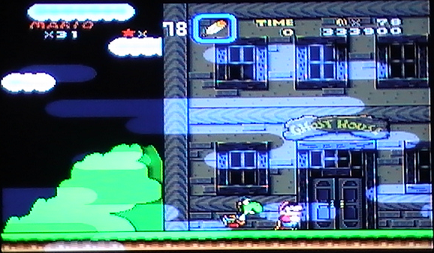
Some of the interiors areas aren't too shabby either, in particular the Ghost Houses where the Boos reside; what I like the most about that is the clever décor surrounding it--if you look closely there are pieces of wood with patterns similar to those from Super Mario Bros. 2 and the walls are comprised of gray versions of breakable blocks from Super Mario Bros. 3. Nice nod to the predecessors there! =D The foreground design and platforms are simple as well; among them a series of logs, grassy fields, icy terrain, and dithering used for the water effects. Any time you reach the end of a Fortress or Castle there are instances of Mode 7 scaling and rotating effects (whether it be a big platform on top of lava, a platform rotator, or some of the bosses themselves, especially against Bowser) which are sufficiently incorporated.
 |
| Wait! Those are Goombas?? o~O I'm sorry, but those can't be Goombas; they look like rotten apples to me! |
The character and enemy sprites are all adequate with little animation, but they are very colorful to look at. Mario looks and moves nicely, with his nice blue overalls and mustache; he can now even look up, and his twisting animation shows you every side of him. I liked the motions of the wavy and fluttering cape as well, even if it's just for a soft jump (it's the little details that make them great). In the original version of Super Mario World if you played with two players then you'd find that Luigi was a palette swap of Mario; I understood why that was the case in Super Mario Bros. 3 (Super Mario USA was not out in Japan yet), but in here's it's just befuddling (Nintendo would rectify Luigi's height in Super Mario All-Stars + Super Mario World in 1994). Yoshi looks and animates decently, and I like the animation for when he hatches out of his egg and when he sticks out his tongue. =) This also marked the first time Princess Toadstool appeared as a blonde in the series with her familiar hairstyle (and would remain that way since), as before she was interpreted as either a redhead (Super Mario Bros. and The Lost Levels) or a brunette (Super Mario Bros. 2 and 3).
 |
| Hooray for infinite flight above the clouds! =D |
All the Mario regulars are back: the Koopas, the Paratroopas, Lakitu and his Spinies, the Piranha Plants, the Bullet Bills, and the Boos are as we remember them and have never looked better (except the Goombas: they've always looked wrong to me in this game). New to this game are the Banzai Bills, Torpedo Teds, Monty Mole, the Wigglers, and Magikoopa, and they're designed and work perfectly for this Mario installation. Each respective Koopaling looks decent and their surroundings aren't bad either (especially when they climb a closed-in wall), the Big Boos are menacing in scope, the Reznors are cool; but the real show stealer is Bowser in his ship--with nothing but a gradually thundering sky in the background, and the way he occasionally flies and scales away from or swoops to the screen is impressive considering its age (I bet everyone was wowed by that in 1990), and it still looks seamless. =)

Also making an appearance is here Ninji from Super Mario Bros. 2; unfortunately by the time you get to that point it's too little too late as they're in the room that precedes the door to battle Bowser; as a result a handful of gamers are under the impression that Ninjis are not present in the game (even the cast of enemies and bosses after the credits sequence neglects to mention them, which is a shame). =(
 |
| "Oh no! No one-a-told me there would a-be actual ghosts hiding inside this ghost-a-house!" O= |
Returning from the 8-bit console Mario platformers, Koji Kondo provides the music for Super Mario World, and while it's far from the best soundtrack the Nintendo 16-bit console ever had, it is one of the most memorable and superior ones from the series outside of the Super Mario Galaxy games. =D The SFC/SNES's 16-bit processors really helped elevate the sound quality from the FC/NES predecessor, and all the better for it.
 |
| Now that's what I call a cage match |
Some of the area themes are quaint and bouncy in their composition and uplifting in tone, each hub has its own respective theme (from the brief melody in Dinosaur Land, to the silent beat in Vanilla Dome, and even the mysteriousness in the Forest of Illusion) which are nice in their own right, and the way the tempo slows down for the underwater stages really fits swimmingly (pun not intended). The Ghost House theme is lightheartedly menacing with its seemingly ominous cues, the Fortress/Castle theme is dark and somber near the end, and the normal boss theme is okay. In the Special map screen the original Super Mario Bros. theme can be heard and sounds great in 16-bit format, however you have to wait three minutes in order to listen to it in-game. Bowser's theme is foreboding and brooding in nature and adds to the greatness of the battle, and one of its notes sounds similar to Maleficent's theme from Sleeping Beauty (though, it may have been coincidence); but the best song is the ending/credits theme, as it is as perfectly rewarding as it is humorously upbeat for a polka party tune. =) The sound effects are all decent, like the one for when Mario or Luigi get the feather and when they soar in the sky.
 |
| Help, I'm drowning in dithering water not unlike the one from Jerry Boy and Ocean's The Addams Family! |
The single-greatest contribution Super Mario World gave to the series is the introduction of Yoshi and how perfectly utilized he was. Producer Shigeru Miyamoto wanted to include him from the very beginning in Super Mario Bros., but due to the technical limitations of the Famicom/NES it wouldn't allow it. So when the SFC/SNES doubled its capabilities to 16-bit Miyamoto was overjoyed to finally incorporate the character he's been trying to add to the series for five years. Yoshi was one of the most celebrated things about the game, for it was great how you could ride on him and the way he could give you a boost as you jump high and/or jump off him to gain altitude; and luckily he was so celebrated that he stuck around since (for the other Mario games, the Mario spin-offs, and even Yoshi's own line-up of games). I'm glad Yoshi wasn't a one-off character, otherwise it would've been disappointing; I have many friends and cousins who love Yoshi, and so do I. <=)
 |
| " |
On the surface Super Mario World is relatively simple and is largely an easy game through and through, but what makes up for that and is one of the best things about the game is the sheer amount of replay value it's got in store. =D The majority of stages have got more than one exit, and finding it (whether it be the goal post or a key fit for a keyhole) leads to segments of the hub you would not have normally reached, or if not that then they would lead you to shortcuts that lead to later (or secret) portions of the game. Luckily if you missed those the first time you can explore the red dotted stages again after you beat them, and in total there are ninety-six exits (and finding them all is part of the fun). Some are easy to find while others take a bit of exploration and/or challenge to do so; needless to say, a single exit requires making a sacrifice in order to get to it (if you get my drift). This is one of the many reasons Super Mario World holds up so well!
 |
| Matching time! |
Another thing that's great about Mario's 16-bit foray is its overall cleverness and invention when it comes to the stage layouts. There is one stage where its progress depends on how many coins and/or how much time you have; it might lead to a different part of the area regardless (trial-and-error is a blast here). There is an occasion or two when a P-switch and a "?" block which stores a line of coins (going the direction you press in the Control Pad) must be used consecutively and timed properly. One area involves progress on a trail of dolphins whilst avoiding a spiky blowfish, and a handful of stages even having floating diagonal platforms; plus other examples.
 |
| Look out from above! |
I know when it comes to games that have oft been spoken and clamored by many it's hard to say something regarding them that haven't been said before (lest I feel differently towards them), which is why I mostly focus on games that are either overlooked, underrated, or just don't get enough attention for my blog; but depending on the mood I like to share my own two cents when all is said and done. When I was a kid I did like this game enough, but my gaming skills were not up to snuff at the time and I only managed to get to one of the Ghost Houses as a result; but I think I truly began to appreciate and love this game in my very late teens several years ago (when my gaming skills improved with age) and have loved since. =) I still slightly prefer Super Mario World 2: Yoshi's Island (as I have since I was little), but the original Super Mario World's importance cannot be understated.
 |
| Hey, I don't remember Yoshi being red in the title sequence... |
Back in 2002 when I found out that Super Mario World was given the Game Boy Advance treatment as Super Mario Advance 2: Super Mario World I was happy about it, and looking back it was ideal for someone who didn't yet own an SNES console as it wouldn't be until six and a half years later that one of my cousins would loan me his. But that's the thing: if you own an SFC/SNES, a Wii, or a Wii U, then there is absolutely no reason to own a heavily downsized version of the game (unless you're a fan of the original Mario Bros. arcade game), even if it did have Charles Martinet's digitized voice. I own the GBA port, but I didn't care to take any screenshots for it (or replay it for the sake of the review); you can't beat the original in terms of color, sound, size, and scope. Being loaned an SNES console by my cousin in 2008 is one of the best gaming events that ever happened to me. =D
 |
| Invincibility time! |
Nintendo's 16-bit powerhouse had come under fire for notoriously having the console redesigned for North America. Apparently, from what I recall one of the internet users explaining years back, there was fear that due the flat design of the Super Famicom that it would've been "used as a coaster for drinks by accident" if released as is in America; which frankly is the most irresponsibly idiotic thing I've ever heard in my life (no self-respecting gamer would ever stoop this low). But okay, you change the design to prevent heavy damage to the system, I get that; what I don't get is why the physical change only applied to North America and not Europe and Australia as well (all of which which somehow retained the original SFC design). You know what else those two continents kept? The colored button controllers. o~O

Left: Super Morph [PAL SNES] / Right: Super Wagyan Land [SFC]
Unlike Japan, Europe, and Australia, where the right side of the controller had four differently colored buttons which all had the same feel; North America got unlucky for it got two different hues of purple--with two concave buttons and two convex buttons--instead. This was a real blow to American gamers, not only because we got deprived of the controller setup as it should've been, but because the purple buttons completely defeat the purpose of Super Mario World's red-blue-green-yellow motif that Nintendo's been trying to convey (which is border-on egregious). =(

Really think about it for a minute: the name of the game is "Super Mario World", not "Super Mario World". By the time you find every exit you'll find Yoshis who are not just green, but blue and red and yellow as well; not only that, but the Koopas and Paratroopas have shells that are those exact colors (even the "!" switch palaces and blocks share the red-blue-green-yellow motif). It's miraculous then that the Special map retained the Super Famicom logo in the top part of the screen, which by the way, was inserted in all Japanese Super Famicom and PAL SNES carts (like the two examples I've just shown).

Look at the dark gray symbol on the right side
So how do you devalue the intended motif the game's been trying to present even more? How about by removing the Super Famicom logo from the North American NTSC carts and replace them with indistinguishably different dark gray and black holes? *sigh* '90s video game politics and practices in America have never made sense, and I pray to God I never understand the justification behind it all, otherwise I would find it to be more mindboggling (and depressing) than it already is. T-T
 |
| Gliding high in the coin-ridden sky |
In preparation for this review and to attain better screenshots I played it on the 1st of November, and not only did I start a new game and beat it, but I also managed to complete it and find all ninety-six exits that day taking less than twenty-four hours; it was a real rush and I'm glad because it may be the best Mario playthrough I've had. =D Super Mario World still holds up incredibly well after twenty-five years, and the fun simplicity of the gameplay and multitude of areas, ingenuity, charm, and exits all really help it stand the test of time perfectly, and it's because of this that a lot of gamers look fondly toward it and consider it one of their favorites (if not the favorite). Is it my Number One favorite Nintendo 16-bit game? No, that would be Tenchi Sōzō (Terranigma). Is it one of my top favorite platformers on the system? Absolutely! Where does Super Mario World rank among my personal favorite Mario games? Somewhere in the top alongside Super Mario Galaxy and Super Mario 3D Land. =)
 |
| An apt descriptor for not just this game, but the Nintendo 16-bit console as well! Long live the King! =D |
Super Mario World outdoes its predecessors in terms of fun and replay value for me (for me it's the best 2D platformer of the series), and even if it doesn't it's still a platformer I highly recommend playing. It's got everything you would want in a platformer, and more. But if in the off chance you have not played this wonderful classic, where have you been? It's a quarter of a century old, and you could not ask for a better way to introduce Nintendo's 16-bit console. =D

(Oh, now they get Luigi's height right--in the last minute!) >_<
My Personal Score: 10/10


<( ^o^)^TO EACH THEIR OWN^(^o^ )>
P.S. All right, I finally got to talk about this game, yes! ^(^o^)^
P.S. 2 I was considering whether to include the tidbit that Shigeru Miyamoto was not 100% satisfied with the game and felt that in the end Super Mario World was rushed during production, and expressing hope that in time that games on the console would put more emphasis on story and emotion, but I did not know what section of the review I would include it in. So I'll just mention it here.
P.S. 3 Normally I don't say this aloud in my blog, but I wonder what the great RVGFanatic would say if he just finished reading my review of this game? ^~^ And while I bring him up: I can't wait to read his hundredth SNES Review on his site.
HAPPY 25th ANNIVERSARY,
SUPER MARIO WORLD! =D
-----------------------------------------

FOR READING MY REVIEW, MY READERS, PLEASE LEAVE ME A COMMENT AND LET ME KNOW WHAT YOU THINK! =D HAPPY THANKSGIVING, AND TAKE CARE!!!