Received: December 25th, 2015 / Written: February 2nd-6th, 2016
Alternate Title: Chō Makai Taisen! Dorabotchan [|O|]
Year: 1993, 1994 | Developed by: Red Company and Naxat Soft
Published by: Bullet-Proof Software
Hello everyone, StarBoy91 here; passionate about video games, big retrophile, and fan of all things 16-bit. =) You know, there is something oddly fascinating about games within the same canon and series that wind up being different genres from each other.
In 1990, Red Company (of Bonk fame) developed a sidescrolling platformer called Makai Prince Dorabotchan published by Naxat Soft for the PC-Engine console which remained exclusively in Japan; I never played it (I don't own the console). Said platformer got followed up on March 1993 with a top-down A-RPG on the Super Famicom (with some help from Naxat Soft) named Chō Makai Taisen! Dorabotchan, or as it got known as when localized to North America on June the following year by Bullet-Proof Software (of Yoshi's Cookie fame): The Twisted Tales of Spike McFang.
A little similar to how Namco went from top-down Valkyrie-controlled action-adventures Valkyrie no Bōken: Toki no Kagi Densetsu and Valkyrie no Densetsu to Krino Xandra-controlled 2D platforming SFC-exclusive prequel Xandra no Daibōken: Valkyrie to no Deai in the same series. Huh! Funny... parallel,... that. o~O
When it comes to having only played a single entry out of the entire series, it can put me at a bit of a disadvantage because I have no idea how it is compared to what the rest of the series has to offer; but the least I can do is acknowledge their connection to their respected series and express my thoughts on them as individual games. For example: I might not have much experience with the Valkyrie series, but I honestly felt Xandra no Daibōken was a fun, good game on its own terms (after having given it a true chance this January) that, while difficult, has a lot of commendable things going for it and is worth it with lots of perseverance in stow. =) Likewise, I can't speak for the Dorabotchan series as a whole, but what did I think about this Nintendo 16-bit offering? I thought it was quite good, let's talk about it! =)

Long separated from the human race, the islands of Vladamasco was a place where monsters and misfits roamed and lived in peace and prosperity for centuries thanks to the rule of three leaders: Dracuman, Vampra, and Von Hesler. But one day everything turned upside down when Von Hesler suddenly decided to invade the other two kingdoms and plan to rule Vladamasco all by himself.
This resulted in a decisive battle that would begin to change the course of the islands, and not for the better. While Vampra was busy battling Von Hesler's nefarious forces her young daughter Camelia got a chance to escape from the aftermath and decided to search for Dracuman's heir Spike McFang so that he would help her right this wrong, for he's the only one who can save Vladamasco from Von Hesler.
But when she catches up with and finds that Spike needs to train first she's disappointed, so Camelia decides to go after Von Hesler herself. The young vampire prince, feeling that it is his duty to save the day, finishes up his important session afterwards so that after he's done he'll be ready to journey far from home and do what it takes to restore peace to these lands.
Spike McFang's journey begins here.
 |
"Go forth, Caped Crusader, and be the hero you
were destined to become!" |
For the sake of posterity I'll only discuss the SNES version I played since I haven't played the Japanese SFC original. The Twisted Tales of Spike McFang has you take control of the small vampire heir of Vladamasco Spike McFang who can roam around in all eight directions and primarily uses his cape and hat to attack and dispose of enemies. By simply pressing the Y button Spike will spin around thereby attacking with his swirling cape that he holds in his hand, and you can tap it several times in a row to perform consecutive spins, but tap it too much and Spike will unleash a wild and powerful cape-induced cyclone but at the expense of the poor little guy becoming dizzy for a few seconds (kind of leaving you at a vulnerable position if you did it while surrounded by enemies).
 |
"There's danger brewing here. Stay close."
"Is it behind those bunny rabbits?"
"It is the bunny rabbits." |
By holding down the Y button as you hold still Spike will begin enchanting his hat as it floats above his head, and by letting go in any direction the vampire heir will throw his headwear which depending on what emblem you got on it will stick to the enemies for a little bit or it will follow Spike until it lands back on his head again. After finishing your training you're given a box that can hold a myriad of cards in your stock (the limit being ten for each kind you can carry) which you can toggle between with either shoulder buttons and use the one you selected with the A button; they can be restocked (albeit randomly) at a card shop. Another welcome gameplay element is Spike McFang's ability to jump with the B button (how high or low you jump depends on how hard you press it), as there are moments when jumping is required--using the cape can also be done while in midair. =) I actually recommend that strategy, as it will help a lot.


Occasionally you will stumble across Spike's freelancing and friendly sentient Moai head aide who will agree to let you save your progress should you select "Yes" with the A button. When you see this guy, press Y next to him to talk to him, and save often!
 |
| Magical flying hats are the best! =D |
When you start the game Spike will begin by himself, but after liberating Dracuman Castle he will be accompanied by a partner: on some occasions he'll be joined by Von Hesler's son Rudy (who wants to prove his father's innocence) and other times the boy vampire prince will be helped by Vampra's daughter Camelia, and they're all CPU-controlled. Naturally, Dracuman's son gets the lion's share of the work done and is the only one capable of level-gaining; Rudy and Camelia will sometimes attack nearby enemies, and their AI is rather serviceable throughout. It's no Secret of Mana or Seiken Densetsu 3 in this regard, not even close as this is one player-only, but with all that said it's a nice element to have as Spike McFang doesn't have to go it alone in the long run. =)
 |
| Light-reflective stained glass windows |
Spike McFang's visuals are extraordinarily vibrant and colorful to look at, with each area of Vladamasco having their own diverse details and characteristics that help differentiate each portion of the lands. =) For starters the inside of Dracuman Castle is dimly lit with some nice red carpets abound (outside of the light emanating from the stained glass windows in the back; unless you're in the outer section where it's bright) that augments a sense of atmosphere, and I love the design of the entrance to the castle with the bat on the hat (it's perfect). Another neat-looking area is the desert landscape with the shadows of the clouds touching the ground, and I like the detail in the sand and in the temples that you enter.
 |
| Ice and snow enshrouding a once warm location |
But one of my favorite visuals out of the entire game is the snow laden land and interior of Vampra's island and castle, for various reasons. One of the reasons being that it's a very relaxing area to look at and explore, what with the different hues of cyan and blue permeating throughout it (except during an inbetween moment) and with the snow gradually falling on the ground. Another reason it stands out is that the majority of this section is designed and viewed from an isometric perspective, which is very fascinating all things considered! =) It's like the game went from traditional top-down perspective to the easier equivalent of Equinox all of a sudden (minus the invisible platforms and secret rooms, that is), which is awesome. =D
 |
| Hoppity hoppity hop hop hop |
The characters and enemies are very charmingly designed in-game, for they are all very colorful and brimming with personality too; Spike McFang included. The kid vampire prince is really great to watch, and I like how fluid some of his animations are (like when he's swiftly spinning his cape and when he's frozen or burnt up). His hat's design is pretty neat, looking from a certain viewpoint like a placeholder for a crown (if I didn't know any better, I'd say that is his crown on his hat), and I like the stars that follow it when it's been launched ahead. His dizzy animation for when he's spun around too much is cute, and I love how he faces all eight directions as opposed to four and the correct placement of the emblem on his hat instead of copy-pasting the left/right side (like most Nintendo 16-bit A-RPGs at the time). Another thing about Spike is that he doesn't walk throughout the game, he waddles. '~' He waddles! >~< And he doesn't jump either, but rather hops with both legs in the air. I mean, d'awwww, that's adorable! <=)
 |
Wandering the Kalala Desert over yonder
Heh, couldn't help it =3 |
The soundtrack is very pleasant to listen to, flawlessly lending Vladamasco its sense of atmosphere and wonder, and much of its high quality is attributed to its masterful and playful usage of brass instruments. The first major song you hear in the game sounds energetically incredible, heard when Spike commences his training in the beginning of the game (and only that part of the game, sadly), for it's so inspiring and really amazing that it manages to suck you in to the adventure from the get go! =) Now that's how you start a game's soundtrack with a bang! Everything else is still good and great for the ears to listen to. When Spike truly begins in Dracuman Castle, its quirky theme that embodies the main area is very enjoyable to listen to and does a good job of setting the lighthearted tone of the game while at the same time adding a sense of mystique to the proceedings.
 |
| Super cape spin attack |
A few other good themes that spring to mind in the game is the central desert/temple where it starts out slightly menacing until it gradually segues into a deep piano-ridden melody ending in a big finish. The theme for the snow-capped Vampra is engrossing and relaxing with its soft and playful cues, plus it fits rather well whenever you're inside its isometric castle halls. =) The regular boss theme is surprisingly upbeat and playful in nature, but the final boss theme takes the cake as it is a darker and more ominous cue compared to everything else the game has to offer. The sound effects are decently chosen, such as when Spike uses specific cards, the swirling sounds of his swiftly spinning cape, and the woozy sound for when Spike's head is briefly spinning.
 |
| Introducing the Dracuman family pet Sid |
The difficulty in Spike McFang is a bit on the easy-normal spectrum side of things, as it is very manageable to play and easy to follow. In the game are plenty of enemies (partially) based on Japanese folklore that you will fight: such as clove variants, ogres, blobs, feline fighters, spiders, bouncing snowmen, snow queens, and sentient cacti to name some, and the farther you go the more experience points they'll be worth. By earning just enough experience points from battling baddies you'll gain a new level, and if you want to know how close or far you are from leveling up you can always press the Select button to look it up--this is especially important since you have to be at a certain level to bout these bosses. Spike's health is represented by tomatoes while the enemies' health is represented by onions, and if your health reaches zero you'll have to restart from your last saving point.
 |
| "Uhhh... no mas... no mas..." @.@ |
Spike's cape attacks require that he have close range with the enemies and bosses he comes into contact with, which means that you're in a vulnerable position if you're outnumbered; but the more you level up the less health you have to worry about losing (and the stronger you become). The hat that you throw at your enemies can be used as a long ranged projectile attack (which comes back to you like a boomerang), but in order for it to be thrown you have to hold still and hold Y until it's time to let go, which means that you need to find a safe spot in order to execute your hat attack otherwise it'll be interrupted by an enemy. The latter technique takes a bit to get used to, and when you do it'll serve you greatly, but only do it if you really have to.
 |
An act of true friendship will thaw a frozen heart
Or just last a few seconds =3 |
The tone in Spike McFang is unapologetically quirky and lighthearted to a fault, but that's one of the reasons the game is so appealing. =) It is genuinely funny too, partly to do with the young vampire prince's (and certain other characters') facial expressions and largely on account of the game's writing. I like the dialogue between the characters, some of the banter between Spike and his companions is humorous, the way each boss has a pre-battle and post-battle conversation between Spike and them is funny, and any time you level up you're given a call by Professor Steam. And on a few occasions you're given a heads up by certain characters what level the next boss is going to be at; well that's nice of them to let us know how much level-grinding we have to do until then, thanks. =) And yes, there is some necessary level grinding to do in order to augment chances of survival, but at least it's not annoyingly time-consuming level grinding like in Xak: The Art of Visual Stage--but that's a ship we'll sail some other time.
 |
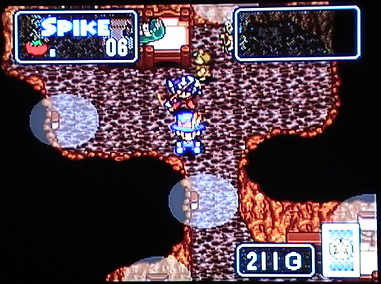
| Such a welcoming atmospheric cavern =) |
All the dialogue adds a bit of charm to this 16-bit venture and there's a bit of a wholly innocent flavor sprinkled throughout because of it, which I heartily appreciate. <=) There is a moment right before Spike gives Felina the finishing blow of his hat, but before he does that he utters this quip: "Eat hat, cat!" =3 You know, that line is so cheesy beyond belief, but I just could not help but chuckle at it (even on my first playthrough). Yeah, it's so obvious a punny wordplay, but you know what? I can forgive that because it gels with Spike McFang's tone so much.
 |
| "Go, my bat minions! Do my bidding!" |
This is a very fun game to play, so much so that I could not believe it was over after about four and a half (non-consecutive) hours on my first playthrough. =( I admit I was under-leveled at 15 at the end (even on my newest playthrough), but even so I was honestly surprised: "Wait, that's it? Where's the rest of it?" It just comes to show how much I enjoyed Spike McFang as a whole, and I wish it was slightly longer. On the other hand, perhaps its short length can be seen as a blessing in disguise 'cause while it might not be long at least it doesn't overstay its welcome at roughly four to five hours. But its brevity in no way makes this a bad game, for its numerous strengths outweigh its weaknesses and is worth the experience. =)
 |
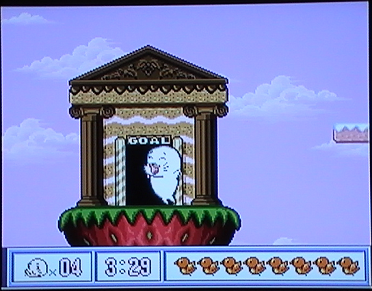
| Hopping in the heavens |
Spike McFang's adventure is also a tad on the linear side, meaning it is possible to backtrack while in certain segments, but the moment you reach the next major area you cannot come back. Like, say you reach Vampra, then you cannot go to the area that preceded it but you can peruse its segments while it lasts. Vladamasco's numerous areas are well-designed and it's easy to know where to go next despite some occasional forks. The very last area, however, is a bit of a mind teaser at first as you have to take the correct sequence of directions in order to reach your destination, but after a bit of trial and error it can be done with no problem; and the final boss is the only boss battle where I start using many of the cards at my disposal (which are last bought in Vampra, because after you permanently leave it there is no other opportunity).
 |
"There could've been a Bat and his Blob-style
game, but instead the blob made it about a boy..." >={ |
I remember first hearing about The Twisted Tales of Spike McFang many years ago online as a teenager, and some of the sites I went to that talked about it had nothing but praise for it (among them good ol' RVGFanatic). That, coupled with the appealing screenshots I saw of it, made me very curious about it. And for years I wanted to try it, but two things kept me from trying it sooner: the fact that there are so many games out there to choose from which attributes to my sometimes indecisive nature and the fact that (by itself or full CIB) it costs quite a bit (not necessarily in the $100s range, but not exactly in the $20s range either). =( It wasn't until late 2015 that I thought it was time I caught up with this game, having asked for it that Christmas. And when Christmas '15 came, I not only got Spike McFang after years of curiosity, but I also got Brandish on the SNES (another A-RPG I was long curious about), Yoshi's Woolly World on the Nintendo Wii U (a game I looked forward to for ever), as well as a Super Famicom console with some games for it. That was the best Christmas in a long time, and honestly all those years of curiosity have been worth it for I have adored Spike's quest from the moment I started it. =)
 |
"With this you can use it as a free coupon for
Yooka-Laylee when it comes out"
If only! =( |
My guess as to why the American version costs so much must be because Spike McFang has garnered a bit of cult following over the years, having fallen under the radar when it first came out. But surprisingly, for comparisons' sake, I found that the Japanese version Chō Makai Taisen! Dorabotchan costs cheaper than Spike McFang. And apparently from what I looked up the American version was made a little bit harder than its original Super Famicom edition, with higher enemy defense and not having health being refilled any time you level up while the Japanese version was reportedly easier. =/ Huh! Well, at least the change in difficulty is consistent and not sporadic like a certain Quintet A-RPG (*cough*Illusion of Gaia*cough*) that got marginally ruined Westside structurally and narratively due to the direct involvement of a certain company (*cough*Nintendo*cough*). Sorry, trying to clear my throat here. ~o~ *cough*Gaia Gensōki is better*cough* *hack* *cough* All clear now! ^~^
 |
| Vampire home sweet vampire home |
The Twisted Tales of Spike McFang is a very endearing and entertaining action-adventure romp, with its tongue firmly planted in its cheek with its lighthearted humor and simple yet intuitive gameplay carried throughout. It's also incredibly innocent and colorful that you can't help but become enamored with it, even if it is linear and largely straightforward. =) It is too bad that it's short , but while it lasts the game is a whole lot of fun and the big bosses are great to battle, not to mention the dialogue is rich. It's not exactly a hard venture, but I did like some of the ways that Red Company and Naxat Soft tried to challenge you (the Jungle of Mazes in particular). Spike McFang might not hold a candle next to the best A-RPGs the Nintendo 16-bit has got to offer, but it is worthy of playing once in awhile and on its own terms it is really good!
 |
| What a view! |
If you want to play a really enjoyable A-RPG then Spike McFang is not a bad option as it really is a good venture. If you're looking for a hard or complex game from the genre to play then you might have to search elsewhere; but if you're okay with a somewhat easygoing and manageable A-RPG then you'll be all set. If you're not keen on A-RPGs that take many hours to beat, then this will suit you just fine as it is fun at four to five hours. But if you want a game that'll make you smile, charm you, and is very quirky then Spike McFang is easily going to win you over as it is charming and innocent, and fortunately the gameplay is good as well. =) Though if I had to express which game I (slightly) preferred between this and Brandish, well, you wouldn't believe me if I told you. ...... I'll be in my outlier corner. T_T
 |
| I tip my hat to you, Red Company and Naxat Soft =) |
I may never have played Makai Prince Dorabotchan, but for being my first foray to the Dorabotchan series The Twisted Tales of Spike McFang was a really good starting point for me, having enthralled me from start to finish. Eventually I'll import the Japanese version in the future (given that I own a Super Famicom now), but for the time being I'm satisfied with the American version I played. =) It's not perfect, but because of all its good qualities and lighthearted quirkiness, what I ended getting turned out to be purely irresistible. =3
My Personal Score: 8.0/10
<( ^o^)^TO EACH THEIR OWN^(^o^ )>
P.S. I absolutely love how there are a total of four digits (if zeroes are to be counted) in the level counter in the Select screen even though you won't even be halfway near triple digits by the time the game is finished, level-wise. XD
8/21/16 Update: Especially since 16 is the level cap in this game.
P.S. 2 A browsing of this game on The Cutting Room Floor website in preparation for the review has led me to the discovery that there is another Dorabotchan game on the Super Famicom! =D
This excites me since I loved this game, for these characters are going to appear again in Super Naxat Open: Golf de Shōbu da! Dorabotchan! ^(^o^)^ Yay! Must! Import! Now! I hope it's as good as Spike McFang, if not better! '~'
Thank you for reading my review, please leave me a comment and let me know what you think. I hope you have a great Winter day, and take care! =)
-----------------------------------------------------------------
*PPPFFFFFT* That poser??? NO!!!! XD
Image from Neoseeker website
This cute little badarse over here? He's Croc, and he always will be to me! <=) I loved this guy since I was introduced to him in 1997 (almost twenty years ago) on the PlayStation One, and he is so underrated and underappreciated among the masses. His first game is one of my top favorite games in the console, no lie!